

Resin Flooring FAQs: Answers to Common Questions
Specifying an industrial floor is an engineering decision, not a purchasing one. These resin flooring FAQs set out the criteria facilities managers assess before commissioning an installation. Load profile, chemical exposure and substrate condition govern the outcome. Choosing the wrong chemistry shortens service life and forces early capital replacement. Matching the system to the building prevents that.
Most specification errors surface long before the first coat is poured. Moisture readings, ambient temperature and return-to-service windows are settled at survey stage. Get those wrong and the programme slips. Can your team state the substrate moisture level, the required thickness and the traffic return time for every zone?
Key Takeaways
- Industrial resin systems run from £8 to £45 per square metre, driven by FeRFA type and substrate condition.
- A correctly specified industrial floor lasts fifteen to twenty years where cleaning regimes stay disciplined and spills are cleared.
- Return to service ranges from two hours for polyaspartic coatings to forty-eight hours for standard epoxy systems.
- Mechanical diamond grinding or captive shot blasting removes laitance and opens the capillaries that carry the chemical bond.
- Forklift traffic demands screeds of 4 mm to 9 mm, whilst light storage bays need only a thin seal.
Resin System Types, Thickness and Cost
Chemistry selection follows the operating environment, not the budget line. Temperature exposure, mechanical abrasion and washdown regime decide which FeRFA classification suits a given area. The table below sets out standard thickness, typical application and indicative rate for each system. In practice, the operating conditions narrow the choice to two or three viable options.
Rates assume sound concrete and standard access. Substrate repair, damp proof membranes and out-of-hours working sit outside these figures. Facilities teams should use the table to set an indicative budget envelope. A measured site survey then confirms the thickness, the preparation method and the final rate for each zone.
| System Classification | Standard Thickness | Typical Application | Indicative Cost per m² |
|---|---|---|---|
| Floor Seal (FeRFA Type 1) | Up to 150 microns | Dustproofing light storage | From £8 |
| High Build Coating (FeRFA Type 3) | Up to 1000 microns | General warehousing and demarcation | £8 – £12 |
| Self-Smoothing (FeRFA Type 5) | 2 – 4 mm | Cleanrooms and pharmaceutical | £20 – £30 |
| Heavy Duty PU Screed (FeRFA Type 8) | 6 – 9 mm | Food processing and steam cleaning | £30 – £40 |
| Polyaspartic System | 300 – 500 microns | Rapid turnaround and cold rooms | £38 |
| Methyl Methacrylate (MMA) | 2 – 6 mm | Sub-zero freezer installations | £45 |

Cost Ranges and Project Budgeting
Square Metre Rates Across Industrial Systems
Industrial resin installations run from £8 to £45 per square metre. That rate covers mechanical preparation, labour and materials on sound concrete. Basic seal coats sit at the lower end. Multi-layer broadcast systems fall between £12 and £16. Flowable self-smoothing floors range from £20 to £30 per square metre.
Thicker builds command higher rates. Heavy-duty polyurethane screeds cost £30 to £40 per square metre. Fast-curing polyaspartic sits around £38. Sub-zero methyl methacrylate systems reach £45. From experience across the sector, the headline rate rarely decides the project. Preparation and detailing move the final figure far more than the resin itself. All figures remain indicative until an on-site survey confirms the substrate condition.
Variables That Drive Overall Expenditure
Three variables move a resin floor budget more than any other. Substrate repair comes first, because damaged concrete demands extra grinding passes, crack stitching and mortar patching. Moisture suppression comes second, requiring a two-coat liquid damp proof membrane. Detailing comes third, covering coving, drainage tie-ins and demarcation.
Working hours also shift the figure. Night shifts and weekend work carry higher labour rates. Phased installation around live racking adds further cost. Detailing items are priced per linear metre and sit outside the open-floor rate. In practice, we find clients underestimate this line most often. A floor with heavy coving, drainage and demarcation can carry a materially higher rate than the same area left plain.
Lifespan and Floor Durability
Expected Working Service Life
A correctly specified industrial resin floor delivers fifteen to twenty years of service under manufacturing conditions. That figure depends on matching thickness to the actual traffic, not to the brochure. Thin coatings fail early beneath steel-wheeled pallet trucks. Heavily filled polyurethane screeds absorb impact and abrasion for decades.
Wear concentrates at predictable points. Forklift turning circles, racking aisle ends and loading dock thresholds degrade first. Specifiers should uprate thickness in those zones rather than across the whole floor. Routine mechanical sweeping and neutral washing preserve surface integrity across the design life. Where a floor reaches twenty years, disciplined housekeeping is almost always the reason.
Maintenance Neglect and Early Failure
Neglected cleaning regimes cut effective service life sharply, often to well under half the design figure. Airborne grit and metal fines act as a grinding paste beneath hard polyurethane wheels. That abrasion strips the clear seal coat. The body coat then sits exposed to contaminants.
Standing spills accelerate the damage. Organic acids, solvents and vehicle fluids soften the resin matrix over long dwell times. A structured cleaning protocol prevents chemical etching. It also protects the slip-resistant texture, which matters for compliance as much as for wear. Replacing a neglected floor early costs far more than maintaining it.
Did You Know?
The workplace exposure limit for respirable crystalline silica in Great Britain is 0.1 mg/m³. That limit is an eight-hour time-weighted average, published by the HSE in guidance note EH40. Bare concrete sheds respirable silica under abrasion, which brings the floor itself within scope of COSHH.
Cure Times and Return to Service
Walking and Traffic Windows
Standard epoxy and polyurethane systems take foot traffic twenty-four to forty-eight hours after the final coat. Those chemistries need a stable ambient temperature of at least 15°C to cross-link properly. Full operational loading follows two to five days later. Chemical resistance develops last and takes longest.
Rapid-cure chemistries compress the programme. Polyaspartic formulations allow pedestrian access in roughly two hours and reach full mechanical cure within twenty-four. Methyl methacrylate hardens in about an hour per coat. These systems carry a premium per square metre. For a live distribution centre, that premium usually costs less than the lost operating days it avoids.
Curing Behaviour in Low Temperatures
Standard epoxy cures slowly below 10°C and stalls altogether as temperatures approach 5°C. Ambient and substrate temperature govern the rate of polymerisation. Installers check dew point and relative humidity before any material is mixed. Unheated winter buildings arrest the cure and produce surface bloom or amine blush.
Specialist chemistries remove the need for temporary heating. Polyaspartic coatings cure down to −5°C, which suits walk-in chillers without breaking the cold chain. Methyl methacrylate installs inside blast freezers at sub-zero temperatures. The trade-off is vapour. MMA releases a strong monomer odour, so contractors must run dedicated extraction to avoid tainting stock.

Need a Resin Flooring Site Visit and Quote?
Suitability Over Existing Substrates
Concrete Substrate Preparation Essentials
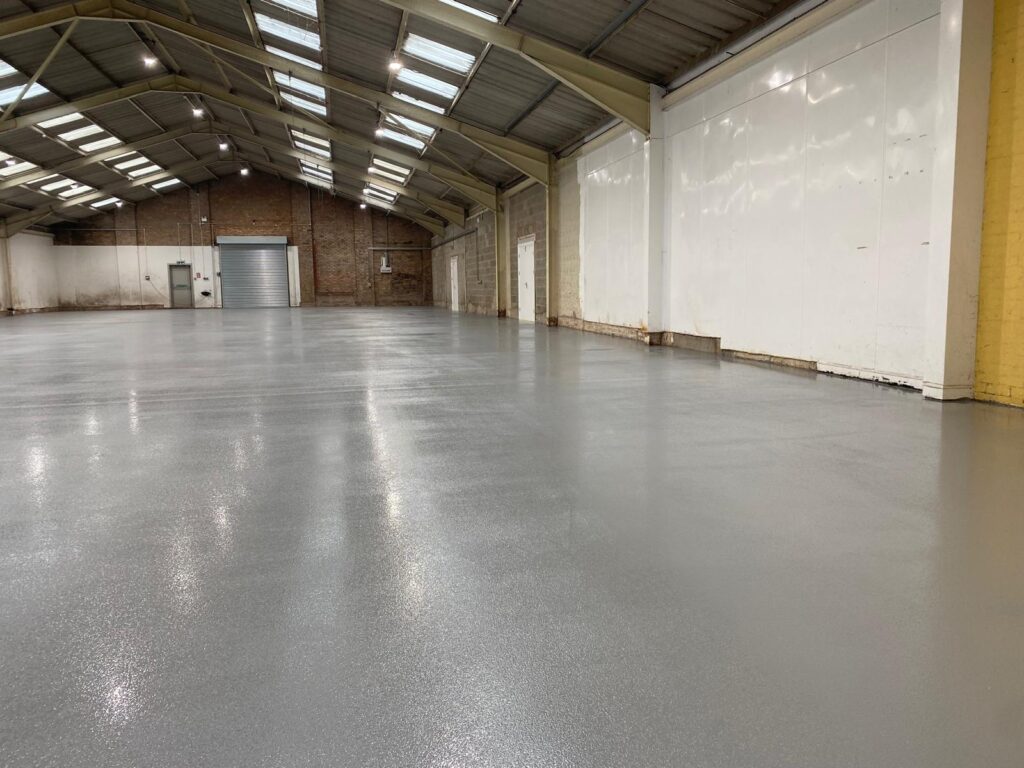
Resin bonds to open-pored, sound concrete and nothing else. Laitance and power-trowelled surfaces must come off first. Mechanical diamond grinding is the standard method, run with HEPA-filtered dust extraction. Grinding cuts away weak cement fines, removes old coatings and exposes a profile the resin can key into.
Captive shot blasting covers large warehouse areas faster. Steel shot fired at the surface produces a uniform profile across thousands of square metres. Contractors deliberately avoid acid etching. It introduces uncontrolled moisture and leaves corrosive residue inside the concrete pores. In practice, poor preparation causes more delamination failures than any other factor.
Resin Over Existing Tiles and Coatings
Resin can go over ceramic tiles or aged coatings, but only where the existing material is firmly bonded. Technicians run mechanical pull-off tests across representative zones to measure that bond. Weak, loose or hollow-sounding sections come out completely. Removal takes the floor back to base concrete before priming.
Overcoating a compromised finish carries real risk. When old floor paint detaches under load, the new resin lifts with it. Grouted tiled floors need a polymer smoothing underlay to stop grout lines telegraphing through. Direct preparation of the base concrete remains the most dependable route. We recommend it wherever the programme allows.
Case Studies
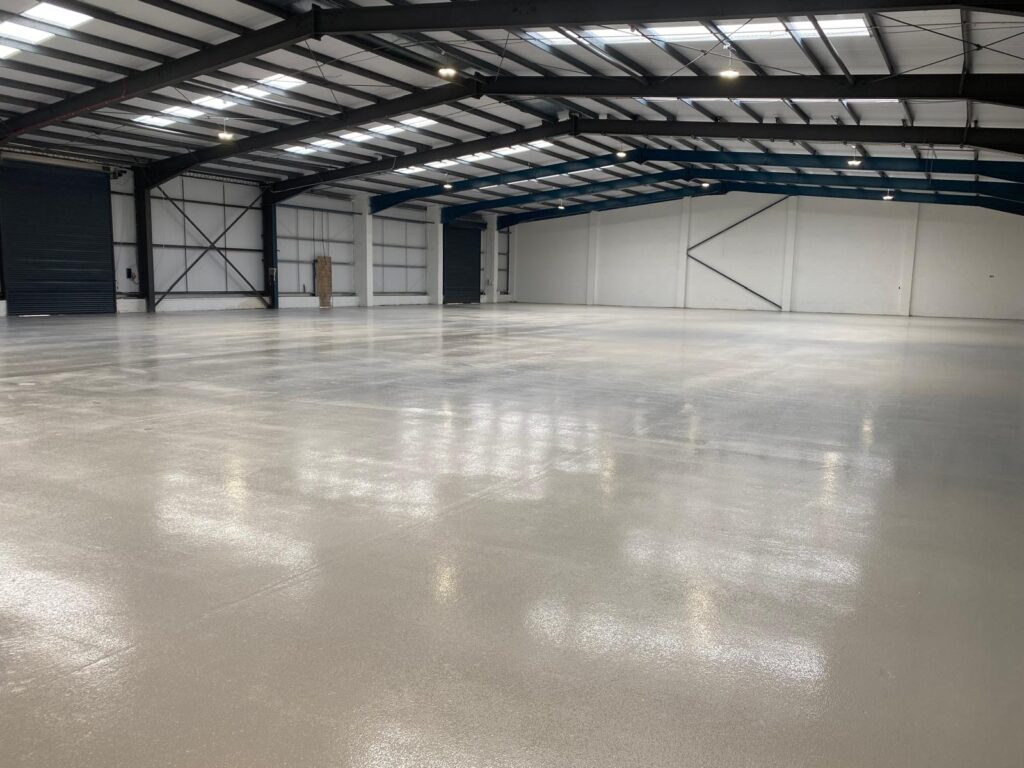
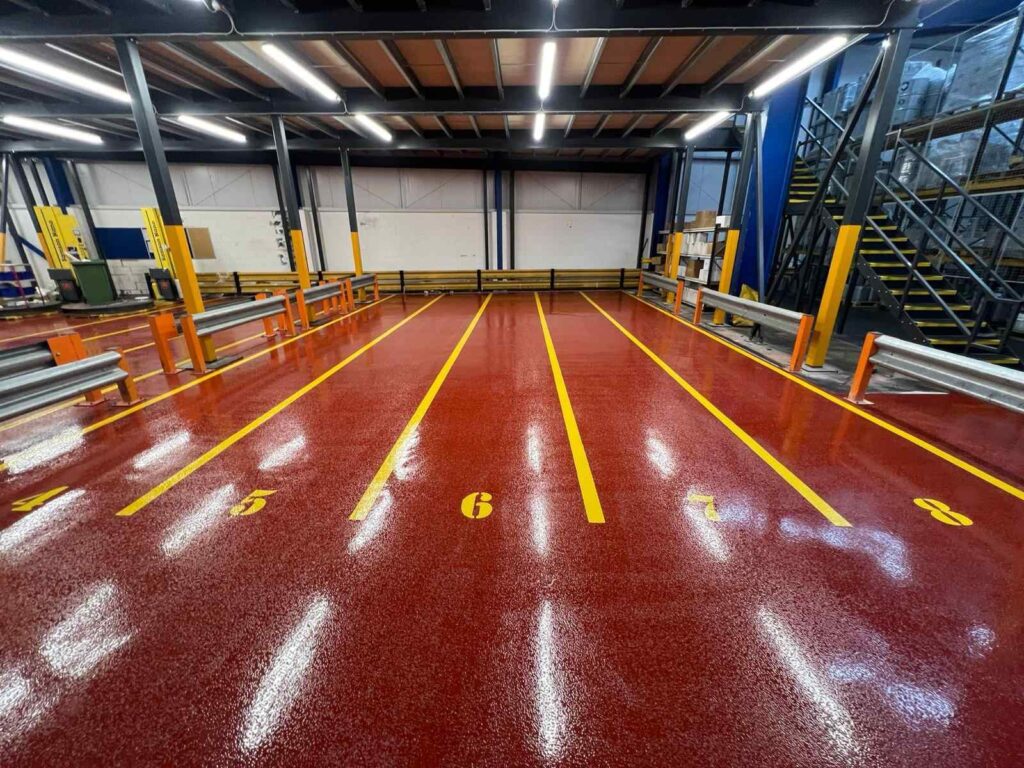
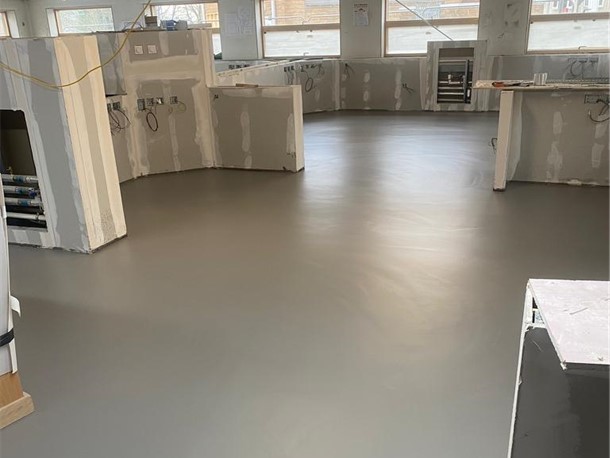
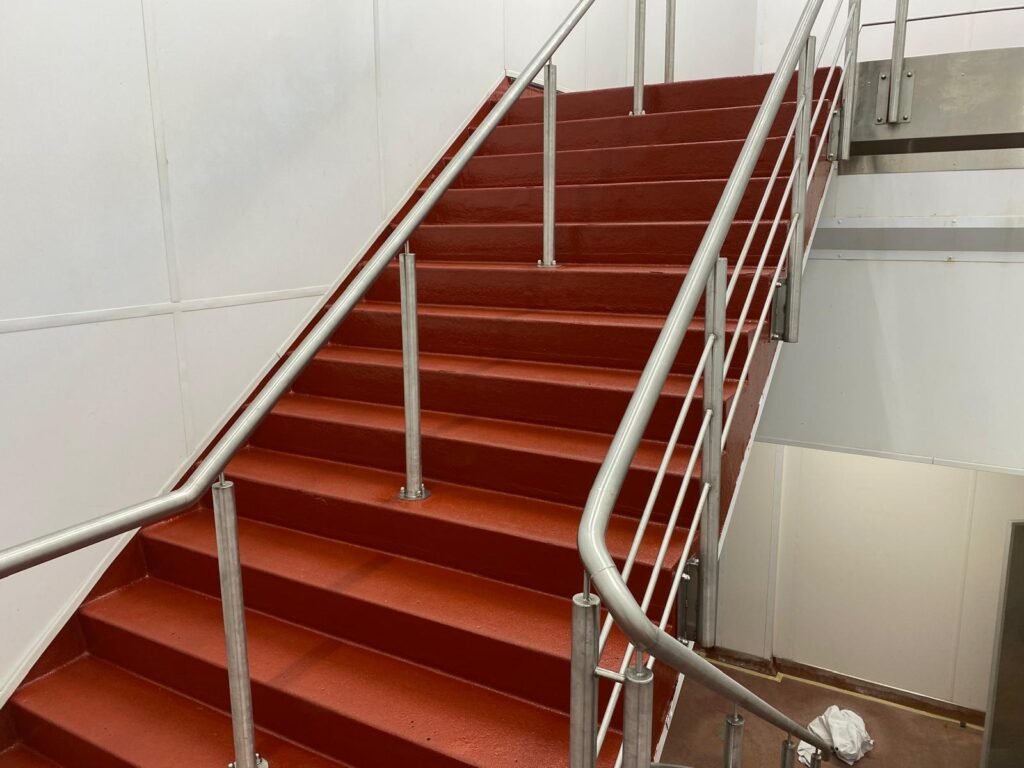
Our case studies cover – Printing & Packaging, Warehousing & Logistics, Pharma & Healthcare, Automotive & Engineering, Aviation & Aerospace, Food & Drink, Printing & Packaging, Warehousing & Logistics, Pharma & Healthcare
Heavy Machinery and Loading Demands
Compressive Strength and Forklift Traffic
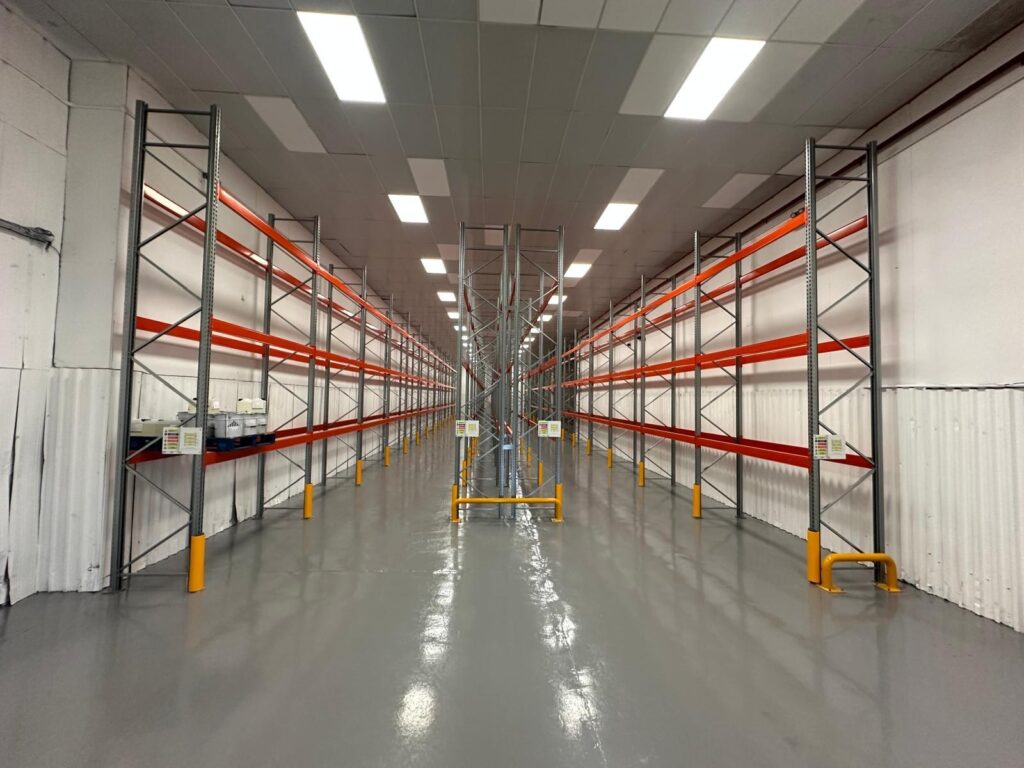
Forklift movement exerts point loading that shatters thin, unreinforced coatings. Medium-duty operations need high build coatings or multi-layer broadcast floors from 1 mm to 3 mm. Those build-ups spread static pallet weight across a wider footprint. The result is less edge damage and fewer cracked arrises around racking.
High-intensity distribution hubs sit at the other end of the scale. Counterbalanced forklifts running continuously demand flowable or trowelled polyurethane screeds from 4 mm to 9 mm. These dense matrices match or exceed the compressive strength of structural concrete. They resist point-load cracking beneath racking uprights. They also survive the continuous turning scrub of hard wheels.
Dynamic Impact and Vibration Control
Vibrating plant and dropped components create dynamic stresses that fracture brittle finishes. Polyurethane screeds offer greater ductile elongation than rigid epoxy systems. The floor flexes slightly under shock instead of cracking. That elasticity matters most around machining centres, stamping presses and die-maintenance bays.
Joint design decides how long the floor survives wheel impact. Unsupported saw-cut joint arrises spall quickly under repeated forklift crossings. Installers rebuild broken arrises with high-strength structural resin mortar. They then reinstate the movement gap with a flexible sealant. That sealant absorbs vibration without splitting open under load.
“JD Flooring did an excellent job installing a resin floor in our food production facility. The floor is durable, hygienic, and meets all safety regulations. The team was knowledgeable and professional, and the project was completed within the agreed-upon timeframe. I highly recommend JD Flooring for food industry flooring needs.”
Alex Martinez
Colour and Workspace Customisation
Standard Industrial Colour Palettes
Industrial resin floors come in a standard range of solid colours. Light greys and mid tones raise reflectance, which cuts the lighting load across large sheds. Darker shades hide tyre marking better in heavy traffic areas. Colour also separates functional zones without any additional signage.
Exact shade matching between batches requires tight process control. Minor variation can still appear between separate manufacturing runs, so large areas are best laid from a single batch. Standard epoxy also chalks and yellows under prolonged ultraviolet exposure. Where colour stability in sunlight matters, an aliphatic polyaspartic topcoat is the correct specification.
Demarcation and Visual Management
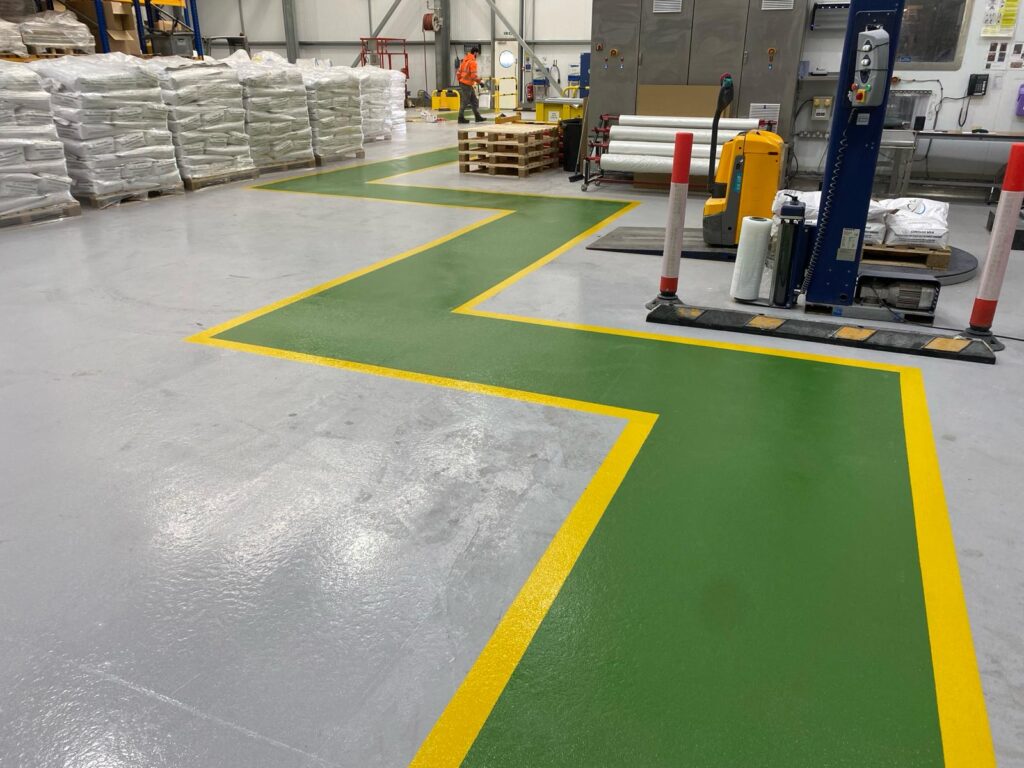
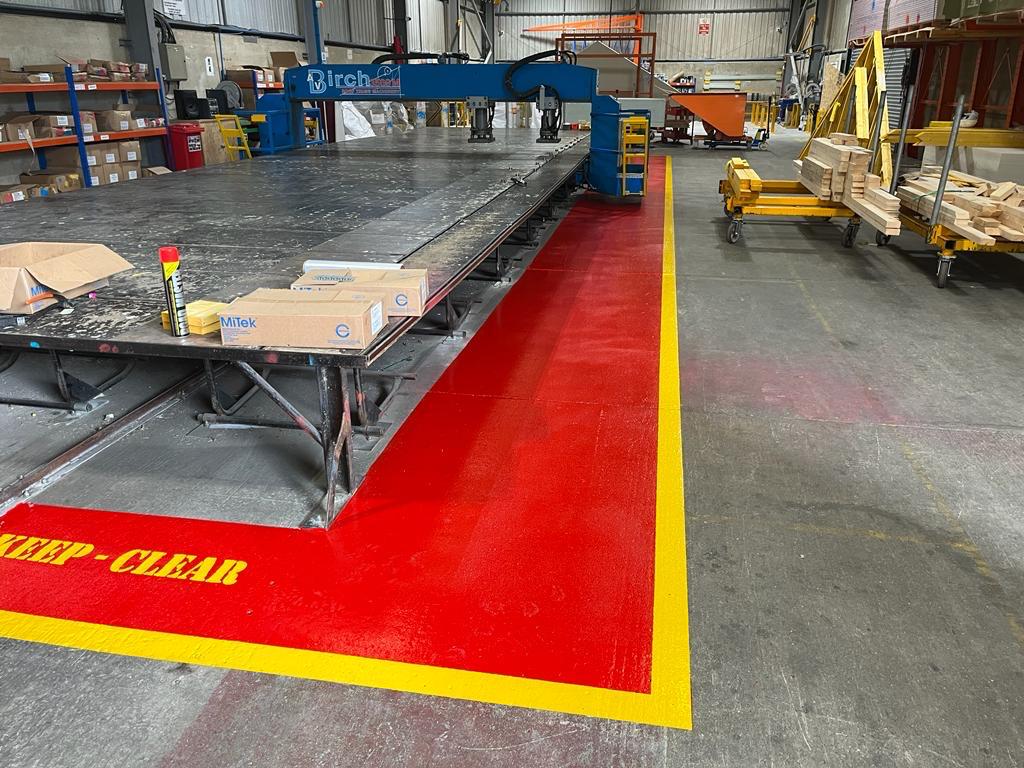
Resin line markings outlast floor paint and adhesive tape under forklift traffic. Regulation 17 of the Workplace (Health, Safety and Welfare) Regulations 1992 covers the organisation of traffic routes. It requires routes to be suitably indicated where vehicles and pedestrians share space. Installers cut and roll the lines into the floor itself.
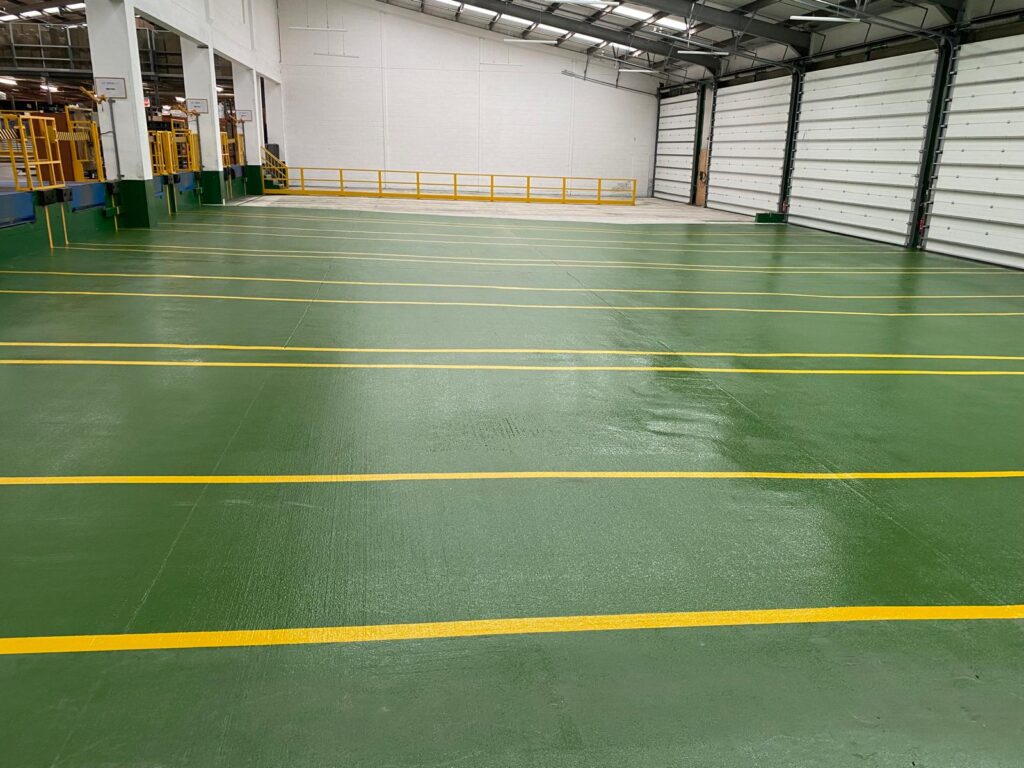
Demarcation underpins lean programmes such as 5S. Clear lines define work-in-progress bays, pedestrian crossings, quarantine zones and pallet positions. Common conventions allocate yellow to walkways, white to vehicle lanes and red to fire equipment. Green marks safe or first-aid positions. Because the colour sits within the resin, it does not peel or lift.
Calculate The True Cost
A three day shutdown at a plant turning over £2,000 an hour is £120,000 of lost output. On most sites that is several times the cost of the new resin floor installation. We have developed our own free custom calculator top help you calculate the true cost and a new resin floor.
Maintenance Protocols and Downtime Management
Routine Housekeeping and Cleaning Regimes
Industrial resin surfaces need weekly scrubber-dryer washing with pH-neutral chemicals at the stated dilution. Strong caustic detergents and unbuffered acids etch gloss topcoats over time. Brush selection matters as much as chemistry. Aggressive abrasive pads dull a smooth finish and damage the slip-resistant texture on broadcast floors.
Dry sweeping is the single most valuable daily task. It removes the grit, timber splinters and swarf that scratch coatings under moving wheels. Staff should mop spills promptly to limit contact time. From experience across the sector, floors fail on housekeeping long before they fail on specification.
Phased Installation to Limit Downtime
Full shutdowns are rarely necessary. Dividing a floor into sequential phases keeps most of the building operational throughout. Logistics sites treat racking aisles one at a time, isolating each zone behind dust curtains. Cured sections hand back as the preparation team advances across the facility.
Fast-curing chemistry offers a second route. Polyaspartic coatings support complete weekend or overnight installations, with full traffic restored by Monday. The rate per square metre is higher. The arithmetic still favours it where a day of lost production costs more than the uplift. Facilities directors should price the downtime before they price the floor.
Final Thoughts
These resin flooring FAQs point to one conclusion. A high-performance floor is the product of disciplined engineering decisions, not brand selection. Traffic profile, substrate moisture, ambient temperature and chemical exposure all shape the specification. Matching the FeRFA classification to actual operating conditions protects the capital spend.
Specification starts with measurement, not with a quotation. Commission moisture testing, pull-off testing and a documented site survey before choosing any system. Dust control duties and hygiene requirements continue to tighten across UK industry. Facilities teams that record those conditions now will specify better floors later.
Arrange a Free Site Survey
If you are thinking about upgrading the flooring in your commercial or industrial space then we would love to hear from you. Our team of experts will conduct a free onsite survey and then guide you through the process of product selection and project planning, whilst remaining mindful of your budgetary restraints.
Frequently Asked Questions
A:
Vehicle access depends on the chemistry and the ambient temperature. Standard industrial epoxy and polyurethane screeds take light wheeled traffic after forty-eight hours. Full forklift loading follows five to seven days later at 15°C. Rapid-curing polyaspartic floors accept laden forklift traffic within twenty-four hours. Methyl methacrylate tolerates heavy dynamic wheel loading roughly two to three hours after application. Cold conditions extend every one of these windows, so always confirm the figure with the installing contractor.
A:
Standard epoxy is unsuitable outdoors. Ultraviolet radiation degrades aromatic polymers, causing chalking and discolouration within months. Exterior work demands aliphatic polyurethane or UV-stable polyaspartic chemistry. Those systems handle thermal cycling, moisture movement and direct sun without cracking or peeling. External surfaces also need a coarse aggregate broadcast profile. That profile maintains wet pendulum slip resistance in UK rainfall. Falls and drainage must be designed in, since water cannot be allowed to pond on the finished surface.
A:
Blistering almost always stems from osmotic pressure. Moisture vapour rises through the slab and becomes trapped beneath an impermeable resin membrane. The usual cause is a missing test. Installers should measure concrete relative humidity with a hygrometer before any primer goes down. Readings above 75% call for an epoxy liquid damp proof membrane. Trapped moisture dissolves soluble salts within the concrete pores. The resulting hydraulic pressure lifts the coating away from the substrate.
A:
Start with a written chemical exposure schedule. List every substance, its working concentration, the process temperature and the maximum likely contact time. Generic epoxy coatings cope with occasional fuel or oil splashes. They soften under sustained organic acid attack. Hot washdown environments are harsher still. Dairy processing, brewing and battery charging bays normally require a dense polyurethane screed formulated for aggressive reagents. Share the schedule with the contractor before specification, not after a failure.
A:
Yes, for the service life of the system. Resin penetrates open pores and binds the weak surface fines that cause dusting. Bare concrete sheds respirable crystalline silica under abrasion. That creates a duty under the Control of Substances Hazardous to Health Regulations 2002. Even a light FeRFA Type 1 seal coat closes the capillaries and produces an impervious, easily cleaned surface. Dusting only returns once the coating itself wears through, which makes periodic reseal coats worthwhile.
