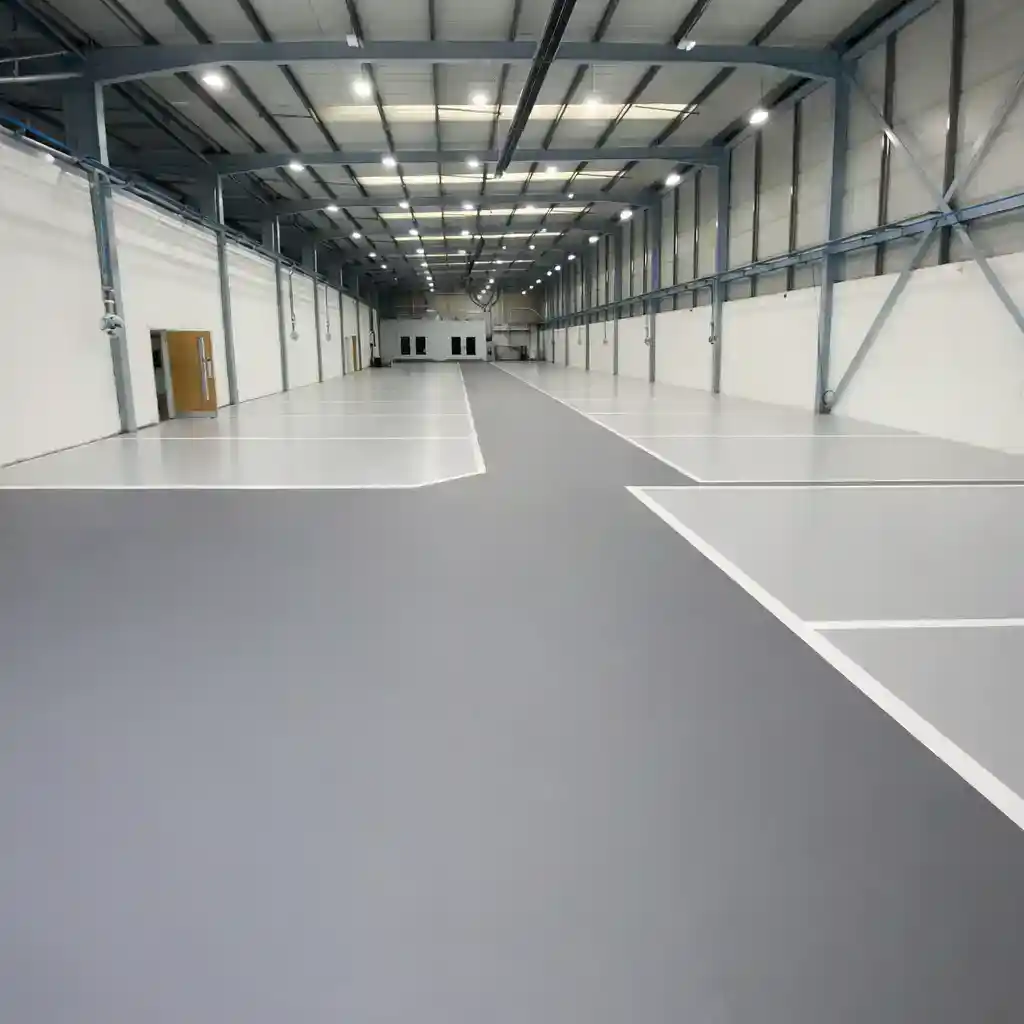
The most commonly specified industrial resin system, and the one most often specified badly. A high build epoxy coating gives a hard-wearing, chemically resistant, seamless floor at a cost per square metre that works over large areas. It is the right answer for dry production, warehousing and workshops, and the wrong one for hot wash-down. This page sets out which is which, and what governs the build.

| System | Resin High Build Coating |
|---|---|
| Classification | FeRFA Type 3, aligned to BS 8204-6 |
| Duty | Medium duty |
| Typical thickness | Up to 1,000 microns |
| Cost indicator | £8 to £12 per square metre |
| Return to service | 24 to 48 hours |
| Application temperature | 15°C and above |
High build is a thickness classification, not a brand or a quality claim. It describes where the system sits in the FeRFA range, and that position is what determines the duty it will carry.
A high build coating is laid in two or more solvent-free coats to a finished thickness of 300 to 1,000 microns — several times that of a floor paint, which is why it survives traffic.
It sits at Type 3 in the FeRFA classification aligned to BS 8204-6: more body than a floor seal or a thin coating, less than a self-smoothing system or a heavy-duty screed.
The coating is only as good as what it is bonded to. The substrate is diamond ground, joints and cracks are repaired and the floor is tested before any resin is mixed.
Dry production areas, warehouses, engineering workshops, plant rooms, distribution floors and vehicle workshops. Anywhere the duty is abrasion, point loading and chemical spillage rather than heat, and where a cost-effective finish over a large area matters.
Hot wash-down, steam cleaning and boiling discharge will take a coating off a floor. Food and drink production, commercial kitchens and cold stores need a polyurethane screed, which tolerates thermal shock that epoxy does not.
A high build epoxy is not one product. The number of coats, the aggregate and the topcoat are set by what the floor carries, what gets spilled on it and how wet it gets.
Forklift wheels, pallet trucks and steel castors decide the build. We specify thickness against the traffic the floor actually carries, not against the floor area.
Epoxy resists oils, fuels and most process chemicals well. We check the specific substances on site, because a resistance chart is not a specification.
A smooth epoxy is slippery when wet. Aggregate is broadcast into the coating and the finish is set against BS 7976 pendulum values for the contamination present.
Almost every delaminated epoxy floor we are called to failed at the bond, not in the resin. Laitance was left in place, the substrate was damp and untested, or an old coating was overlaid rather than removed. None of that is visible once the floor looks finished, which is why it keeps happening.
Every installation starts with mechanical diamond grinding and HEPA-extracted vacuum, so the dust is controlled under COSHH and the EH40 respirable crystalline silica limit of 0.1 mg/m³. Cracks and joint arrises are cut out and repaired, and the slab is tested for moisture before the primer goes down. Where the reading is high, a liquid damp proof membrane is specified first — a coating laid over a damp substrate will blister whatever it cost.

We attend site, test the substrate for moisture and contamination, and record the traffic, chemicals and temperatures the floor sees. The system comes out of those findings. If a high build epoxy is wrong for your floor, we will tell you so and specify what is right.
Cookies on this site
We use strictly necessary cookies to make this site work. With your permission we would also like to use analytics cookies to see how the site is used so we can improve it. You can change your choice at any time. See our cookie policy.