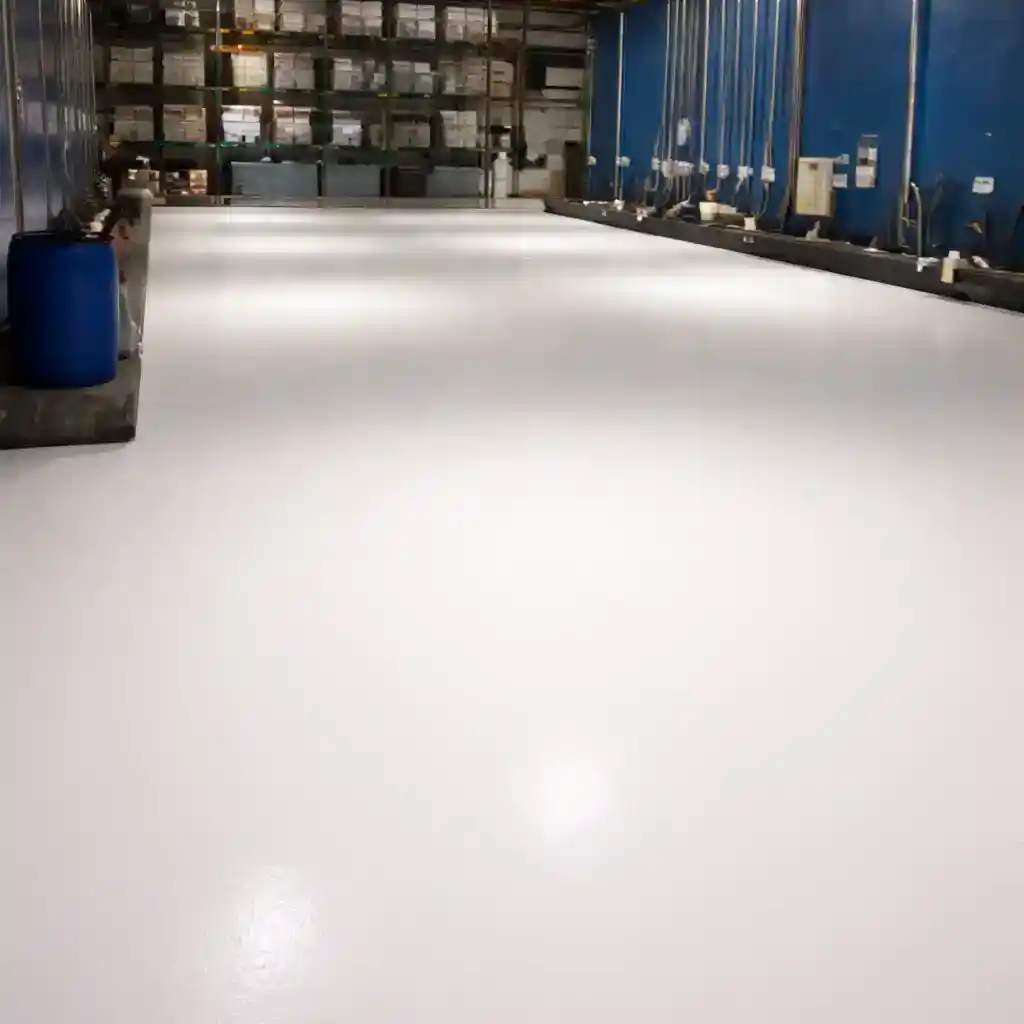
Most floors make you choose between a smooth, cleanable surface and heavy duty performance. This is the build where you do not have to. A three-part filled system laid at 4 to 6mm that still flows out seamless, it sits one step below a polyurethane screed and well above anything that can be called a coating.

| System | Heavy Duty Flowable Resin Flooring |
|---|---|
| Classification | FeRFA Type 7, aligned to BS 8204-6 |
| Duty | Heavy to very heavy duty |
| Typical thickness | 4 mm and 6 mm |
| Cost indicator | £25 to £35 per square metre |
| Return to service | 24 to 48 hours |
| Application temperature | 15°C and above |
Flowable sits in an unusual position in the range: screed-level thickness and duty, delivered by a self-smoothing application rather than a trowel. That combination is the whole reason it exists.
A three-part filled system laid at 4 to 6mm that still flows out to a smooth finish. Screed performance without the trowel marks of a trowelled screed.
Type 7 in the FeRFA classification aligned to BS 8204-6, one step below a heavy duty polyurethane screed and well above any flow-applied coating.
Most systems make you choose between a seamless smooth surface and heavy duty performance. This is the build where you do not have to choose.
Production floors carrying heavy traffic that still have to be cleanable and flat: food and drink areas without severe thermal shock, process plant, pharmaceutical production and heavy manufacturing.
Steam cleaning, boiling discharge and the most aggressive washdown still belong to a polyurethane screed. And where the duty is genuinely light, this is a great deal more floor than you need.
At 4 to 6mm the question is never whether the floor is strong enough. It is whether that thickness is justified, and whether the surface still has to be smooth once it is.
Four to six millimetres is specified against real loading. We record the plant, the wheels and the point loads before deciding where in that band it sits.
A flow-applied finish is chosen when the floor must be smooth and cleanable. Any grip has to be introduced deliberately rather than assumed.
Flowable handles heat well but not the extremes a screed does. We record the actual temperatures on the floor before choosing between the two.
These two systems are the top of the range and they get confused constantly, because both are heavy duty and both are expensive. The difference is not strength. It is heat and finish. A heavy duty flowable gives you a smooth, seamless, genuinely heavy duty floor. A polyurethane screed gives up some of that smoothness and gains the ability to survive thermal shock, roughly minus 40 to plus 120 degrees, and the hot wash-down regimes that come with it.
So the question at survey is simple enough: does boiling liquid, steam or a cold store cycle reach this floor? If it does, the screed is the answer whatever else is true. If it does not, flowable usually gives a better surface for the same money, and a floor that is easier to keep clean for the next decade.
We attend site, test the substrate and record the loading, the temperatures and the cleaning regime. Where flowable and a screed are both candidates, those readings decide it rather than a preference for the heavier system.