
Warehouse resin flooring for distribution centres, logistics hubs and storage units across the North West, Yorkshire, the Midlands and North East Wales. Heavy duty build-ups that take counterbalance traffic and pallet drops, with demarcation and dust control built in, installed around live racking.
Wear in a warehouse is never even. It concentrates in the turning circles at aisle ends, along the main run between goods-in and dispatch, and in front of the dock levellers where every pallet crosses the same metre of floor.
Those are the areas that decide the specification. A build-up that copes with the open storage bays will polish through in the turning circles within a couple of years, and once the resin is gone the concrete underneath dusts and starts breaking up.
The other pattern is racking. Point loads under baseplates, impact damage at the uprights, and the fact that the floor beneath a run of racking is effectively unreachable once the racking is loaded. Getting the specification right there matters more than anywhere else on site.

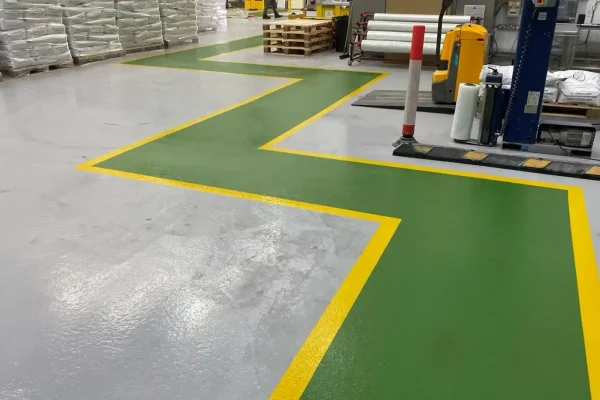
The usual choice for storage bays or picking areas. Cures quickly, takes colour well for demarcation, and low cost.

Six to nine millimetres for aisle ends, dock approaches and anywhere counterbalance trucks turn under load.

Where the concrete is sound but dusting, a seal binds the surface and stops fines contaminating stock and scanners.

Ready for traffic in around two hours, so a bay closed on Saturday morning is back in use the same day.
The floor under a loaded racking run is unreachable. Once the uprights are down and the bays are full, the only way back to that concrete is to decant the stock and dismantle the racking, which costs far more than the flooring ever will.
On a new fit-out or a relocation, the whole floor is coated before installation. It is the only time the full area is accessible and it is always the cheapest pass.
On a live site we work the aisles and open areas and detail neatly to the baseplates, leaving the covered footprint uncoated rather than pretending otherwise.
Where a run can be emptied, we take it bay by bay in sequence with your decant plan so the floor gets done properly without the site stopping.

An untreated warehouse slab sheds fine dust continuously. It settles on stock, works into barcode scanners and MHE bearings, and shows up as a cleaning line in the budget long before anyone connects it to the floor. Sealing the surface stops it at source.
A light-coloured resin floor bounces a great deal more light back into the space than bare grey concrete. On high-bay sites that changes how many fittings are needed to hit the lux level on the picking face, and it makes the aisles feel safer to work in.
Vehicle and pedestrian segregation, racking runs, walkways, crossing points and keep-clear hatching are laid in as part of the build-up rather than added afterwards. Doing it while the floor is being installed costs considerably less than a separate visit, and the lines are bonded into the surface so they cannot lift under a pallet truck.
From £8 per square metre for a floor seal up to £40 for a heavy duty polyurethane screed, inclusive of preparation, labour and materials. Large warehouse areas usually sit toward the lower end because the open bays take a lighter build-up than the aisle ends and dock approaches. Full rates by FeRFA type are on the cost page.
Yes. Work is phased area by area, taking aisles and open bays in sequence and handing each back as it cures. The floor beneath loaded racking cannot be coated without decanting, so we detail neatly to the baseplates and leave that footprint rather than claiming otherwise.
If it is specified for it. Polyurethane screeds at 6 to 9mm are laid for constant counterbalance traffic and point loading. Thinner coatings will polish through in the turning circles at aisle ends, which is the most common reason a warehouse floor fails early.
Often, yes. Fast-curing systems can be back in service in around two hours, so a zone closed on Saturday morning can be taking traffic the same day. Whether the whole floor fits into one weekend depends on the area and how much preparation the substrate needs.
It stays as it is unless the racking is being moved. If you are relocating, refitting or replacing racking, that is the moment to coat the whole floor, because it is the only time the full area is reachable and it is always the cheapest pass.
Yes. Dusting is loose laitance at the surface of the concrete breaking down. Grinding it back and sealing it binds the surface so it stops shedding fines onto stock, into scanners and into MHE bearings.
Tell us the area, the traffic that runs across it and whether the racking is staying put. We survey the substrate, specify against the duty and quote the programme alongside the floor.
Cookies on this site
We use strictly necessary cookies to make this site work. With your permission we would also like to use analytics cookies to see how the site is used so we can improve it. You can change your choice at any time. See our cookie policy.