
ESD Resin Flooring Cost: Earthing, Testing and Spec
A realistic ESD resin flooring cost covers far more than resin and application labour. Electrostatic discharge flooring is an active electrical safety system. It protects microelectronics, avionics and explosive atmospheres from damaging static charge. A complete specification combines substrate preparation, conductive priming, copper earthing grids, static-control body coats and verified testing. Omit any electrical element and the budget fails at audit.
Specialist contractors price these layered systems against resistance thresholds, site constraints and floor area. Specifiers comparing tenders must establish whether each quote is genuinely turn-key. Many conceal the testing and earthing costs entirely. How can procurement teams identify every mandatory line item before committing capital?
Key Takeaways
- Transparent pricing schedules itemise diamond grinding, conductive priming, continuous copper earthing tape and post-cure electrical testing as separate line items.
- Conductive systems channel charge rapidly in explosive ATEX zones, whilst dissipative formulations bleed charge progressively to shield sensitive electronic assemblies.
- Incomplete quotations often omit certified earth connection points and formal BS EN 61340-5-1 resistance testing, creating later commercial and regulatory risk.
- Substrate condition, moisture barriers and conductive matrix additives drive expenditure alongside the required FeRFA classification from Type 3 through Type 8.
- Cleaning regimes using conventional floor polish insulate the surface and ruin conductivity, so scheduled re-testing protects continuing electrostatic discharge compliance.
Commercial Cost Breakdown for Static Control Flooring
Anti-static flooring budgets follow the electrical specification and the physical build thickness. Resin installations across British facilities run from thin industrial coatings through to heavy-duty polyurethane screeds. Conductive and dissipative chemistries then command a premium over standard formulations. The table below sets out representative installed rates across the common FeRFA classifications.
Every installation needs a site evaluation that matches operational traffic against the statutory resistance window. High-traffic cleanrooms and ATEX manufacturing suites need flow-applied or heavy screed builds. Premature mechanical wear otherwise disrupts the static control pathway. Comparing system builds against duty allows accurate budget allocation before surface preparation begins.
| FeRFA Classification | Typical Build Thickness | Indicative Installed Cost Band |
|---|---|---|
| FeRFA ClassificationType 3 High Build Coating | Typical Build ThicknessUp to 1,000 microns | Indicative Installed Cost Band£8 – £12 per m² |
| FeRFA ClassificationType 5 Self-Smoothing Resin | Typical Build Thickness2 – 4 mm | Indicative Installed Cost Band£20 – £30 per m² |
| FeRFA ClassificationType 7 Heavy Duty Flowable | Typical Build Thickness4 – 6 mm | Indicative Installed Cost Band£25 – £35 per m² |
| FeRFA ClassificationType 8 Heavy Duty PU Screed | Typical Build Thickness6 – 9 mm | Indicative Installed Cost Band£30 – £40 per m² |

Core Components of a Complete Static Control System
Essential Substrate Preparation and Priming Layers
Mechanical preparation creates the foundation for every durable conductive floor finish. Installers diamond-grind the concrete to strip laitance, contaminants and failed coatings. Grinding also opens the surface pores. An engineered conductive primer then delivers reliable adhesion. It also forms the continuous conductive backing layer that safe charge dissipation depends on.
Competent contractors avoid acid etching. It leaves chemical residues behind and profiles the surface inadequately. Enclosed industrial diamond grinders with HEPA vacuum extraction capture respirable crystalline silica at source. That satisfies statutory health requirements. Once technicians level and profile the slab, they apply the chosen priming matrix. The electrical pathway dictates whether that primer is insulating or conductive.
Copper Grounding Grids and Earth Connection Points
Earthing tape forms the physical bridge between the static-control resin and the building earth. Specialist installers lay high-conductivity copper tape across the primed substrate in a planned geometric grid. The strips terminate at certified facility grounding studs. That connection gives accumulated static charge a controlled escape route to earth.
Installers position connection points on perimeter walls, structural stanchions or dedicated busbars. Multiple redundant pathways to ground are the objective. If impact damage isolates one area of the floor, the remaining perimeter connections maintain continuity. In practice, we specify at least two earth points per bay. A competent electrician must inspect and terminate every connection for statutory compliance.
Primary Drivers Determining the ESD Floor Price UK Specifiers Face
FeRFA System Selection and Film Thickness Requirements
System thickness governs durability and raw material expenditure on every facility refit. A FeRFA Type 3 high build coating suits light-duty electronics assembly at modest cost. Heavy manufacturing demands Type 7 flowable resin or a Type 8 polyurethane screed. Thicker builds consume more material and raise the installed rate accordingly.
Specifiers must match anticipated mechanical traffic against resin build. A 300-micron high build coating cannot survive hard nylon forklift wheels. Pallet truck dragging abrades the conductive matrix within months. The opposite error also wastes money. A 9 mm polyurethane screed in a light foot-traffic cleanroom adds capital cost without operational benefit.
Substrate Moisture Mitigation and Liquid Damp Proof Membranes
Substrate moisture adds material and labour to any industrial flooring budget. Standard epoxy formulations tolerate relative humidity of roughly 75 to 80 per cent within the concrete base. Hygrometer readings above that threshold change the specification. Installers must then apply a two-coat epoxy liquid damp proof membrane to suppress rising moisture.
Unsuppressed vapour drives soluble salts upward beneath the impermeable resin skin. The result is osmotic blistering and large debonded bubbles. An epoxy liquid damp proof membrane controls vapour emission up to 98 per cent relative humidity. The extra layer extends the programme and the budget. Skipping it risks total adhesive failure across the installation.
Did You Know?
BS EN 61340-5-1 does not stop at surface resistance. Within an EPA, the flooring and footwear system must also limit personnel body voltage to below 100 volts. The test method is BS EN 61340-4-5. A floor can therefore pass a resistance reading and still fail the body voltage requirement.
Conductive Versus Dissipative Resistance Classifications
Dissipative Formulations for Cleanrooms and Assembly
Dissipative flooring balances electrostatic protection against operator safety in electronics assembly environments. These surfaces work within a resistance range up to 1 × 10⁹ ohms under BS EN 61340-5-1. Charge drains away smoothly rather than instantly. Controlled dissipation prevents the sudden surges that destroy microprocessors through dielectric breakdown during production.
Dissipative floors also suppress rapid, spark-inducing discharges. Those discharges startle personnel and create local power transients. Formulators achieve the balance by dispersing conductive carbon fibres or metallic particles through the polymer matrix. Technicians then discharge safely through conductive footwear as they move between workstations.
Conductive Systems for Explosive Environments and ATEX Zones
Potentially explosive atmospheres governed by DSEAR demand immediate removal of static charge. Conductive floor systems hold a tight resistance window between 1 × 10⁴ and 1 × 10⁶ ohms to ground. These low-resistance surfaces route charge instantly into the earthing network. Dangerous potentials never accumulate at the surface.
Solvent handling suites, munitions stores and powder processing rooms share one risk. A minute electrostatic spark can ignite airborne vapour or combustible dust. The Dangerous Substances and Explosive Atmospheres Regulations 2002 require duty holders to eliminate electrostatic ignition sources. Specifiers must therefore select verified conductive chemistries. The system must hold low resistance under continuous production traffic.

Need a Resin Flooring Site Visit and Quote?
Mandatory Testing Protocols and Compliance Documentation
BS EN 61340-5-1 Surface Resistance and Handover Surveys
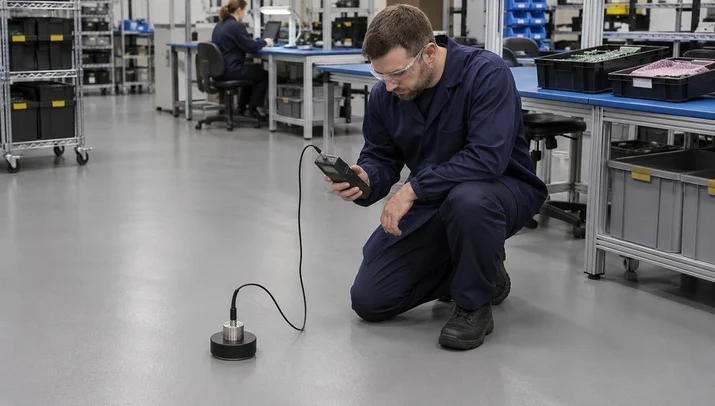
Independent post-installation testing confirms the finished floor meets its mandatory resistance limits before sign-off. Technicians use calibrated concentric ring probes and weighted electrodes. They record point-to-point values and resistance to ground across every bay. The survey proves that the electrical pathway runs continuously and produces defensible compliance data.
Testing follows strict environmental controls. Ambient relative humidity and room temperature both alter measured surface resistance. Technicians record readings on a structured grid and note variations at doorway transitions and perimeter edges. Professional installers then issue a handover certificate. It carries individual probe measurements, ambient conditions and signed test results for the facility safety file.
Ongoing Verification Audits and Static Certification Records
Regular verification audits hold certification in aerospace, pharmaceutical and high-technology electronics facilities. Humidity fluctuation, daily traffic, surface contamination and abrasive cleaning pads all shift measured resistance over time. Formal test logs demonstrate proactive diligence under health and safety frameworks. The records keep statutory and technical compliance continuous rather than assumed.
Quality managers build annual or quarterly resistance mapping into their management systems. The surveys reveal whether friction from rubber forklift tyres has degraded conductivity. Particulate build-up produces the same drift. Historical audit records protect the business during client inspections and insurer reviews. They evidence that critical ESD control areas remain inside operational parameters.
Case Studies
Our case studies cover – Printing & Packaging, Warehousing & Logistics, Pharma & Healthcare, Automotive & Engineering, Aviation & Aerospace, Food & Drink, Printing & Packaging, Warehousing & Logistics, Pharma & Healthcare
Hidden Expenses in Incomplete Contractor Quotations
Inadequate Substrate Profiling and Mechanical Grinding Omissions
Unusually low tenders frequently disguise shortcuts in the mandatory preparation phase. Rogue contractors offer sweeping or non-compliant acid washing instead of enclosed diamond grinding. Dust-controlled extraction disappears with it. Skipping mechanical keying causes delamination within the first year. The building owner then funds remedial grinding to strip the failed resin.
Diamond grinding opens the concrete capillaries. Low-viscosity primers penetrate deeply and form a durable mechanical lock. Contractors who omit dust control expose occupants to respirable crystalline silica. Enforcement notices under COSHH follow. Transparent tenders itemise the preparation method, the diamond tooling passes involved and the crack repair materials included.
Omitted Electrical Verification and Earth Stud Connection
Cheap estimates regularly exclude final termination to the building earth and formal handover testing. Unscrupulous suppliers lay conductive coats straight onto bare concrete. No copper grid goes in and nothing connects to a physical earth bar. Facility managers then pay specialist electrical engineers to complete and certify the installation.
A static control floor cannot function without continuous earthing. Quotations that bundle grounding under vague descriptions usually exclude the certified brass studs, copper straps and verification labour. From experience across the sector, this is where the largest variations appear. Specifiers should require a stated quantity of earth points, a bonding method statement and BS EN 61340-5-1 documentation.
“JD Flooring did an excellent job installing a resin floor in our food production facility. The floor is durable, hygienic, and meets all safety regulations. The team was knowledgeable and professional, and the project was completed within the agreed-upon timeframe. I highly recommend JD Flooring for food industry flooring needs.”
Alex Martinez
Downtime Economics and Fast-Cure Resin Alternatives
Production Shutdown Costs Versus Resin Chemistry Selection
Facility downtime often eclipses the quoted installation price in total expenditure. Standard epoxy formulations need 24 to 48 hours before foot traffic. Full chemical cure can take five days. Pausing a high-volume manufacturing line for that period creates commercial losses that dwarf the flooring contract itself.
Operational managers should price the shutdown before pricing the resin. Cleanrooms, electronics assembly lines and pharmaceutical packaging suites all carry a measurable hourly output value. Where lost output reaches thousands of pounds per hour, a cheaper slow-cure resin becomes a false economy. Total project cost weighs application rate against unrecoverable downtime.
Rapid-Turnaround Systems for Live Technical Environments
Fast-curing polyaspartic and methyl methacrylate chemistries compress downtime during urgent refurbishment programmes. Polyaspartic coatings accept foot traffic in roughly two hours. They reach full cure within 24 hours, even at temperatures down to minus five degrees Celsius. Technical facilities can therefore phase installations across a single weekend shift.
Methyl methacrylate resins cure chemically in two to three hours. Industrial zones return to service within the same shift. MMA does release a strong acrylic odour during application. That odour can taint unprotected food ingredients, pharmaceutical materials and packaging stock. Facilities using MMA need forced-air ventilation and isolated work zones to stop vapour migrating into live bays.
Calculate The True Cost
A three day shutdown at a plant turning over £2,000 an hour is £120,000 of lost output. On most sites that is several times the cost of the new resin floor installation. We have developed our own free custom calculator top help you calculate the true cost and a new resin floor.
Long-Term Maintenance and Retaining Electrical Performance
Specialist Cleaning Regimes and Eliminating Insulating Residues
Electrostatic performance survives only with a dedicated maintenance regime using pH-neutral detergents. Conventional wax emulsions and silicone floor polishes introduce an insulating barrier across the surface. That thin non-conductive film blocks every discharge pathway. An expensive dissipative floor then fails its resistance testing despite remaining visually sound.
Cleaning teams should run scrubber-dryers fitted with soft or medium non-abrasive pads. Coarse pads strip the clear topcoat and abrade the conductive carbon fillers in the resin. Documented cleaning schedules with approved static-control chemistries keep the surface clear of insulative grime, grease and rubber deposits.
Scheduled Condition Surveys and Proactive Bay Recoating
Routine condition surveys catch topcoat erosion, joint arris spalling and electrical drift before failure. Recoating a worn seal coat protects the conductive matrix underneath at modest cost. Delay changes the economics completely. Continued traffic damages the embedded copper grid, and a full floor replacement becomes the only remaining option.
Plant engineers should track physical wear alongside periodic resistance testing on primary transport lanes. Pedestrian and forklift traffic removes the sacrificial topcoat gradually. Point-to-point resistance then drifts outside target thresholds. Early resealing prevents moisture ingress and protects the copper grid beneath. Well-maintained systems commonly last fifteen to twenty years.
Final Thoughts
A complete view of ESD resin flooring cost lets facility managers defend their capital decisions. Static control flooring is an engineering asset, not a surface finish. It demands rigorous preparation, high-purity copper grid installation, specialised conductive binders and formal resistance verification. Pricing every mechanical and electrical line item prevents delays, variations and damage to sensitive electronics.
Correct specification balances mechanical duty against verified electrical resistance parameters. Specifiers should weigh site survey findings, itemised tenders and demonstrable contractor competence. Prioritising compliant earthing and independent testing delivers dependable static protection and long service life across demanding manufacturing environments.
Arrange a Free Site Survey
If you are thinking about upgrading the flooring in your commercial or industrial space then we would love to hear from you. Our team of experts will conduct a free onsite survey and then guide you through the process of product selection and project planning, whilst remaining mindful of your budgetary restraints.
Frequently Asked Questions
A:
Standard industrial resin systems run from around £8 to £45 per square metre. Thickness, preparation demands and resin chemistry drive the variation. Anti-static builds sit in the middle and upper bands. They require conductive primers, carbon additives and copper earthing grids. FeRFA Type 3 high build anti-static coatings typically start at £8 to £12 per square metre. Heavy-duty flowable systems and polyurethane screeds run between £25 and £40, subject to site survey findings.
A:
A complete ESD flooring cost including testing covers diamond-grind substrate preparation, crack repair and conductive priming. Copper earthing tape and the static-control body coats follow. The quotation should also include physical connection to certified earth points. Formal surface resistance testing to BS EN 61340-5-1 and full handover certification belong in the same price. Quotes that omit testing or earthing look cheap at tender stage. They leave the client funding remedial work to reach compliance.
A:
An ESD protected area needs a dissipative or conductive floor. The surface bleeds static away from sensitive microelectronics and personnel. An electrical switchroom needs the opposite. There the floor must be electrically insulating to protect maintenance staff from severe shock, working to IEC 60364. An insulating floor stops current passing through the operator to ground. Specifying a conductive floor in a high-voltage switchroom creates an immediate, life-threatening hazard.
A:
Standard commercial wax or acrylic polish destroys static control performance. These products dry to form an electrically insulating film. The film blocks charge from reaching the conductive resin matrix and the earthing grid beneath. Maintenance teams must clean static-control surfaces with approved pH-neutral detergents that contain no film-forming additives. Where appearance needs restoring, only certified dissipative polishes formulated for ESD installations are suitable.
A:
Excess moisture in a concrete substrate causes osmotic blistering and adhesive delamination beneath impermeable resin. Standard epoxy coatings tolerate substrate relative humidity up to roughly 75 or 80 per cent. Higher hygrometer readings require a specialist two-coat liquid damp proof membrane. That membrane goes down before the conductive primer and earthing tape. Omitting moisture testing or the membrane can cause catastrophic debonding and destroy the functional grounding grid.
