
Heavy Duty Epoxy Flooring: When a Coating Is Not Enough
Specifying heavy duty epoxy flooring requires an objective assessment of physical site traffic, dynamic loads, and mechanical wear. Many industrial facilities apply thin coatings to minimise initial expenditure. However, these thin surface films quickly deteriorate under aggressive operational trafficking. Coatings protect clean concrete from light dusting and minor spills, but demanding industrial facilities require substantial depth. Recognising the difference between thin protective coatings and high-build resin screeds prevents premature failure. It also ensures operational continuity across busy manufacturing sites.
Operations managers regularly encounter surface breakdown when continuous vehicular movements grind away micro-thin resin films. Choosing an unsuitable specification causes unscheduled production delays and repeated repair bills. Premature debonding disrupts daily workflow and creates hazards. Are you continuously repainting worn logistics aisles when your industrial working environment genuinely requires an impact-resistant resin screed build-up?
Key Takeaways
- Film thickness remains the primary factor governing floor durability, cleanly separating cosmetic surface seals from impact-absorbing resin screeds measured in multiple millimetres.
- Specifying thin coatings in high-intensity forklift aisles leads to rapid delamination, deep surface gouging, and recurring operational disruption across busy logistics facilities.
- Abrasive fines tracked across loading aprons turn standard warehouse traffic into aggressive grinding mechanisms that rapidly strip away light-duty liquid floor treatments.
- Polyurethane screeds withstand severe thermal shock and organic acid attack that routinely shatter rigid epoxy chemistries during intensive high-temperature facility washdowns.
- Selecting the correct FeRFA system class during early project design stages prevents repeat installation costs, unscheduled operational downtime, and protracted compliance disputes.
FeRFA Classifications and Nominal System Thickness
Synthetic resin floors span a broad spectrum of thickness and structural capability. Systems range from thin dust-proofing seals to heavy-duty trowelled screeds. Facilities managers must look past initial material cost. They need to evaluate the real mechanical forces acting on their concrete substrate. Thickness, not brand name, governs how a floor behaves under load.
The FeRFA classification underpins BS 8204-6 and defines eight resin flooring types by applied thickness. Type 1 covers floor seals up to 150 microns. The table below sets out Types 2 to 8. It shows nominal thickness against the service duty each type is built to carry.
| FeRFA Type | System Description | Typical Thickness | Target Service Duty |
|---|---|---|---|
| Type 2 | Floor Coating | 150 to 300 microns | Light commercial and storage areas |
| Type 3 | High Build Coating | 300 to 1000 microns | Medium factory and warehouse routes |
| Type 4 | Multi-Layer Flooring | Over 2 mm | Medium to heavy industrial processing |
| Type 5 | Flow Applied Flooring | 2 mm to 3 mm | Hygienic production and manufacturing areas |
| Type 6 | Resin Screed Flooring | Over 4 mm | Heavy duty service, including laid falls |
| Type 7 | Heavy Duty Flowable Flooring | 4 mm to 6 mm | Very heavy loading and intense trafficking |
| Type 8 | Heavy Duty Resin Flooring | Over 6 mm | Extreme impact, washdown and chemical exposure |

Mechanical Limits of Thin Coatings
Film Thickness and Substrate Protection
Thin resin coatings provide nominal barriers between 150 and 1000 microns that primarily seal the concrete face. High build coatings prevent dusting. However, they lack the physical mass required to absorb heavy mechanical impacts. They transfer crushing external forces directly into the concrete substrate beneath.
When heavy items strike thin coatings, kinetic energy passes straight through the polymer layer. If the underlying concrete substrate yields, the rigid film fractures immediately. Thicker systems distribute compressive forces across a broader footprint. This preserves the structural integrity of the entire floor.
Abrasion Cycles and Premature Wear
Standard liquid coatings lose structural film integrity quickly under continuous mechanical abrasion caused by regular industrial logistics operations. Once grit lodges under hard wheels, thin coatings experience relentless micro-scratching. This action rapidly strips the protective seal coat down to bare concrete.
True abrasion resistant flooring requires sufficient depth of resin binder and graded aggregate. A 300-micron coating offers little sacrificial depth against abrasive wear. Once traffic cuts through the topcoat, the exposed bond line admits liquids. These contaminants accelerate widespread delamination across the bay.
Heavy Duty Epoxy Flooring for Forklift Operations
Point Loads from Hard Tyres
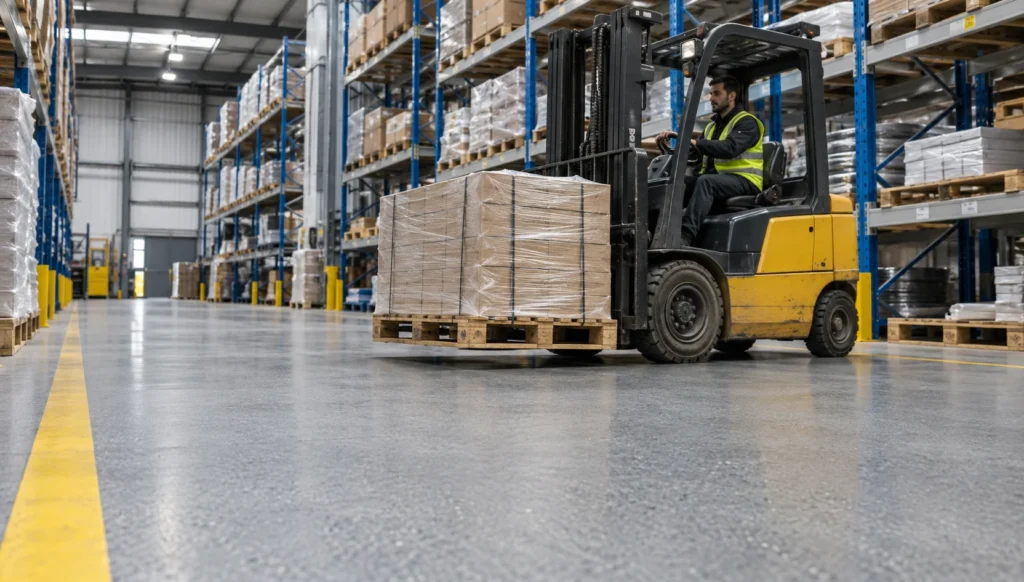
Industrial forklifts exert massive concentrated point loads through small, hard polyurethane or nylon wheels. Because these wheels lack pneumatic cushioning, dynamic vehicular mass focuses onto a tiny contact footprint. This intense local pressure crushes thin coatings and rapidly fractures the underlying concrete surface.
Specifying heavy duty epoxy for forklift traffic demands careful analysis of dynamic wheel loads rather than gross vehicle tonnage. A two-tonne pallet truck on solid rollers exerts immense contact pressure. This force often exceeds the footprint loading of a laden lorry on pneumatic tyres.
Directional Shear and Turning Stresses
Forklifts generate severe rotational shear forces during sudden braking, acceleration, or sharp turns in narrow aisles. Thin coatings possess very limited tensile and shear tolerance. These lateral stresses cause thin resin matrices to rip away from the substrate profile during daily logistics activities.
Warehouse floors require heavy duty epoxy flooring systems with robust bonding properties and dimensional mass. Trowel-applied screeds and heavy-duty flowable systems bridge micro-defects in the substrate. They anchor the topping securely against relentless torsional forces.
Did You Know?
Polyurethane resin screeds commonly contain diisocyanates. GB REACH Annex XVII entry 74 restricts their use at work. Any product at or above 0.1 percent diisocyanate content requires approved safe-use training before use. That duty took effect on 24 August 2023. Training must be repeated at least every five years.
Dropped Material and Physical Impact
Impact Energy Dissipation
Dropped tools, metal scaffolding, steel stillages, and heavy production jigs deliver localised shock waves that easily shatter brittle floor finishes. Without adequate layer thickness, kinetic force compresses the surface instantly. This concentrated mechanical energy leads to star-cracking and chipping across the affected zone.
Thick aggregate-filled resin screeds absorb and disperse impact energy before it reaches the concrete substrate. Systems installed above 6 mm act as structural buffers. The polymer matrix cushions the shock, preventing the substrate from spalling. This stops fractures from travelling horizontally across the floor.
Edge Spalling at Joint Arris Lines
Joint arrises represent the most vulnerable points across any factory or warehouse floor subject to regular industrial movements. Unprotected joint arrises fracture under rolling wheel loads. They break down rapidly under continuous percussive wheel strikes from loaded warehouse vehicles during active production shifts.
A thin surface coating provides zero edge protection to saw-cut joints. Restoring failing joints requires cutting out damaged arrises. Installers rebuild shoulders with high-strength structural resin mortar. They finish the repair with flexible polysulphide jointing compounds. Applying thick screeds with armoured transitions eliminates recurrent joint failure.

Need a Resin Flooring Site Visit and Quote?
Abrasion Resistant Flooring Under Grinding Traffic
Tracked Abrasives from External Yards
Vehicles entering warehouse bays from external yards carry hard grit, road sand, and sharp metal fines on their tyre treads. These fine particles become embedded under rolling wheels. They act like commercial sandpaper against the indoor industrial floor surface during daily movements.
In facilities with open loading bays, grit tracking destroys standard floor paint within weeks of application. Abrasion resistant flooring incorporating hard aggregate fillers resists this aggressive scouring action. Systems built with graded quartz or emery aggregates retain integrity long after smooth surface coatings wear away completely.
Surface Erosion and Cleaning Problems
Constant mechanical abrasion scours away thin resin seals, opening up microscopic pores that trap dirt, oils, and chemical residues. Once a floor surface becomes pitted, standard scrubber-dryers cannot clean it effectively. This issue leads to unsightly staining and compromised workplace hygiene standards.
Industrial facilities need flooring systems with sufficient body to withstand continuous industrial scrubbing machines. Thicker flowable systems and heavily filled screeds maintain a uniform density throughout their depth. Even if microscopic surface wear occurs over years of use, the impermeable barrier remains completely intact.
Case Studies
Our case studies cover – Printing & Packaging, Warehousing & Logistics, Pharma & Healthcare, Automotive & Engineering, Aviation & Aerospace, Food & Drink, Printing & Packaging, Warehousing & Logistics, Pharma & Healthcare
Thermal Cycling and Chemical Attack
Rigid Epoxies and Thermal Shock
Epoxy resins exhibit thermal expansion rates four to five times higher than underlying concrete bases. This creates immense internal stresses during sudden temperature swings. Exposure to boiling water, steam clean-down cycles, or hot production discharges causes rigid epoxy coatings to crack and delaminate quickly.
Facilities subjecting floors to steam cleaning or hot process spills should specify heavy-duty polyurethane resin screeds. Polyurethane screeds installed above 6 mm withstand thermal cycling from minus 40 degrees Celsius to 120 degrees Celsius. The flexible polymer matrix absorbs movement that fractures rigid epoxy chemistries.
Chemical Exposure and Acid Resistance
Thin coatings fail rapidly when exposed to aggressive industrial chemicals, concentrated acids, or corrosive manufacturing reagents. Solvents and organic acids soften thin resin layers quickly. This chemical softening allows corrosive liquids to seep down into the porous concrete substrate beneath the bond line.
Protecting substrates against continuous chemical spills requires verified chemical exposure schedules and impermeable screeds. Heavy-duty polyurethane systems provide superior resistance against organic acids such as lactic, citric, and acetic formulations. In contrast, thin epoxy coatings are generally restricted to light splash-and-wipe exposure regimes.
“JD Flooring did an excellent job installing a resin floor in our food production facility. The floor is durable, hygienic, and meets all safety regulations. The team was knowledgeable and professional, and the project was completed within the agreed-upon timeframe. I highly recommend JD Flooring for food industry flooring needs.”
Alex Martinez
Substrate Regularity and Drainage Falls
Surface Profile and Mechanical Anchoring
Thin resin coatings faithfully mirror every contour, dip, and imperfection present across the prepared concrete surface. Substrates often exhibit extensive spalling, undulations, or poor surface regularity. Applying a thin coating will not correct those underlying profile defects across the busy operational area.
Resin screeds allow flooring contractors to regulate irregular surfaces and establish smooth, flat operating planes. Installers level uneven concrete with trowel-applied mortars after thorough mechanical grinding. This process produces consistent surface tolerances that meet modern warehousing standards, including Concrete Society TR34 regularity classifications.
Falls and Drainage Channels
Wet processing environments require positive falls to move standing liquids away from active work areas and into drainage channels. Thin coatings cannot create falls because they are liquid membranes. They simply puddle in existing low spots across the concrete substrate profile.
Installers use heavy-duty resin screeds to form falls directly on top of flat concrete surfaces. Screeds laid at falls between 1:80 and 1:100 ensure rapid effluent drainage. This layout prevents standing liquid pools that create slip hazards under the Workplace (Health, Safety and Welfare) Regulations 1992.
Calculate The True Cost
A three day shutdown at a plant turning over £2,000 an hour is £120,000 of lost output. On most sites that is several times the cost of the new resin floor installation. We have developed our own free custom calculator top help you calculate the true cost and a new resin floor.
Specification Decisions and Lifecycle Economics
Initial Capital versus Total Lifecycle Cost
Specifying thin coatings appears cost-effective on initial purchase orders, but frequent re-coating cycles quickly erode upfront financial savings. A thin coating requires re-application every few years. This recurring expense costs far more over a decade than a durable screed built to last twenty years.
Industrial buyers must evaluate the true downtime expense associated with repeated floor replacements. Clearing stock, moving machinery, and stopping production shifts inflates overall lifecycle costs. These hidden operational expenses far exceed the initial installation price of a heavy-duty FeRFA Type 7 or Type 8 system.
FeRFA Type Selection for Operational Demands
Matching the operational duty of a facility to the appropriate FeRFA classification ensures long-term floor performance without unnecessary overspecification. Medium-duty storage bays operate reliably with high build coatings. Conversely, loading bays, wet production lines, and heavy forklift avenues require flowable or trowelled screeds.
Graded specification offers the most practical approach for large commercial sites. Facilities managers can install high build coatings across light pedestrian areas. They can reserve heavy duty epoxy flooring screeds for high-wear transit aisles, loading aprons, and intense manufacturing cells.
Final Thoughts
Selecting heavy duty epoxy flooring over a thin coating becomes necessary under severe mechanical abrasion. Concentrated wheel loads and aggressive impacts destroy thin surface seals. Thin liquid coatings serve a valuable role in dust-proofing and light-duty storage areas. However, they cannot withstand the physical punishment delivered by industrial material handling equipment. Under-specifying thin films in high-traffic areas leads to surface delamination and damaged vehicle running gear. This mistake invariably causes expensive operational downtime.
Specifiers must evaluate the long-term mechanics of their site before finalising a flooring schedule. Assessing dynamic wheel loads, tracked contaminants, temperature swings, and chemical exposure indicates the required FeRFA class. Investing in adequate system thickness and professional mechanical substrate preparation ensures lasting durability. A properly specified resin installation remains serviceable across decades of rigorous operational use.
Arrange a Free Site Survey
If you are thinking about upgrading the flooring in your commercial or industrial space then we would love to hear from you. Our team of experts will conduct a free onsite survey and then guide you through the process of product selection and project planning, whilst remaining mindful of your budgetary restraints.
Frequently Asked Questions
A:
The difference centres on thickness and mechanical capability. An epoxy coating is measured in microns, typically between 150 and 1000. It seals concrete against dust and light liquid contamination. A resin screed is measured in millimetres, usually 4 mm and above. Screeds provide a robust wearing surface. They absorb heavy point loads, resist gouging, and withstand impact from dropped components. Screeds can also be laid to falls for drainage.
A:
Heavy duty epoxy for forklift traffic is essential wherever material handling equipment runs on hard nylon or polyurethane tyres. These vehicles concentrate large dynamic loads onto small contact patches. They also generate intense rotational shear during turning and braking. Thin coatings delaminate and wear through under continuous traffic. Heavy-duty flowable systems and trowelled screeds spread contact pressure across the substrate. That prevents cracking, gouging and premature debonding along busy transit lanes.
A:
Saw-cut joints and expansion gaps are structural discontinuities. Unsupported concrete edges take direct wheel strikes at these points. Thin coatings offer no mechanical backing to absorb the blows. As hard wheels cross open joints, the arrises spall away beneath the brittle film. The result is potholing, vehicle suspension damage and rapid delamination along joint lines. Repair means rebuilding the arrises with structural resin mortar and installing flexible sealants before applying a thick screed.
A:
Standard epoxy screeds struggle under thermal shock. Rigid epoxy expands far faster than concrete. Sudden boiling discharges or steam cleaning cycles then shear the bond line. Where thermal cycling occurs, specify heavy-duty polyurethane resin screeds instead of epoxy. Polyurethane screeds above 6 mm stay thermally stable from minus 40 degrees Celsius to 120 degrees Celsius. Their flexibility accommodates rapid temperature swings without cracking, blistering or loss of adhesion.
A:
Most industrial resin flooring failures trace back to inadequate preparation or incorrect specification. Mechanical preparation removes weak concrete laitance and surface contaminants. Captive shot blasting and diamond grinding are the usual methods. Both open the concrete pores so primer penetrates and keys mechanically. Without that step, even the thickest screed debonds under operational stress. Good preparation keeps the installed resin system bonded to the substrate throughout its design life.
