Commercial Anti-Slip Floor Coating for Wet Areas
A commercial anti-slip floor coating has to deliver grip without wrecking the cleaning regime. Surface water cuts traction sharply in wet industrial areas. Walkways and processing floors then become real slip hazards. A resin system with embedded aggregate restores grip and helps satisfy UK safety duties. Coarse finishes still need planning, because texture changes how a floor must be cleaned.
Many sites over-specify coarse profiles across whole buildings. The result is a hygiene problem that no cleaning team can win. Assess thresholds, washdown zones and cleaning methods first. Can a facility then hold compliance, keep traction and still run a realistic maintenance routine without wasted capital spend?
Key Takeaways
- Slips, trips and falls on the same level cause 30% of reported non-fatal injuries in Great Britain.
- Pendulum testing to BS 7976 is the recognised benchmark, with a wet PTV of 36 confirming low slip potential.
- Coarse aggregate delivers grip in wet processing areas, but the voids hold soil and demand mechanical scrubber-dryers.
- Zone high-traction finishes to wet thresholds and washdown bays, leaving dry circulation routes easier to clean daily.
- Industrial anti-slip resin runs from roughly £8 to £45 per square metre, depending on preparation, thickness and site conditions.
Performance Profiles of Anti-Slip Resin Systems
Anti-slip systems differ widely in build thickness, slip potential and cleaning demand. The right choice depends on how much liquid the floor actually sees. Intermittent spills, scheduled washdowns and permanent standing water are three different problems. The table below sets out how common resin specifications behave across typical commercial settings.
Slip resistance is an engineered compromise, not one universal specification. High-build coatings and heavy-duty screeds accept a wide range of aggregate broadcasts. Fine aluminium oxide sits at one end and coarse quartz at the other. Match the mechanical profile to the washing equipment, the chemicals in use and the real volume of liquid on the floor.
| FeRFA System Type | Typical Build Thickness | Achievable Wet PTV | Cleaning Effort Level |
|---|---|---|---|
| FeRFA System TypeType 3 High Build Coating | Typical Build Thickness300 to 1000 microns | Achievable Wet PTV36 or above with light broadcast | Cleaning Effort LevelModerate (mop or light machine) |
| FeRFA System TypeType 4 Multi-Layer Quartz | Typical Build Thickness2 to 3 mm | Achievable Wet PTV40 or above with medium broadcast | Cleaning Effort LevelHigh (scrubber-dryer required) |
| FeRFA System TypeType 7 Heavy Duty Flowable | Typical Build Thickness4 to 6 mm | Achievable Wet PTV45 or above with coarse broadcast | Cleaning Effort LevelHigh (rotary brush or pressure wash) |
| FeRFA System TypeType 8 Heavy Duty Resin Flooring | Typical Build Thickness6 to 9 mm | Achievable Wet PTV50 or above with coarse broadcast | Cleaning Effort LevelIntensive (industrial washdown or steam) |

Workplace Safety Duties for Commercial Anti-Slip Floor Coating
Statutory Duties Under UK Workplace Regulations
Regulation 12 of the Workplace (Health, Safety and Welfare) Regulations 1992 requires floors to be suitable for their purpose. Employers must ensure, so far as is reasonably practicable, that surfaces are not slippery. Floors must also stay free of substances that create a slip risk during normal work.
Under-specification is therefore a compliance failure, not just a durability flaw. Sections 2 and 3 of the Health and Safety at Work etc. Act 1974 extend the duty to employees, delivery drivers and visitors. An appropriate anti-slip resin system engineers the hazard out at source. The Management of Health and Safety at Work Regulations 1999 place that kind of control above reliance on protective equipment. In practice, we find sites rely on signage and mats long after resin has become the cheaper answer.
Financial Penalties and Regulatory Enforcement
The Health and Safety Executive enforces floor safety through improvement notices, prohibition notices and prosecution. Where an inspector identifies a material breach, the Fee for Intervention scheme recovers HSE time from the duty holder. That charge applies at £188 per hour from 1 April 2026, whether or not anyone has fallen.
Serious failings reach the courts under the definitive guideline for health and safety offences. A large organisation with turnover above £50 million faces a starting point of £2,400,000 for a high-culpability, harm category 1 offence. The range runs from £1,500,000 to £6,000,000. Civil claims under the Occupiers’ Liability Act 1957 carry uncapped damages on top. Controlling slip risk protects staff and the balance sheet in equal measure.
Traction Measurement in Wet Operational Environments
Pendulum Test Values and BS 7976 Standards
The BS 7976 pendulum test is the recognised method for assessing floor slip resistance in Great Britain. A standardised rubber slider swings across the wetted surface and loses energy to friction. The instrument converts that loss into a Pendulum Test Value, which quantifies slip potential under realistic footwear contact.
Scores fall into three bands. A PTV of 0 to 24 indicates high slip potential, roughly a one in twenty chance of slipping. A PTV of 25 to 35 is moderate and a PTV of 36 or above confirms low slip potential, around one in a million. Always test with the contaminant actually present, because a profile that performs in clean water can fail in grease.
German Ramp R Ratings Versus Pendulum Evidence
DIN 51130 ramp tests produce the familiar R9 to R13 ratings quoted in architectural specifications. The Health and Safety Executive does not accept an R rating alone as proof of compliance. The method uses motor oil and heavily treaded boots on an adjustable incline, which bears little relation to a British workplace.
R11 and R12 remain useful commercial shorthand for wet areas. They are not evidence. A floor rated R10 can still return a pendulum score below 36 when wetted with process water or dilute detergent. Insist on documented on-site pendulum testing to BS 7976 after installation. That record is what demonstrates low slip potential under site conditions.
Did You Know?
Slips, trips and falls on the same level accounted for 18,051 reported non-fatal employee injuries in Great Britain during 2024/25. That is 30% of the RIDDOR total and the largest single accident kind (HSE, RIDDOR, 2024/25).
Cleanability Trade-Offs with Textured Anti-Slip Systems
Aggregate Profiles and Soil Retention
Coarser aggregate raises surface friction. It also creates deeper microscopic valleys that hold soil, fats and chemical residues. Coarse quartz and bauxite give dependable grip in contaminated areas. The same texture traps mop fibres and stops a flat mop lifting residue from the surface.
The penalty is operational and ironic. A textured floor that cannot be kept clean stops being slip resistant. Grease, mineral scale and protein films fill the valleys. Footwear then glides across packed soil instead of contacting the aggregate peaks. From experience across the sector, the coarsest available broadcast often produces the dirtiest floor and the worst pendulum results.
Mechanical Traction Balanced Against Routine Maintenance
Target the lightest aggregate profile that still satisfies the site slip risk assessment. An intermediate broadcast lets a standard scrubber-dryer with cylindrical brushes agitate and extract liquid soil. The micro-roughness stays clear without aggressive acid or caustic treatment, which protects the seal coat and the aggregate matrix.
Maintenance must match the texture. Harsh caustic degreasers and abrasive stripping pads erode the seal coat over time. The finish dulls and porous layers become exposed. Set a daily sweep to remove abrasive grit, then machine clean with pH-neutral detergent at the correct dilution. A disciplined regime preserves both the seal and the mechanical micro-roughness across a fifteen-year service life.

Need a Resin Flooring Site Visit and Quote?
Entrance Matting and Building Threshold Design
Rainwater Ingress at Pedestrian Entrances
External doorways carry large volumes of rainwater into commercial buildings. Smooth interior floors then become an immediate slip hazard. A primary matting well captures bulk moisture and wet soil before foot traffic reaches the interior. Less liquid then travels into reception halls and corridors.
HSE guidance expects a barrier system long enough to dry footwear in bad weather, which often means several metres of continuous matting. Where matting meets hard flooring, an anti-slip coating for wet areas prevents an abrupt drop in friction. Coordinate the absorbent zone with a textured resin border. That combination holds the weather at the threshold rather than inside the building.
Friction Transitions at Internal Doorways
Abrupt changes in friction between adjoining rooms cause a high share of pedestrian slips. Staff moving quickly from a heavily profiled wet area onto a smooth corridor lose traction without warning. Stride dynamics break down at that point, and the fall usually happens within a pace or two.
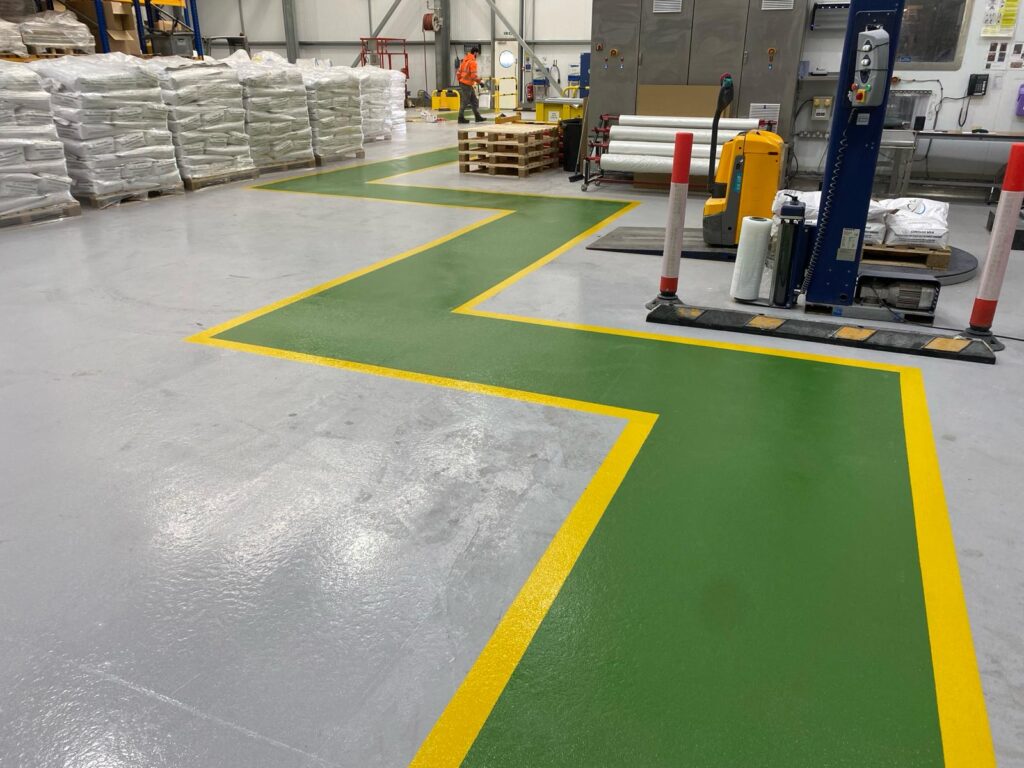
Graduate the texture across internal thresholds using an intermediate broadcast. Mark the boundary with contrasting coloured resin so staff see the change. That demarcation supports the Health and Safety (Safety Signs and Signals) Regulations 1996. Gradual transitions let employees adapt their gait between wet process rooms and dry corridors.
Case Studies
Our case studies cover – Printing & Packaging, Warehousing & Logistics, Pharma & Healthcare, Automotive & Engineering, Aviation & Aerospace, Food & Drink, Printing & Packaging, Warehousing & Logistics, Pharma & Healthcare
Washdown Stations and Heavy Wet Process Zones
Thermal Cycling and Chemical Exposure in Washdown Bays
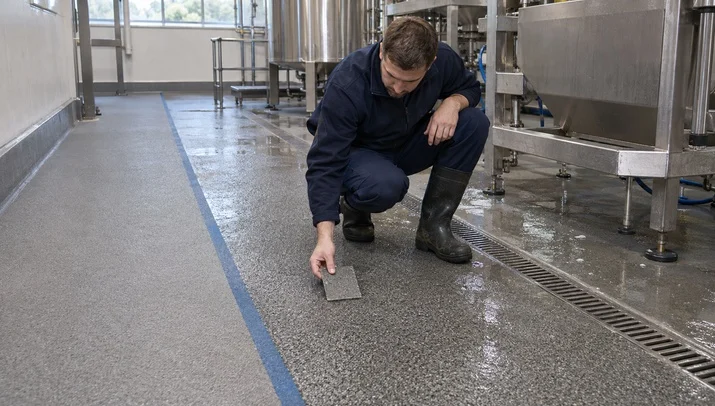
Washdown zones face continuous standing water, active CIP chemicals and sudden thermal shock from steam. Rigid epoxy expands and contracts at a different rate from the concrete beneath it. Thin resin films then blister, crack and delaminate under repeated hot washdowns, often within the first two years.
Aggressive washdown bays need a heavy-duty polyurethane screed at 6 to 9 mm. Polyurethane screeds flex and tolerate roughly minus 40°C to plus 120°C without debonding. Check the safety data sheet and label before use. Where a product contains diisocyanates, COSHH requires suitable information, instruction and training before anyone handles it.
Positive Falls and Drainage Surrounds
Ponding water accelerates chemical attack, harbours bacteria and raises slip risk. Forming positive falls of 1:80 to 1:100 sheds liquid towards stainless steel drainage channels. A cementitious pumped screed or heavy-duty resin base can carry those falls without compromising the finished surface.
Retained Regulation (EC) 852/2004 requires food premises to keep sound, cleanable floors with adequate drainage. Effluent must flow away from clean areas. Detail gullies and channel edges with integral coved resin skirting. That removes the right-angled junctions where grease and dirty wash water collect. Seamless detailing also protects perimeter joints from arris spalling under trolley and pallet traffic.
“JD Flooring did an excellent job installing a resin floor in our food production facility. The floor is durable, hygienic, and meets all safety regulations. The team was knowledgeable and professional, and the project was completed within the agreed-upon timeframe. I highly recommend JD Flooring for food industry flooring needs.”
Alex Martinez
High-Traction Finishes Zoned Across the Facility
Aggressive Profiles Targeted at High-Risk Zones
An aggressive anti-slip profile across an entire facility is an expensive mistake. It inflates cleaning labour for decades. Zone heavy aggregate textures tightly around the high-risk assets instead. Washdown bays, peeling stations, drainage gullies and wet vehicle loading docks are the usual candidates on an industrial site.
Zoning confines the difficult cleaning to areas that are wet by design. A heavy-duty flowable or multi-layer system with coarse aggregate holds grip in wet process bays. Dry packing lines take a smooth, self-smoothing resin. The result cuts maintenance labour and directs capital where slips are actually foreseeable.
Medium Profiles in Connecting Traffic Routes
Connecting corridors, forklift aisles and packing zones need a commercial anti-slip floor finish that handles occasional tracking. A FeRFA Type 3 high-build epoxy with a light aggregate broadcast gives reliable wet traction at PTV 36 or above. Flat-mop and rotary scrubber-dryer cleaning then stays quick.
Grading the specification between heavy process rooms and peripheral storage improves lifecycle economy. Smooth high-build systems sit around £8 to £12 per square metre. Heavy-duty textured screeds run from roughly £30 to £40 per square metre. Zoning those grades across a floor plan avoids over-specification in benign areas. Day-to-day upkeep gets simpler without any loss of worker protection.
Calculate The True Cost
A three day shutdown at a plant turning over £2,000 an hour is £120,000 of lost output. On most sites that is several times the cost of the new resin floor installation. We have developed our own free custom calculator top help you calculate the true cost and a new resin floor.
Substrate Preparation and Lifecycle Care
Mechanical Substrate Preparation Methods
Preparation decides whether a resin coating bonds permanently or lifts under traffic. Installers must diamond-grind or captive shot-blast the concrete to remove laitance, old coatings and contaminants. The result is a clean, open-pored profile that lets the primer key mechanically into the slab.
Grinding carries its own health risk. Concrete dust contains respirable crystalline silica, a recognised carcinogen. The workplace exposure limit is 0.1 mg/m³ over an eight-hour time-weighted average under COSHH 2002. Professional installers control dust at source with on-tool HEPA-filtered extraction. That also keeps abrasive particulate away from sensitive production machinery nearby.
Periodic Testing and Proactive Recoating
Slip resistance declines as aggregate wears and voids clog with grease or cleaning residue. Commission an annual condition survey that includes calibrated pendulum testing. The survey should confirm that traffic routes still hold a minimum PTV of 36 under the wet conditions the floor actually sees.
Catching a worn seal coat early allows a maintenance recoat before the aggregate matrix erodes. A well-maintained commercial resin floor delivers fifteen to twenty years of service. Neglected floors often need full replacement within five to seven years. Condition monitoring also builds the compliance record an inspector will ask for. In practice, that discipline is where the whole-life saving sits.
Final Thoughts
Specifying a commercial anti-slip floor coating means weighing worker safety against the cleaning regime that follows. The coarsest available aggregate solves today’s slip hazard and creates tomorrow’s hygiene problem. A verified PTV of 36 or above, measured with the contaminant actually on the floor, is the defensible position. That figure holds up with an inspector and with an insurer.
Zoning remains the most cost-effective route for commercial and manufacturing premises. Concentrate thermal-shock-resistant screeds in the washdown stations. Specify cleanable medium-traction coatings across circulation routes. Then audit by pendulum each year and match the cleaning method to the texture. Surface performance holds for decades when those two disciplines stay in step.
Arrange a Free Site Survey
If you are thinking about upgrading the flooring in your commercial or industrial space then we would love to hear from you. Our team of experts will conduct a free onsite survey and then guide you through the process of product selection and project planning, whilst remaining mindful of your budgetary restraints.
Frequently Asked Questions
A:
HSE guidance and BS 7976 point to a Pendulum Test Value of 36 or above for a commercial wet area. The test must use the contaminant actually present on site. A score of 36 or more indicates low slip potential, which equates to roughly a one in a million chance of a slip. Testing a dry, clean surface proves very little. Water, grease or dilute detergent should be used, depending on what the floor meets in normal operation.
A:
Coarse aggregate creates deep ridges and valleys across the resin surface. The peaks pierce the water film and provide grip. The valleys hold grease, dirt and mop fibres that manual tools cannot lift. Once soil packs into those depressions, the floor becomes unhygienic and the aggregate peaks sit buried beneath the contamination. Slip resistance falls away at that point. A coarse floor therefore needs a scrubber-dryer with suitable brush agitation, not a mop and bucket.
A:
Zone aggressive finishes to the places where standing water, oils or constant liquid carry-over are unavoidable. Internal washdown stations, chemical cleaning bays, food preparation rooms, peeling stations and exposed external thresholds are the usual targets. Keeping heavy aggregate inside those boundaries avoids a maintenance burden across adjoining dry areas. Storage bays, packing lines and general circulation routes normally need only light to medium traction, which keeps daily cleaning fast and inexpensive.
A:
A standard epoxy commercial anti-slip floor finish is rigid and handles thermal shock poorly. Hot washdowns and steam cleaning make the coating expand far faster than the concrete below, so it cracks, blisters and delaminates. Heavy-duty polyurethane screeds behave differently. Installed at 6 to 9 mm, they stay flexible across roughly minus 40°C to plus 120°C. That tolerance makes polyurethane the standard choice for bays subject to regular hot washdown.
A:
Regulation 12 of the Workplace (Health, Safety and Welfare) Regulations 1992 is the primary duty in Great Britain. Floors must be suitable for purpose, free from dangerous holes or slopes, and not slippery. Sections 2 and 3 of the Health and Safety at Work etc. Act 1974 add general duties towards employees and others affected. Breach can trigger Fee for Intervention charges and prosecution, with fines set under the definitive sentencing guideline.
