The Cost of Resin Flooring – A Comprehensive Breakdown
Evaluating an industrial or commercial resin flooring cost means looking beyond the headline rate. A durable resin installation protects the concrete substrate against chemicals, impact, forklift traffic and constant abrasion. Facilities managers routinely see wide pricing variation between contractor quotes. The right system balances capital outlay against lifecycle performance. It must also satisfy workplace safety duties without risking early delamination, blistering or floor failure.
Pricing an industrial resin floor means unpicking four things: mechanical preparation, polymer chemistry, nominal build thickness and site logistics. Why do two commercial projects of identical size return radically different tenders, and how should a facilities manager benchmark a realistic cost per sqm?
Key Takeaways
- Industrial resin flooring typically costs between £8 and £45 per square metre across the standard FeRFA classifications and specialist rapid-cure chemistries.
- Mechanical preparation by enclosed diamond grinding or captive shot blasting drives adhesion, and is the largest hidden cost in most quotations.
- Site access, phased working, out-of-hours shifts and substrate repairs set the labour rate just as firmly as the floor area does.
- Detailing such as coved skirtings, drainage falls, movement joints and safety demarcation is priced separately from the square-metre rate.
- Fast-curing polyaspartic and MMA systems compress the installation window, and the downtime saved often outweighs their higher material price.
Benchmark Rates for Industrial Resin Systems
Choosing an industrial floor means matching mechanical duty to capital cost per sqm. The synthetic resin classifications set out by FeRFA and BS 8204-6 run from lightweight surface seals through to heavy-duty polyurethane screeds. Those screeds are built for aggressive manufacturing environments. Benchmark rates give a realistic budget position before any site survey takes place.
The table below sets out typical commercial rates across the core resin chemistries. Each rate assumes mechanical surface preparation, standard priming and material installation. Figures remain indicative and depend on the site survey, substrate soundness and project logistics. Chemical resistance, thermal shock tolerance and return-to-service speed all shape the final system choice.
| System Category | FeRFA Classification | Typical Thickness | Indicative Cost per m² |
|---|---|---|---|
| Floor Seal | Type 1 | Up to 150 microns | From £8 |
| Floor Coating | Type 2 and Type 3 | 150 to 1,000 microns | £8 to £12 |
| Multi-Layer System | Type 4 | 1 to 3 mm | £12 to £16 |
| Self-Smoothing Epoxy | Type 5 | 2 to 4 mm | £20 to £30 |
| Heavy-Duty Flowable or Screed | Type 7 and Type 8 | 4 to 9 mm | £30 to £40 |
| Fast-Cure Polyaspartic or MMA | Specialist chemistry | Up to 6 mm | £38 to £45 |

Industrial Resin Systems and Standard Cost Classifications
Thin-Film Coatings and High-Build Systems
Thin-film coatings give an economical barrier where traffic is light or medium. FeRFA Type 1 floor seals start from £8 per square metre. Type 2 and Type 3 high-build coatings sit between £8 and £12. These two-component, solvent-free applications guard against dust generation, surface oil contamination and everyday operational wear.
High-build epoxy coatings are the most common commercial specification. Installers apply two or more coats to reach a nominal dry film thickness of up to 1,000 microns. They take colour pigment readily, which suits demarcation bays, packing zones and warehouse aisles. Anti-slip aggregate can be broadcast between coats to achieve pendulum test values compliant with BS 7976 in wet conditions.
Flowable, Screed and Rapid-Cure Systems
Heavy industrial settings need thicker configurations that absorb mechanical impact and thermal shock. Self-smoothing Type 5 systems cost £20 to £30 per square metre. Heavy-duty polyurethane screeds run from £30 to £40. Specialist polyaspartic and MMA chemistries cost £38 to £45 per square metre, and buy a rapid return to service.
Heavy-duty polyurethane screeds under FeRFA Type 8 are trowel-applied at 6 mm to 9 mm. Formulated for extreme environments, they withstand steam cleaning and thermal cycling from minus 40°C to plus 120°C. In the UK, always check the product SDS and label. Where a product contains 0.1% or more diisocyanates, professional and industrial users must complete the required training before use. Refresher training is needed at least every five years.
Primary Cost Components of a Professional Installation
Mechanical Substrate Preparation and Profiling
Mechanical surface preparation is the single largest hidden variable in any resin flooring estimate. Captive shot blasting and enclosed diamond grinding strip out weak surface laitance, old coatings and contaminants. That physical profiling opens the pores of the slab. Without it, the applied system cannot bond permanently to the sound base beneath.
In practice, we find the overwhelming majority of premature resin failures trace back to preparation rather than chemistry. Chemical acid etching is obsolete and unacceptable under BS 8204-6. A reputable contractor uses industrial diamond grinders fitted with HEPA-filtered extraction. That equipment controls respirable crystalline silica in line with the COSHH EH40 workplace exposure limit of 0.1 mg/m³. It also establishes an optimal mechanical key.
Primers, System Build-Up and Film Thickness
Primer choice and total system build set both the initial price and the eventual durability. Penetrating primers seal the porous substrate, stop outgassing bubbles and establish the chemical bond. Body coats supply thickness and hold the aggregate. Topcoats deliver chemical resistance and cleanability, and material use scales directly with specified film thickness.
The gap between a £10 coating and a £35 screed is mostly material volume. A thin seal consumes very little resin per square metre. A 6 mm screed demands substantial polymer binder and graded quartz aggregate. Substrates reading above 75% relative humidity need a liquid damp proof membrane primer. A two-coat surface DPM suppresses residual construction moisture up to 98% RH and prevents osmotic blistering.
Did You Know?
Under UK REACH, since 24 August 2023 every industrial and professional user handling a product containing 0.1% or more monomeric diisocyanates must have completed verified safety training. That training must be refreshed at least every five years.
Site Variables That Create Project Price Discrepancies
Substrate Condition and Structural Remediation
Substrate integrity dictates what drives the price of an industrial resin floor long before resin is mixed. Contaminated, oil-soaked or crumbling concrete needs remediation first. That means deep diamond grinding, oil-tolerant primers and resin mortar repairs. Treating cracks and spalled joints prevents reflective cracking, and adds preparatory labour to the invoice.
Resin follows the contours of the base beneath it. It will not level an uneven floor unless a self-smoothing screed is specified. Contractors separate regulating from levelling. Regulating fills local dips. Levelling establishes a new datum plane using polymer-modified screeds. Deep oil contamination needs emulsifying detergents, thermal degreasing or scarification before any primer goes down.
Programme Duration, Phasing and Access Constraints
Access, logistics and scheduling move the contract value considerably. Restricted entry points, small subdivided rooms and awkward geometry all slow installation against an open warehouse span. Out-of-hours shifts, weekend mobilisations and multi-phase programmes built around live operations carry premium labour rates. Those rates feed straight into the cost per sqm.
A single uninterrupted floor plate of 2,000 square metres allows fast machine application and high output. Split that same area into ten phases and you multiply mobilisations, material wastage and travel time. Confined areas requiring hand application around fixed plant push labour costs higher still. This is why two areas of identical size return different tenders.

Need a Resin Flooring Site Visit and Quote?
Specialist Detailing and Regulatory Compliance Costs
Coving, Drainage Terminations and Movement Joints
Perimeter detailing and joint treatment need hand craftsmanship, and that lifts the quotation. Seamless coved skirtings form a hygienic transition between wall and floor, and are priced per linear metre. Structural movement joints must be honoured rather than bridged. They are sealed with flexible compounds that accommodate movement.
Food processing plants and pharmaceutical cleanrooms need coved perimeters to satisfy HACCP and Good Manufacturing Practice. Forming a vertical radius means hand-trowelling thixotropic resin against primed render or wall panels. Expansion joints need elastomeric sealants that flex without splitting. Fill an active joint rigidly and the stress transfers into the adjacent resin, causing edge spalling under forklift loading.
Safety Demarcation, Anti-Slip Profiles and ESD Systems
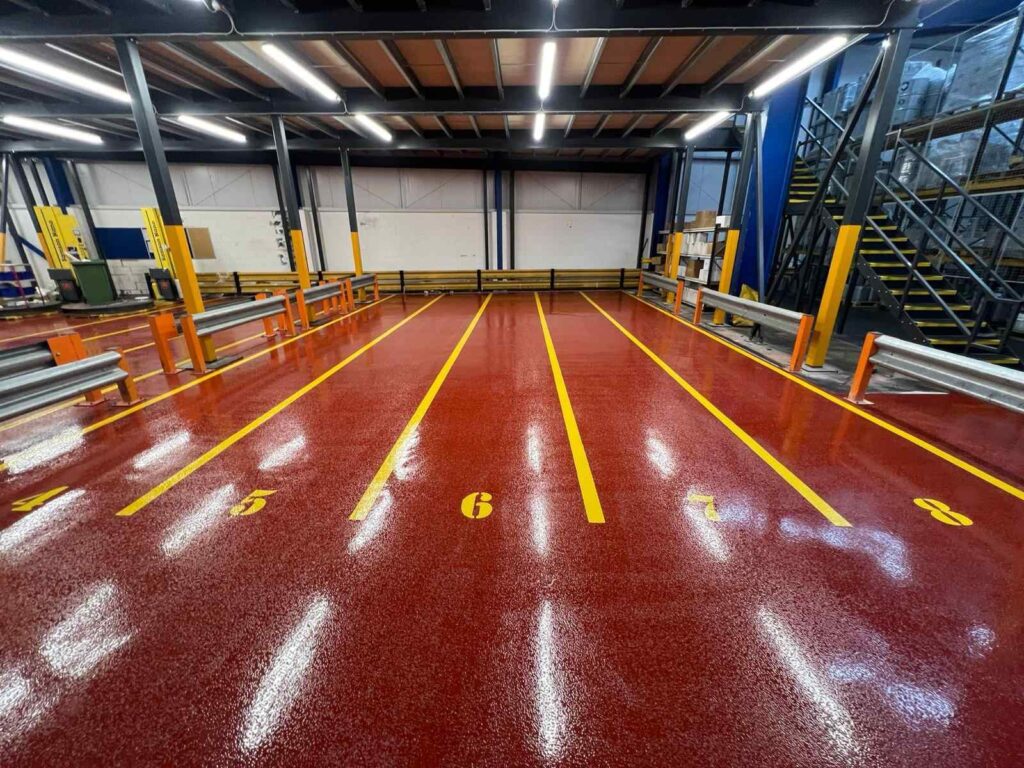
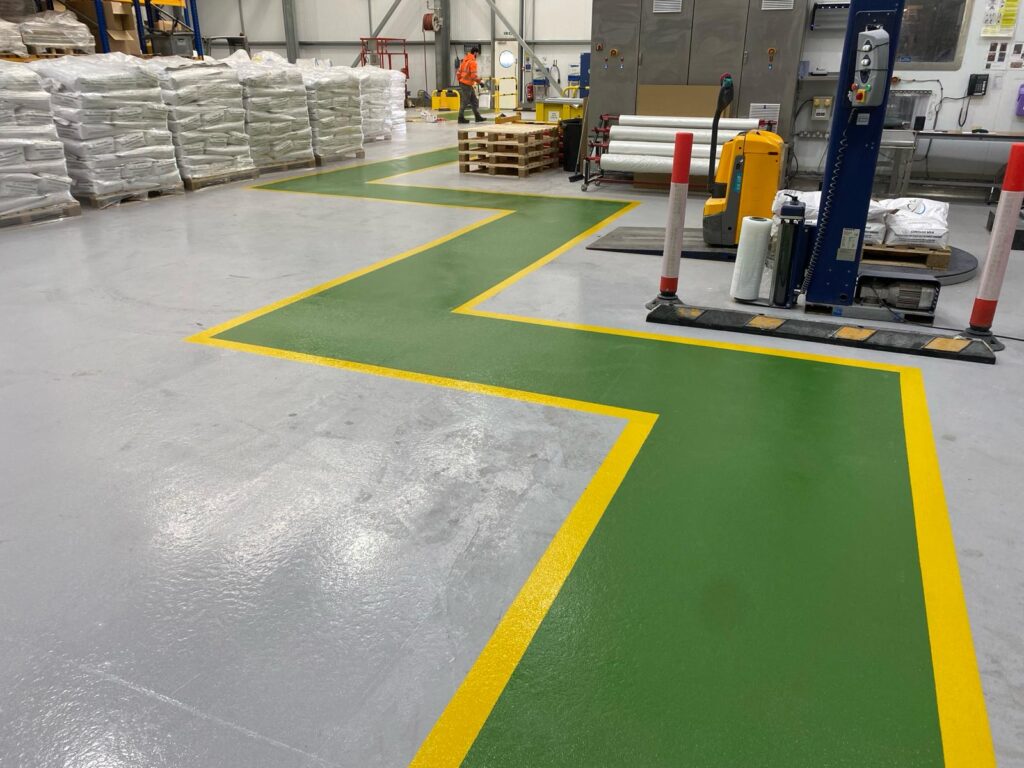
Safety features carry their own material and application cost. Marking pedestrian routes, forklift lanes and hazardous zones calls for high-visibility lining bonded into the resin body. Anti-slip aggregate broadcasts and electrostatic discharge additives change the base material price. Both are specified against the operational risk, not the budget.
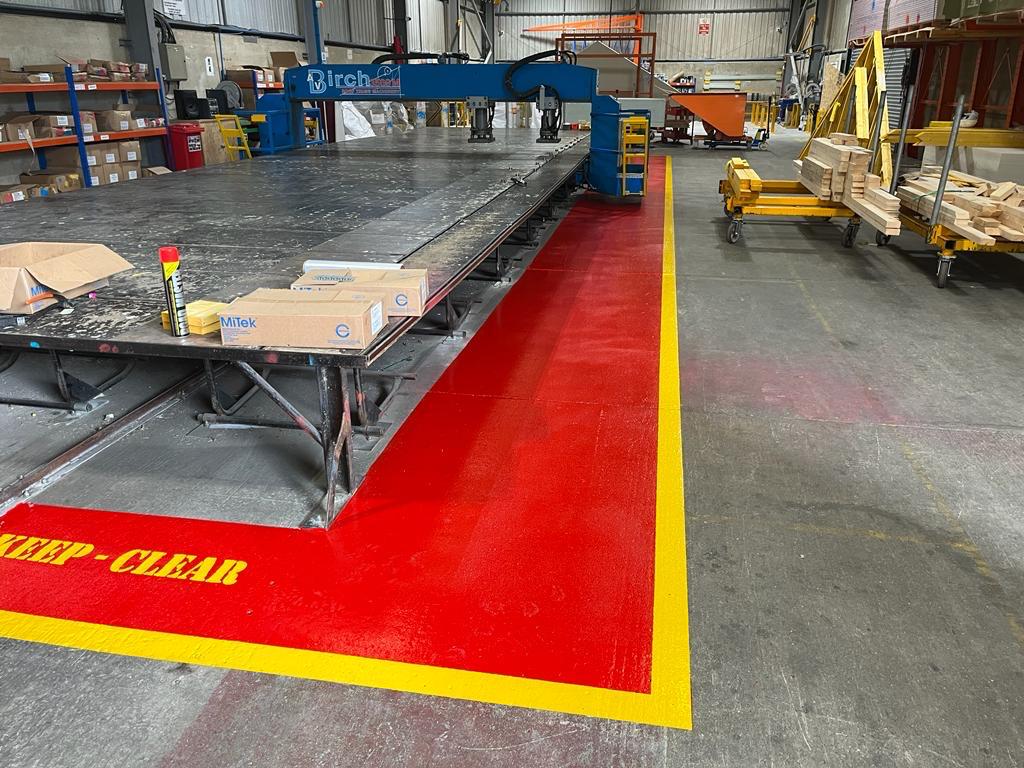
The Workplace (Health, Safety and Welfare) Regulations 1992 require traffic routes to be clearly demarcated. Resin line markings bond chemically into the floor and outlast painted tape under forklift tyres. Anti-slip profiles use graded aluminium oxide or quartz broadcast, and coarser profiles deliver low slip potential under BS 7976 pendulum testing. Electrostatic dissipative systems use conductive carbon fibres and copper grounding tape tested to EN 1081.
Case Studies
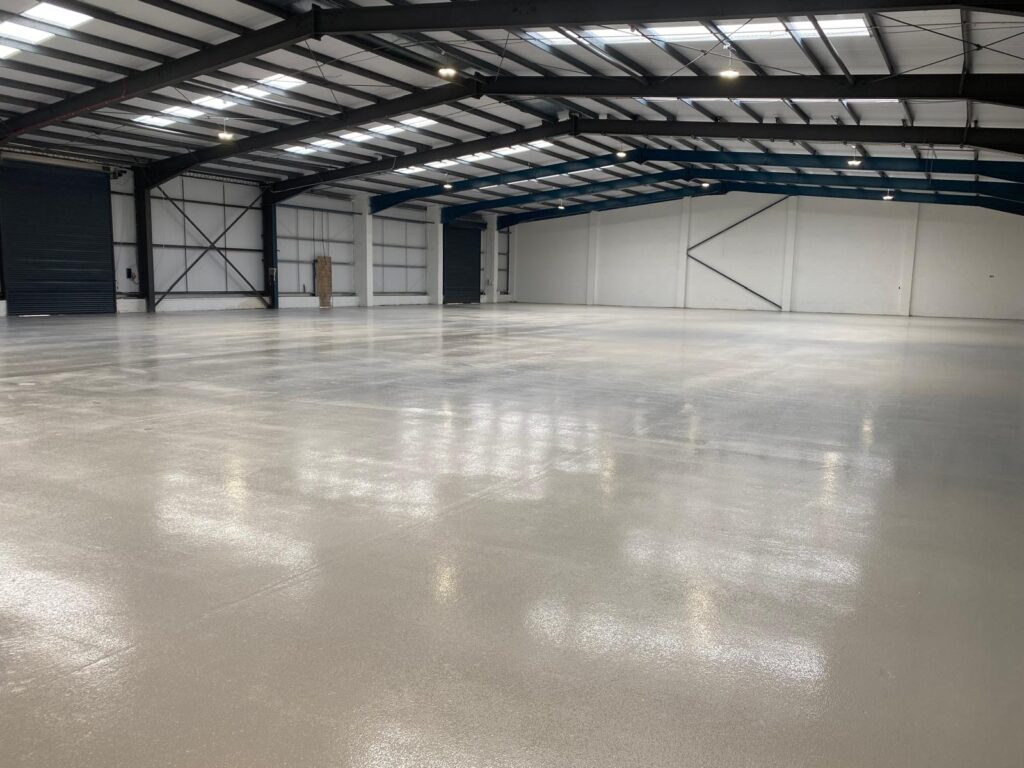
Our case studies cover – Printing & Packaging, Warehousing & Logistics, Pharma & Healthcare, Automotive & Engineering, Aviation & Aerospace, Food & Drink, Printing & Packaging, Warehousing & Logistics, Pharma & Healthcare
Downtime Economics and System Selection
Production Shutdown Costs Versus Fast-Curing Chemistries
Downtime frequently costs more than the flooring itself. Standard epoxy and polyurethane systems need up to forty-eight hours before foot traffic, and several days for full chemical cure. When a production line has to stop, paying the premium for rapid-cure chemistry is usually the sound commercial decision rather than the extravagant one.
Consider a working timber processing plant or a distribution hub. Three lost days can cost tens of thousands of pounds in delayed orders and idle labour. Standard epoxy costs around £12 per square metre but cures slowly. A polyaspartic system costs around £38 per square metre. It takes foot traffic in roughly two hours and full chemical resistance within twenty-four.
Temperature-Dependent Curing and Cold-Store Programmes
Ambient and substrate temperature govern curing kinetics, and they constrain system choice in unheated or refrigerated space. Standard epoxy turns brittle below five degrees Celsius and stops curing correctly. Polyaspartic systems cure down to minus five degrees. Methyl methacrylate installs in sub-zero conditions without breaking the cold chain.
Most commercial cold rooms and chill lobbies run between minus 3°C and minus 5°C. Defrosting an operational freezer to lay an epoxy floor burns energy and risks stock spoilage. Polyaspartic allows direct application inside a live chiller at minus 5°C. MMA cures at sub-zero temperatures within two hours per coat, though its vapour odour demands forced extraction on occupied sites.
“JD Flooring did an excellent job installing a resin floor in our food production facility. The floor is durable, hygienic, and meets all safety regulations. The team was knowledgeable and professional, and the project was completed within the agreed-upon timeframe. I highly recommend JD Flooring for food industry flooring needs.”
Alex Martinez
Value Engineering and Specification Pitfalls
Removing Overspecification Without Losing Durability
Value engineering matches the floor to the actual operational duty. Specifying a thick polyurethane screed across dry, light-duty storage wastes capital. Match the build-up to real traffic loads, chemical exposure and thermal cycling instead. The result satisfies the performance criteria without inflating the budget beyond what the operation genuinely requires.
A distribution warehouse with foot traffic and occasional pallet trucks does not need an 8 mm heavy-duty screed. A FeRFA Type 3 high-build epoxy delivers dustproofing, cleanability and tyre resistance for a fraction of the cost. Zoning helps. Specify heavy-duty flowables in intensive loading docks and thin-film coatings across low-traffic storage bays.
Spotting Unrealistic Quotations and Omitted Preparation
A tender with an exceptionally low headline price has almost always cut preparation or film thickness. Acid etching and quick scouring cannot replicate the key produced by enclosed diamond grinding. When comparing proposals, verify the stated FeRFA classification, the preparation method, the primer specification and the total nominal dry film thickness.
An industrial resin quote below £8 per square metre signals technical compromise. Low bids routinely skip moisture profiling, patch repairs and joint treatment. Some dilute resin solids with cheap solvent, which invites premature wear and hot-tyre delamination. A robust specification itemises grinding, crack stitching, primer type, build coats and topcoats in plain terms.
Whole-Life Cost and Asset Longevity
Maintenance Regimes and Surface Protection Cycles
Routine maintenance preserves the resin surface and prevents topcoat erosion in busy corridors. Sweeping grit away stops mechanical scoring beneath hard wheels. Neutral detergents protect the slip rating. Scheduled inspections and timely seal-coat renewal can extend service life towards twenty years, which cuts the effective annual capital charge sharply.
A neglected floor often needs full resurfacing within five to seven years. Accumulated grit behaves like a grinding paste under forklift wheels and abrades the sacrificial topcoat. Rotary scrubber-dryers with pH-neutral detergent are the sensible regime. Re-applying a clear seal coat every few years restores gloss and protection before wear reaches the body coat.
Long-Term Amortisation Versus Cyclic Concrete Repairs
Judged on whole-life cost, resin compares favourably with cyclic concrete patching or repainting. Unprotected concrete dusts continuously, cracks along unarmoured joints and degrades under chemical attack. That means repeated local repairs. A correctly specified bonded resin floor removes the patching cycle and protects handling equipment from damage.
Bare concrete sheds respirable crystalline silica dust under abrasion, which risks compliance notices and contaminates stock. Single-pack floor paint peels within months under counterbalance forklift turns. A professional FeRFA Type 3 to Type 8 floor amortises across fifteen to twenty years of service. Total cost of ownership falls well below continuous emergency maintenance.
Final Thoughts
Specifying an industrial floor means weighing immediate budget against long-term performance. The true resin flooring cost sits behind the square-metre rate, in substrate condition, preparation method, build thickness and site access. A cheap installation becomes an expensive one the moment omitted preparation produces delamination, blistering or early surface breakdown under load.
Early site survey, moisture testing and honest traffic assessment protect the value of the specification. Align mechanical demand, chemical exposure and curing window with the right FeRFA classification. Do that and the floor delivers decades of low-maintenance service.
Arrange a Free Site Survey
If you are thinking about upgrading the flooring in your commercial or industrial space then we would love to hear from you. Our team of experts will conduct a free onsite survey and then guide you through the process of product selection and project planning, whilst remaining mindful of your budgetary restraints.
Frequently Asked Questions
A:
Industrial resin floors typically run from £8 to £45 per square metre. Thin-film seals and high-build coatings cost £8 to £12 for standard warehousing. Medium-duty self-smoothing systems cost £20 to £30. Heavy-duty polyurethane screeds suited to food processing and chemical exposure cost £30 to £40. Fast-curing polyaspartic and MMA systems cost £38 to £45. All figures are indicative and depend on substrate condition.
A:
Mechanical surface preparation is the largest hidden variable in resin flooring quotations. Unrealistically low bids often omit enclosed diamond grinding or captive shot blasting. They rely on sweeping or acid washing instead. Without proper profiling to remove laitance and open the concrete pores, the coating cannot achieve a permanent bond. A legitimate quotation itemises preparation, crack repairs, joint treatment, moisture barrier primers and total dry film thickness.
A:
Substrate condition sets the preparatory labour and remedial materials needed before resin goes down. Sound concrete needs only standard diamond grinding and priming. Damaged slabs with deep oil contamination, extensive cracking, spalled joints or uneven levels need degreasers, resin mortar repairs and levelling screeds. Slabs reading above 75% relative humidity also need a surface damp proof membrane to prevent osmotic blistering, which adds to the upfront cost.
A:
Often, yes, despite the higher material rate per square metre. Standard epoxy and polyurethane systems need forty-eight hours before pedestrian traffic and several days for full chemical cure, which halts operations. Polyaspartic systems take foot traffic in roughly two hours and reach full service within twenty-four. For manufacturing plants, cold storage hubs and busy distribution centres, the operational output saved easily offsets the material premium.
A:
A correctly specified and professionally installed industrial resin floor lasts fifteen to twenty years or more when maintained. Lifespan depends on matching the FeRFA classification to the traffic levels, chemical exposures and thermal cycles at the site. Routine housekeeping with pH-neutral detergent removes the abrasive grit that causes premature wear. A fresh seal coat every few years restores wear resistance and avoids full-depth replacement.
