Which Resin Floor Do I Need? A Selection Guide
Specifying a commercial or industrial floor finish means matching mechanical demands against downtime and budget. Facility managers regularly ask which resin floor do I need when faced with dusting concrete, erosion or heavy forklift traffic. The answer rests on exposure conditions, not decorative preference. Resin formulations range from thin topical sealers to heavy trowel-applied screeds. Correct chemistry and thickness deliver longevity, regulatory compliance and dependable performance.
An unsuitable formulation leads to bond failure, blistering, joint arris damage or rapid surface erosion. Industrial sites face distinct chemical, mechanical and thermal pressures across different working zones. Are your operational areas exposed to thermal washdown, chemical spillage, constant abrasion or tight shutdown windows?
Key Takeaways
- Operational exposure to mechanical impact, thermal shock and chemical spillage dictates resin chemistry, system thickness and the required FeRFA specification category.
- Thin epoxy coatings suit dry warehousing and light assembly, whilst heavy processing areas require seamless polyurethane screeds between 6 mm and 9 mm.
- Fast-curing polyaspartic and methyl methacrylate chemistries cut commercial downtime by returning busy industrial spaces to full service within hours.
- Substrate preparation via captive shot blasting or diamond grinding ensures mechanical keying, preventing adhesion failure, debonding and early delamination.
- Site surveys assessing concrete relative humidity prevent osmotic blistering by identifying when a specialist liquid damp-proof membrane becomes essential.
Which Resin Floor Do I Need? System Selection Overview
This summary sets out the main synthetic resin categories classified under FeRFA standards, alongside two specialist chemistries. Build thickness governs operational lifespan and resilience under mechanical impact. Published thickness benchmarks and indicative square-metre rates give project planners a realistic budget range. Detailed substrate surveys then refine that figure before specification is fixed.
Each formulation answers a specific physical stress profile. Demands range from light pedestrian footfall through to intense thermal cycling and point loading from steel wheels. Assessing these parameters establishes the correct specification band for your facility. In practice, we find that this step alone prevents most premature failures. The chosen polymer matrix then performs reliably under genuine site conditions.
| System Category | FeRFA Type | Build Thickness | Indicative Cost per m² | Typical Return to Foot Traffic |
|---|---|---|---|---|
| Resin Floor Seal | Type 1 | Up to 150 microns | From £8 | 24–48 hours |
| High Build Coating | Type 3 | Up to 1000 microns | £8 – £12 | 24–48 hours |
| Multi-Layer System | Type 4 | 1 – 3 mm | £12 – £16 | 24–48 hours |
| Self-Smoothing Floor | Type 5 | 2 – 4 mm | £20 – £30 | 24–48 hours |
| Heavy Duty Flowable | Type 7 | 4 – 6 mm | £25 – £35 | 24–48 hours |
| Polyurethane Screed | Type 8 | 6 – 9 mm | £30 – £40 | 24–48 hours |
| Polyaspartic Flooring | Specialist | Two coats | £38 | 2 hours; full cure 24 hours |

Resin System Selection Guide for Heavy Mechanical Loading
Forklift Aisles and Point Loads
Heavy materials handling equipment exerts severe point loading on floor surfaces. Hard polyurethane and composite wheels drive high compressive stress into the top layers. A heavy-duty flowable resin or screed spreads that load across the prepared substrate. This prevents arris breakdown, wheel ruts and localised surface crushing.
Thin coatings below 1 mm erode quickly under continuous pallet truck traffic. Repeated forklift turning movements accelerate that wear. In high-density warehouses, multi-layer Type 4 systems or Type 7 flowable resins supply the tensile strength and abrasion resistance required. Racking baseplates concentrate extreme point loading, so the specification must accommodate those stresses. Graded specifications let facilities reinforce heavily trafficked aisles without overspending on low-use storage bays.
Impact Resistance from Dropped Tools and Goods
Dropped tools, steel cages and heavy pallet drops cause brittle finishes to shatter or chip. Thicker resin screeds absorb that mechanical energy through a resilient matrix. The underlying concrete substrate stays protected from structural fracture. Polyurethane screeds deliver exceptional impact tolerance because of their inherent structural flexibility.
Epoxy coatings offer high compressive strength, making them rigid and hard-wearing under rolling abrasion. That rigidity can fracture under severe direct impact. Polyurethane systems combine compressive capability with slight elasticity, dissipating shock across a broader footprint. For heavy engineering and maintenance workshops, systems between 4 mm and 6 mm prevent fractures. Those fractures expose bare concrete to subsequent fluid ingress.
Thermal Shock and Wet Washdown Environments
Thermal Cycling from Steam and Boiling Water
Steam cleaning and boiling washdown water cause rapid thermal expansion within floor finishes. Rigid epoxies expand at roughly four to five times the rate of concrete, which breaks the adhesive bond. Heavy-duty polyurethane screeds tolerate repeated thermal shock across an operating window of minus 40°C to plus 120°C.
Boiling water striking a cold surface creates immense shear stress along the substrate interface. Heavy-duty polyurethane screeds at 6 mm to 9 mm flex with that movement, removing the delamination risk. Dairies, breweries and commercial kitchens running daily clean-in-place cycles depend on this tolerance. Standard epoxy specified in a washdown zone cracks and debonds within weeks.
Drainage Falls and Coving Integration
Standing water creates serious biological contamination hazards and raises slip risk across wet production halls. Polyurethane screeds allow contractors to form positive falls towards stainless drainage channels. Integral coved skirting removes the 90-degree wall junction. The result is an unbroken, cleanable transition that satisfies environmental health standards.
Regulation (EC) 852/2004 requires food premises to provide cleanable, non-absorbent surfaces with adequate drainage. Falls formed between 1:80 and 1:100 directly in the resin screed prevent stagnant puddling. Seamless coving ensures wash water drains away without penetrating behind perimeter walls. From experience across the sector, this detailing turns a production floor into a sealed hygienic vessel. It then withstands aggressive daily sanitation regimes.
Did You Know?
Before any resin floor is laid, the concrete substrate must test at or below 75 percent relative humidity. The measurement follows BS 8203, Annex A, using a calibrated hygrometer. Surface tensile strength must also exceed 1.5 N/mm². Readings above that humidity threshold require a liquid applied damp-proof membrane.
Chemical Exposure and Bunded Containment Areas
Organic and Inorganic Chemical Attack
Different chemical compounds attack synthetic resin polymers through distinct mechanisms. Organic acids such as lactic, acetic and citric acid break down standard epoxy surfaces in food facilities. Polyurethane formulations resist organic compounds far better. Specialist epoxies handle inorganic acids and aggressive industrial solvents more effectively.
Chemical attack accelerates as liquid temperature rises, roughly doubling in reaction rate for every 10°C increase. Specifiers should produce a documented exposure schedule before selection. That schedule lists chemical types, concentrations, operating temperatures and maximum contact times before clean-up. Aerospace facilities handle Skydrol hydraulic fluid; automotive bays handle battery acid and brake fluids. The wrong resin matrix in either setting causes soft blistering and rapid dissolution.
Secondary Containment and Environmental Law
Secondary chemical containment bunds need seamless, impervious resin linings to protect local groundwater. The Control of Pollution (Oil Storage) (England) Regulations 2001 set the capacity rule. A bund must hold 110 percent of the largest container it serves. Verified chemical-resistant linings prevent catastrophic breaches and the penalties that follow.
A bund that permits fluid migration breaches the Environmental Permitting (England and Wales) Regulations 2016. Crown Courts can impose unlimited fines and custodial sentences of up to five years for unpermitted water pollution. Resin linings must bridge construction joints and seal around pipe penetrations. Chemical-grade systems guarantee structural impermeability. Leaks stay contained until staff complete remedial disposal.

Need a Resin Flooring Site Visit and Quote?
Rapid Turnaround and Temperature Constraints
Overnight Retail and Commercial Fit-Outs
Commercial premises rarely accommodate multi-day closures for floor installation without heavy revenue loss. Polyaspartic coatings cure rapidly through atmospheric humidity and accept light foot traffic in roughly two hours. That speed enables complete overnight refurbishment. Retail stores, showrooms and leisure venues trade normally the following morning.
A standard epoxy installation needs 24 to 48 hours before foot traffic is permissible. Full chemical cure can take up to five days. Fast-curing polyaspartic coatings compress that schedule into a single shift. Two coats deliver durable wear resistance, light stability and an attractive finish. At £38 per m² the material costs more, though avoided downtime usually offsets the premium.
Cold Storage and Freezer Installation
Refurbishing an operational cold store without breaking the cold chain presents real technical difficulty. Standard epoxy turns brittle and fails to cure below 5°C. Polyaspartic resin cures reliably down to minus 5°C. Methyl methacrylate systems install at sub-zero temperatures without expensive facility defrosting, which protects the stored product.
Methyl methacrylate cures through an exothermic free-radical reaction initiated by a peroxide catalyst. Full chemical strength arrives within two to three hours. Specifiers must manage its pungent odour carefully. MMA vapours taint unprotected food stock, so facilities must clear and ventilate the space during application. Polyaspartic systems give a low-odour alternative for cold rooms between minus 3°C and minus 5°C.
Case Studies
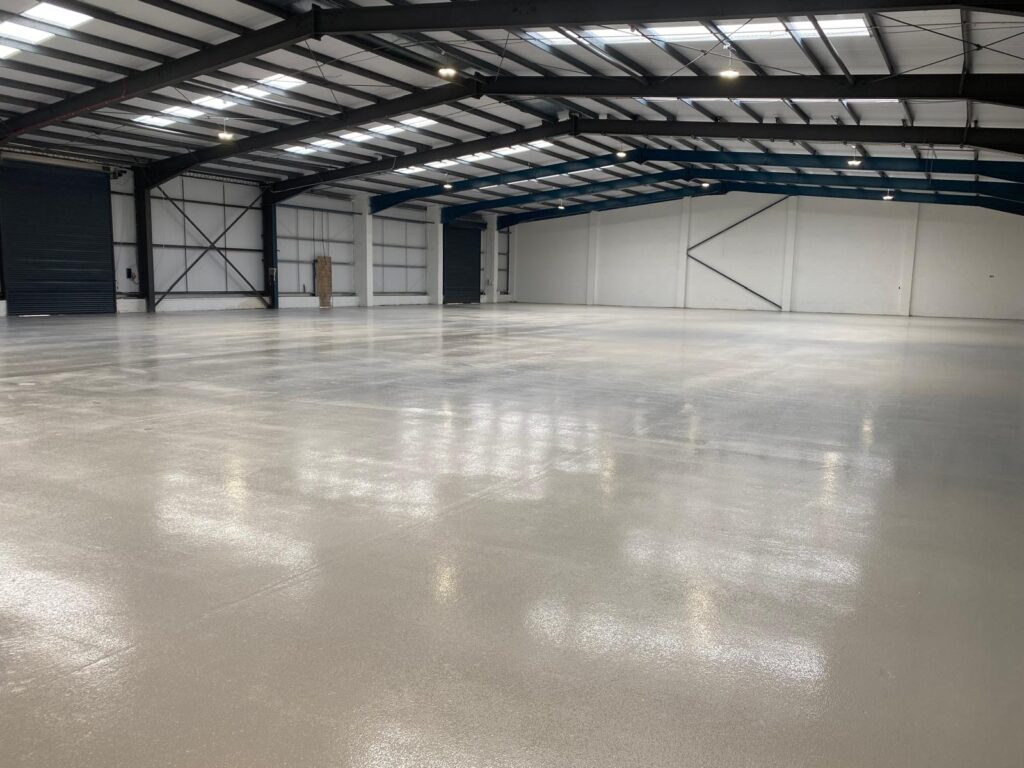
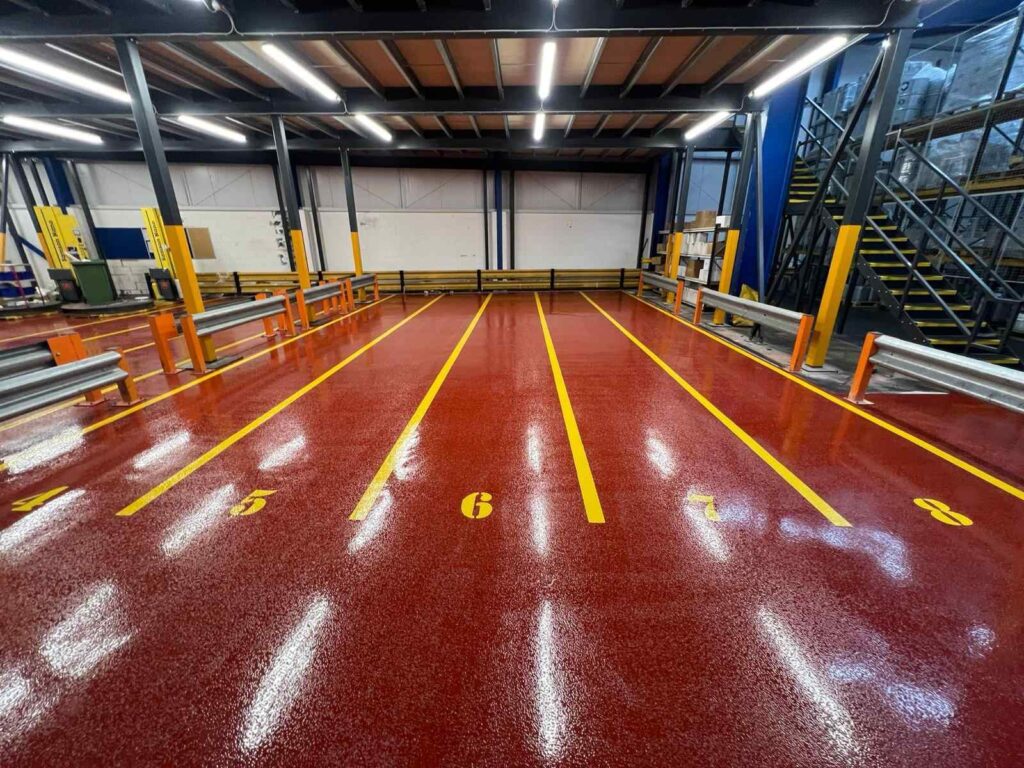
Our case studies cover – Printing & Packaging, Warehousing & Logistics, Pharma & Healthcare, Automotive & Engineering, Aviation & Aerospace, Food & Drink, Printing & Packaging, Warehousing & Logistics, Pharma & Healthcare
Hygiene Compliance and Cleanroom Requirements
Seamless Finishes in Regulated Facilities
Pharmaceutical facilities and cleanrooms demand ultra-smooth surfaces that resist particulate retention and microbial growth. Self-smoothing FeRFA Type 5 epoxy and polyurethane systems flow across the substrate to create a dense, non-porous finish. That unbroken profile meets the surface cleanliness expectations set out in the revised GMP Annex 1.
Cleanroom environments classified under ISO 14644-1 need surfaces that neither generate nor harbour airborne particulates. Grout lines, open saw-cut joints and porous surfaces are critical contamination risks that fail audits. Flow-applied resin systems between 2 mm and 4 mm deliver uniform flatness. They also resist vaporised hydrogen peroxide, alcohols and chlorinated sanitisers without surface clouding.
Dust Control and Respirable Silica
Untreated concrete sheds microscopic abrasive dust under pedestrian and vehicular traffic. That dust contains respirable crystalline silica. The International Agency for Research on Cancer classifies it as a Group 1 human carcinogen. Applying a resin floor seal binds the concrete surface permanently and controls the hazard at source.
Under the Control of Substances Hazardous to Health Regulations 2002, employers must control exposure to respirable crystalline silica. The workplace exposure limit sits at 0.1 mg per cubic metre as an eight-hour time-weighted average under EH40. Beyond the pulmonary risk, airborne silica abrades conveyor bearings and fouls sensitive electronic contacts. It also contaminates sterile primary packaging. Seamless resin finishes stop that particulate generation entirely.
“JD Flooring did an excellent job installing a resin floor in our food production facility. The floor is durable, hygienic, and meets all safety regulations. The team was knowledgeable and professional, and the project was completed within the agreed-upon timeframe. I highly recommend JD Flooring for food industry flooring needs.”
Alex Martinez
Static Control and Explosive Atmospheres
Dissipative Flooring for Electronics Assembly
Static charges generated by walking personnel can destroy delicate microelectronics or corrupt sensitive server hardware. Dissipative resin flooring incorporates conductive carbon fibres or metallic elements that bleed charge safely to earth. The system maintains resistance to ground below one gigaohm, the threshold set under BS EN 61340-5-1.
In electronics manufacturing, static damage often stays undetected until products reach consumers. Expensive warranty claims follow. An effective static-control floor works alongside dissipative footwear and verified grounding points. Conductive resin alone is insufficient; installers must embed a copper grid connected directly to earth. Carbon additives also limit colour selection to darker industrial tones.
Zoned Explosive Environments Under DSEAR
Facilities handling flammable solvents, fine powders or explosive gases face electrostatic sparks as a genuine ignition source. The Dangerous Substances and Explosive Atmospheres Regulations 2002 require operators to eliminate static ignition risk in designated zones. Highly conductive resin floors limit electrical resistance and dissipate charge before dangerous potential accumulates.
Chemical refineries, paint plants and industrial bakeries handling combustible flour dust need strict electrical continuity. Resistance readings in these zones are specified between 10 kilohms and 1 megohm under EN 1081. Specifying the wrong system carries severe consequences. An electrical switchroom requires insulating resin above 50 kilohms to protect operators. That is the exact opposite of an explosive zone requirement.
Calculate The True Cost
A three day shutdown at a plant turning over £2,000 an hour is £120,000 of lost output. On most sites that is several times the cost of the new resin floor installation. We have developed our own free custom calculator top help you calculate the true cost and a new resin floor.
Slip Prevention and Operational Demands
Pendulum Test Values and Wet Traction
Slips and trips account for 30 percent of reported non-fatal workplace injuries across Great Britain. That carries an immense operational cost. The Health and Safety Executive identifies the pendulum test to BS 7976 as the definitive verification method. Broadcast aggregate within a resin coating lifts wet surfaces to a Pendulum Test Value of 36 or above.
Regulation 12 of the Workplace (Health, Safety and Welfare) Regulations 1992 applies directly here. Floors must be suitable for purpose and free from slippery surfaces. A Pendulum Test Value of 36 equates to a slip probability of roughly one in a million. A contaminated floor reading 24 sits in the high slip potential band, at around one in twenty. Duty holders then face regulatory prosecution and civil compensation claims.
Slip Traction Against Cleanability
Coarse surface textures give excellent mechanical grip in contaminated wet environments. They also present significant cleaning challenges. Fine anti-slip aggregate cleans easily with standard scrubber-dryers but offers less traction under heavy oil spills. Balanced trade-offs let the floor satisfy safety duties without creating an impossible maintenance burden.
Anti-slip profiles packed with compacted dirt, grease or food waste lose surface traction entirely. Facilities must match cleaning equipment, brush types and neutral detergents to the installed aggregate profile. An overly aggressive profile in a food preparation area invites bacterial accumulation. A glass-smooth floor in an oily automotive workshop produces slip injuries. In practice, we specify the profile and the cleaning regime together.
Final Thoughts
Answering which resin floor do I need means balancing operating loads, chemical contact, thermal stress and downtime against budget. Thin floor seals and high-build coatings give cost-effective dustproofing for warehousing, from £8 to £12 per m². Food factories, chemical plants and heavy engineering sites need polyurethane screeds between £30 and £40 per m². The correct FeRFA type prevents early adhesive failure and costly disruption.
A successful installation depends on meticulous mechanical preparation, verified moisture testing and a tailored resin formulation. Rather than applying one specification across an entire site, forward-thinking facilities grade the specification by zone. That approach optimises expenditure without compromising the demanding areas. Assessing environmental conditions thoroughly keeps the installed floor safe, hygienic and resilient throughout its service life.
Arrange a Free Site Survey
If you are thinking about upgrading the flooring in your commercial or industrial space then we would love to hear from you. Our team of experts will conduct a free onsite survey and then guide you through the process of product selection and project planning, whilst remaining mindful of your budgetary restraints.
Frequently Asked Questions
A:
Four operational drivers decide the answer. Assess mechanical loading from vehicles and pedestrians. Assess chemical and thermal exposure. Check slip-resistance requirements and the available curing window. Light storage bays perform well with cost-effective high-build epoxy coatings. Wet food processing, thermal washdown zones and chemical containment rooms need 6 mm to 9 mm polyurethane screeds. An on-site survey then confirms substrate moisture, concrete strength and environmental conditions before the specification is fixed.
A:
Thickness, mechanical flexibility and thermal resistance define the difference. Epoxy coatings are applied in micron thicknesses up to 1000 microns. They create a rigid, hard-wearing surface suited to dry industrial traffic. Polyurethane screeds are applied between 6 mm and 9 mm. They offer high impact tolerance and thermal resistance from minus 40°C to plus 120°C. Polyurethane also withstands aggressive steam cleaning and organic acids that break down conventional epoxy.
A:
Concrete finishing brings a weak layer of cement fines, known as laitance, to the surface. Resin applied over laitance or smooth power-floated concrete delaminates early because it cannot form a mechanical key. Captive shot blasting or diamond grinding removes laitance, opens the concrete pores and levels local irregularities. Preparation also allows accurate moisture testing before installation. In practice, mechanical profiling governs most of the long-term adhesion performance of a resin floor.
A:
Yes, in most cases. Fast-curing polyaspartic or methyl methacrylate chemistries minimise operational downtime. Polyaspartic coatings accept pedestrian traffic in roughly two hours and cure fully within 24 hours. That allows overnight or weekend installation. Projects can also be phased zone by zone, isolating active production aisles from the working area. Night shifts are a further option, preserving picking, manufacturing and dispatch operations during normal working hours.
A:
Workplace regulations require floors to be suitable for purpose and free from slip hazards. Matching a resin system to a process area ensures wet or contaminated zones receive aggregate profiles reaching a Pendulum Test Value of 36 or above. Chemical-resistant, non-porous formulations also prevent concrete degradation, potholing and dangerous unevenness. Together these measures support compliance with the Workplace (Health, Safety and Welfare) Regulations 1992.
