
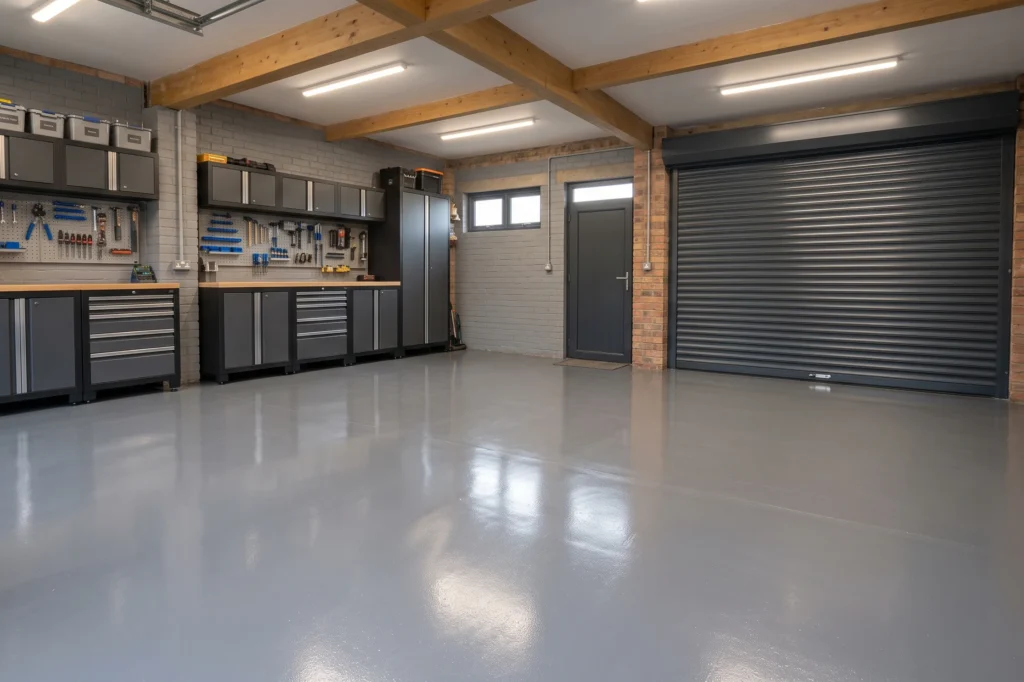
How Much Does an Epoxy Resin Garage Floor Cost?
A realistic resin garage floor cost sits well above a tin of paint from a DIY shed. Domestic garage slabs take vehicle weight, chemical leaks, road salt and constant foot traffic. A professional epoxy or aggregate finish seals that porous concrete against moisture and abrasion. Knowing the price drivers lets you budget accurately and avoid surprise charges.
Homeowners want to know what separates a plain solid colour finish from a decorative flake or quartz system. How does the condition of your existing slab change the figure, and which preparation stages must a defensible quote always include?
Key Takeaways
- Solid high-build epoxy starts at £1,500 for a single garage and £1,800 for a double, subject to survey.
- Substrate condition drives the price, because damaged or oil-soaked concrete needs heavy diamond grinding and resin mortar repairs.
- Decorative PVC Flake and quartz aggregate systems start from £2,550 for a single garage on sound concrete.
- A defensible quote lists diamond grinding, HEPA extraction, crack repair, penetrating primer, basecoat and protective seal coats.
- Book an on-site survey so the installer can confirm slab relative humidity before issuing a firm figure.
Garage Resin Flooring Pricing Matrix
Resin installation prices move with two variables. The first is floor area. The second is system chemistry. A clear breakdown helps you sense-check baseline figures before you commission a site survey. Standard installations use high-build epoxy coatings. Decorative specifications add colour-blended vinyl flakes or graded quartz granules on top of that same base build.
The figures below reflect professional UK installation rates for standard garage layouts. Each price already includes mechanical surface preparation, specialist primer, a durable body coat and a chemical-resistant clear sealer. All figures stay indicative. Site access, slab moisture and the extent of remediation shift the final number, which is why a survey precedes any binding quotation.
| Garage Size | System Specification | Good Condition | Average Condition | Poor Condition |
|---|---|---|---|---|
| Single Garage | Solid High-Build Epoxy | £1,500 | £1,650 | £1,800 |
| Double Garage | Solid High-Build Epoxy | £1,800 | £1,950 | £2,100 |
| Treble Garage | Solid High-Build Epoxy | £2,100 | £2,250 | £2,400 |
| Single Garage | Decorative PVC Flake | £2,550 | £2,700 | £2,950 |
| Double Garage | Decorative PVC Flake | £2,900 | £3,200 | £3,450 |
| Treble Garage | Decorative PVC Flake / Quartz | £3,550 | £3,700 | £3,950 |

Garage Size and System Specifications
Single and Double Garage Pricing
Single garage epoxy installations start from £1,500 on sound concrete. Standard double garages begin at £1,800. Both figures cover high-build solid epoxy, which resists vehicular fluids and hot tyres. Larger footprints return a lower cost per square metre, because transport and site setup are fixed overheads spread across more floor area.
A typical single garage spans roughly 14 to 18 square metres. A double bay usually covers 28 to 36 square metres. Mobilising a crew, delivering grinding plant and transporting resin are fixed costs. Extra area therefore adds material spend without doubling labour. Solid epoxy gives a hard-wearing, uniform finish in industrial shades such as Steel, Slate and Graphite. Slip-resistant aggregate can be broadcast into the topcoat where traction matters.
Treble Garages and Extended Footprints
Treble garage installations begin at £2,100 for solid epoxy on sound concrete. Extended domestic workshops and triple vehicle bays need more material and tighter application control. The upfront figure is larger, yet the cost per square metre falls. The finished floor also runs seamlessly across all three adjoining bays.
Knowing what a single, double or treble garage floor costs lets owners budget with confidence. Triple garages usually measure between 42 and 55 square metres. Areas of that size demand careful batch mixing and coordinated roller work. In practice, we divide the slab into manageable panels during basecoat application to avoid visible wet edges. High-build epoxy across three bays creates an impervious, dust-free surface. It also brightens the interior by reflecting overhead lighting.
Substrate Condition and Preparation Requirements
Good and Average Concrete Conditions
Concrete in good condition needs one diamond grinding pass and light cleaning before priming. Average slabs show minor cracks, slight unevenness or isolated oil staining. That grade adds roughly £150 to the project. Remediation involves targeted mechanical grinding plus localised resin repairs to restore a sound, bondable surface profile.
Contractors grade the slab during the initial inspection. A sound base shows negligible dusting, no standing water and few surface defects. Average concrete often carries hairline settlement cracking around construction joints. Installers chase out those fractures with diamond cutting discs. They then vacuum the debris and fill the void with rapid-curing epoxy mortar. Oil patches need specialist degreasing followed by aggressive abrading, otherwise residual hydrocarbons weaken the resin bond.
Poor Substrates and Heavy Remediation
Slabs graded poor show extensive structural cracking, deep oil saturation or failed historic coatings. Remediation lifts the installed cost to £1,800 for a single garage and £2,100 for a double. Installers run multiple aggressive grinding passes and carry out structural repairs before any primer reaches the concrete surface.
Resin follows the contours of the base beneath it. It is not a structural self-leveller for sunken or badly falling slabs. Where previous owners applied DIY floor paint, every trace must be mechanically removed. Deteriorated latex or acrylic layers form a weak shear plane and trigger delamination if coated over. Severely spalled concrete needs re-profiling with high-strength epoxy screed mortar. Proper preparation lets the system bond into open concrete pores rather than loose laitance.
Did You Know?
The HSE workplace exposure limit for respirable crystalline silica is 0.1 mg/m³, averaged over eight hours, under COSHH and EH40. Dry cutting or grinding a concrete garage slab can exceed that limit within minutes, which is why on-tool HEPA extraction is a legal control measure rather than an optional extra.
Decorative System Finishes and Formulations
PVC Flake Showroom Systems
Decorative PVC Flake flooring begins at £2,550 for a single garage and £2,900 for a double. The specification broadcasts coloured polyvinyl chloride chips into a pigmented basecoat, then seals them under clear resin. The lightly textured result conceals minor slab imperfections, masks everyday dust and delivers a showroom appearance.
The chips are durable polyvinyl chloride, correctly called PVC Flake rather than PVA. Installers broadcast to full rejection, so the wet coloured basecoat disappears entirely. Once cured, technicians sweep and vacuum the excess, then scrape the floor to an even texture. One or two coats of clear UV-stable polyurethane or polyaspartic resin lock the matrix in place. Popular blends include Arctic Grey, Granite, Onyx and Storm Grey. Each gives a slip-resistant, easily cleaned surface.
Coloured Quartz Aggregate Installations
Quartz aggregate flooring carries the same pricing as flake, starting at £2,550 for a single garage. Coloured quartz granules broadcast into wet resin produce a natural stone texture with stronger mechanical traction. The build suits home workshops, vehicle detailing bays and any space exposed to heavy tooling or standing water.
Quartz systems use graded ceramic-coated silica granules instead of vinyl chips. The mineral composition delivers high compressive strength and impact tolerance. When a heavy tool or vehicle component drops, the dense quartz layer absorbs the shock without chipping. Clear seal coats encapsulate the granules and preserve their colour, whilst leaving a cleanable texture underfoot. Owners who want maximum grip in wet bays generally choose quartz over smoother solid epoxy.

Need a Resin Flooring Site Visit and Quote?
Professional Installation Stages and Inclusions
Mechanical Preparation and Dust Extraction
A defensible garage quote always includes mechanical preparation with industrial diamond grinding plant. Planetary grinders strip concrete laitance and open the capillaries within the slab. That profile is what gives the resin its mechanical key. On-tool HEPA vacuum units capture dust at source and keep the working environment safe.
Acid etching is not a substitute for diamond grinding. Acid washing pushes moisture into the slab, shifts surface pH unpredictably and leaves stubborn contaminants in place. Professional contractors use rotary heads fitted with diamond-embedded segments. Coupling those machines to HEPA-filtered vacuums stops respirable crystalline silica migrating into adjacent living space. From experience across the sector, that containment also delivers the clean, dry surface a penetrating primer needs.
Layer Build-Up and Sealing Chemistry
A standard quotation covers high-penetration epoxy primer, a high-build pigmented body coat and a resilient topcoat. Primers soak into the slab and prevent pinholing and outgassing during cure. The body coat supplies structural thickness and impact resistance. UV-stable clear sealers then protect the surface from chemical spills and tyre softening.
Durability tracks dry film thickness directly. Economy paint deposits a film under 100 microns. Professional high-build systems achieve 300 to 1,000 microns or more. The penetrating primer seals micro-pores and removes the air bubbles that leave craters in a finish coat. The high-build basecoat carries the colour and the chemical resistance. The topcoat then handles engine oil, battery acid, brake fluid and winter road salt.
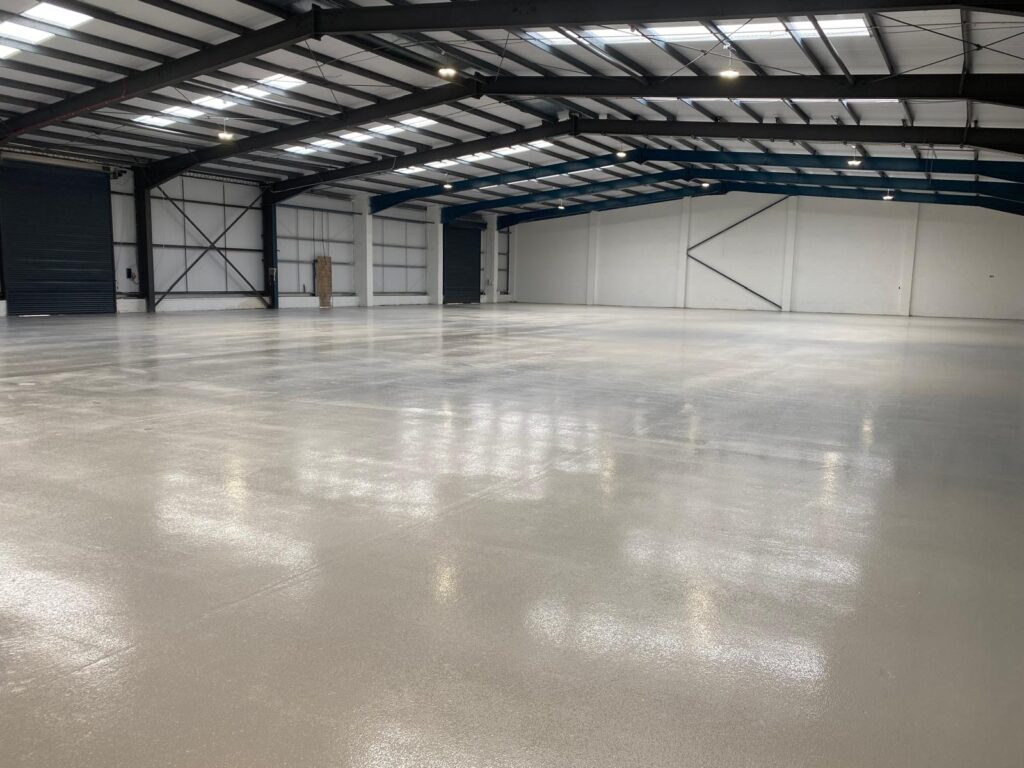
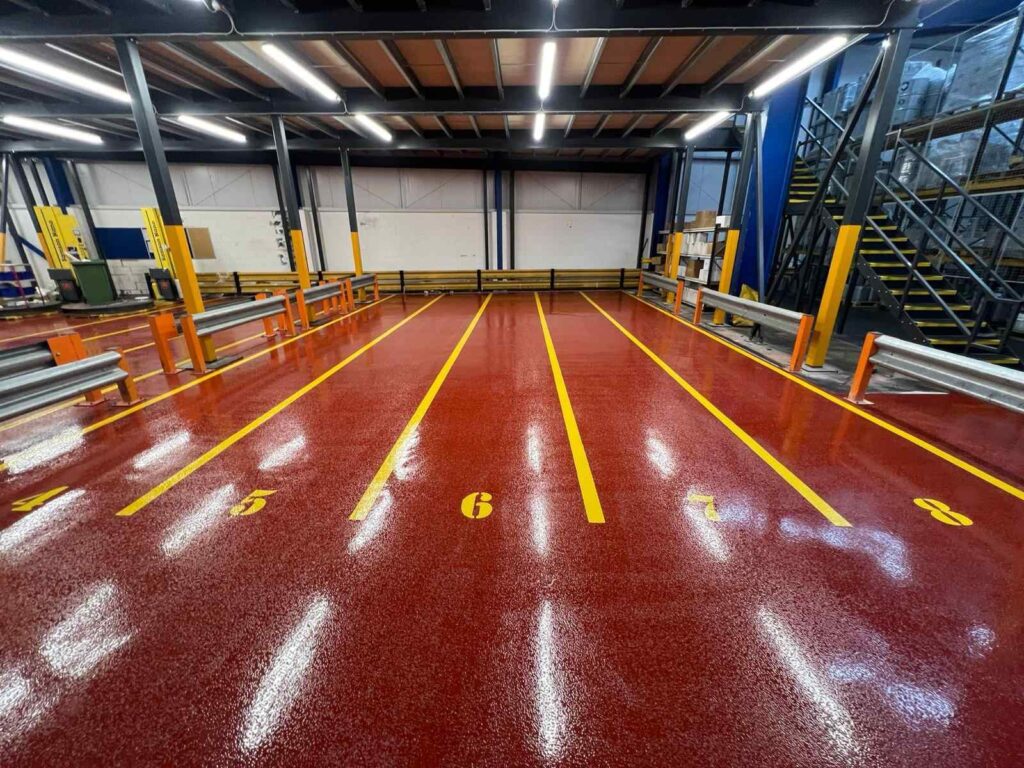
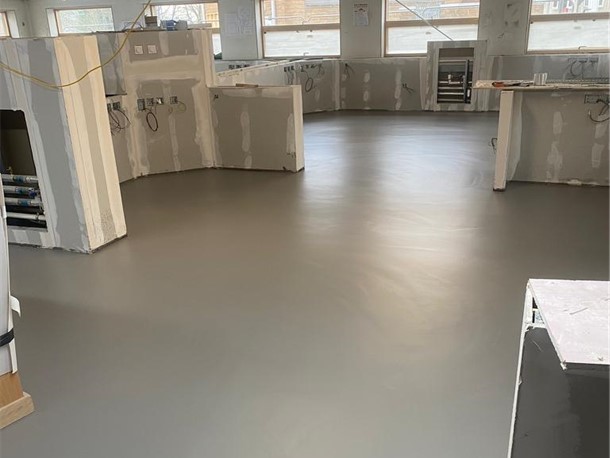
Case Studies
Our case studies cover – Printing & Packaging, Warehousing & Logistics, Pharma & Healthcare, Automotive & Engineering, Aviation & Aerospace, Food & Drink, Printing & Packaging, Warehousing & Logistics, Pharma & Healthcare
Key Variables Influencing Quotations
Moisture Management and Liquid Membranes
Slab moisture is the hidden variable that moves a quotation most. Standard epoxy formulations need relative humidity below 75% to avoid osmotic blistering. Where hygrometer testing shows elevated readings or rising damp, the installer applies a two-coat liquid epoxy damp-proof membrane before the decorative system goes down.
Older domestic garages frequently lack a working damp-proof membrane beneath the slab. Capillary action then draws groundwater upward. Cover damp concrete with an impermeable resin film and vapour pressure builds underneath it. Over a few seasons that pressure produces fluid-filled blisters and widespread delamination. A liquid epoxy membrane suppresses residual moisture up to 98% relative humidity. It secures the bond, but it adds material and labour to the baseline figure.
Access Constraints and Structural Detailing
Site access and perimeter detailing feed straight into the labour allowance. Narrow driveways, limited power supply and awkward threshold terminations all force manual edging with hand tools. Perimeter coving, step risers and drainage gully surrounds need careful hand trowelling. That craft time appears in the quotation as labour rather than material.
The transition between garage interior and driveway needs planning. Terminating the coating neatly along the door weather-seal line means diamond-cutting a keyway into the slab. Movement joints must also be respected. Filling an active expansion joint with rigid epoxy causes reflective cracking as the building moves. Installers instead clean and prime the joint edges, then fit a flexible polysulphide sealant that absorbs thermal movement without tearing.
“JD Flooring did an excellent job installing a resin floor in our food production facility. The floor is durable, hygienic, and meets all safety regulations. The team was knowledgeable and professional, and the project was completed within the agreed-upon timeframe. I highly recommend JD Flooring for food industry flooring needs.”
Alex Martinez
Professional Systems Versus DIY Floor Paint
Durability and Hot Tyre Pickup
Budget DIY garage floor paint often fails through hot tyre pickup within months. Tyres hold heat from road friction, which softens thin water-based films and pulls them off poorly prepared concrete. Professional high-build epoxy bonds into a mechanically ground slab instead, so the adhesion failure mode disappears entirely.
Hot tyre pickup is the classic failure of single-pack retail paint. Synthetic rubber contains plasticisers that leach out at elevated temperature. Park a warm car on an unsealed retail coating and heat transfers into the film. As the tyres cool they contract and grip the softened paint. Reversing off then tears the coating away from the concrete. Cross-linked industrial epoxy resists both thermal load and plasticiser migration.
Whole Lifecycle Costing and Longevity
Professional resin returns better long-term value than repeated paint applications. A domestic epoxy floor delivers an expected service life of 10 to 20 years with routine cleaning. Spread the installed figure across two decades and the annual cost falls well below the running total of repeated DIY attempts.
Retail paint kits demand a recurring maintenance cycle. Owners must empty the garage, scrub the slab and recoat every twelve to eighteen months as tyre tracks wear through. Replacement paint, cleaners and lost weekends soon exceed one professional installation. Flaking paint also has to be stripped mechanically before any later system will adhere. A properly installed resin floor is a permanent asset that improves how the property presents.
Reliable Quotations and Next Steps
Pre-Installation Surveys and Moisture Testing
A reliable contractor surveys the garage before issuing a binding quotation. The specialist scratch-tests concrete hardness, measures slab relative humidity with a precision hygrometer and inspects the cracking pattern. That groundwork confirms the proposed resin chemistry suits actual site conditions and heads off costly adhesion failures later.
A reputable quotation sets out the process in plain detail. It names the preparation method, the system specification, the total applied film thickness and any joint repairs. A quote that omits preparation technique or primer stages signals corners cut on site. Ask whether technicians hold recognised training, such as ISOPA or ALIPA certification for polyurethane handling. Mixing ratios and cure conditions matter as much as the product itself.
Fast Direct Enquiry Channels
You can speed up a consultation by sending clear photographs of the floor by message or phone. Images of existing cracks, expansion joints and threshold transitions let an estimator grade substrate condition quickly. After that remote assessment, the installer books a site survey to confirm measurements and agree a start date.
Regional contractors work defined geographic areas rather than nationwide networks. Installers based across Cheshire, Greater Manchester, Lancashire, Merseyside, Yorkshire and the Midlands respond to local surveys quickly. Send room dimensions alongside photographs of current defects and an estimator can return an indicative range within hours. The in-person survey then confirms moisture readings and slab soundness before the quotation is formalised.
Final Thoughts
An accurate resin garage floor cost balances three things: floor area, chosen finish chemistry and the remediation the slab actually needs. Single garage solid epoxy begins at £1,500 on sound concrete. Decorative PVC Flake and quartz systems cost more and return better slip resistance and appearance. Cutting preparation or ignoring moisture invites delamination and hot tyre pickup.
Grade your concrete honestly and insist on mechanical diamond grinding. Read any quotation for its preparation stages, primer layer and protective clear topcoat before you compare headline figures. A survey with moisture testing turns a dusty slab into a floor that still looks right in fifteen years.
Arrange a Free Site Survey
If you are thinking about upgrading the flooring in your commercial or industrial space then we would love to hear from you. Our team of experts will conduct a free onsite survey and then guide you through the process of product selection and project planning, whilst remaining mindful of your budgetary restraints.
Frequently Asked Questions
A:
A double garage in professional high-build solid epoxy starts at £1,800 where the concrete is in good condition. If the slab needs moderate repair for cracks or staining, the indicative figure rises to £1,950. A decorative PVC Flake or quartz aggregate system costs from £2,900 on sound concrete, rising to £3,450 on poor substrates. Every figure remains indicative until an on-site survey confirms moisture and structural condition.
A:
Substrate condition dictates how much preparation and remediation the floor needs before any resin is applied. Sound concrete takes a single diamond grinding pass and light cleaning. A slab with structural cracks, spalling, deep oil saturation or peeling historic paint needs multi-pass grinding and epoxy mortar repair. That work is what allows the primer to form a permanent bond. Skimp on it and the floor delaminates, so remediation is never an optional line item.
A:
PVC Flake broadcasts coloured vinyl chips across a wet basecoat, giving a lightly textured showroom floor that hides imperfections and everyday dirt. Quartz broadcasts ceramic-coated silica aggregate instead, producing a stone-like texture with slightly higher slip resistance. Both carry identical pricing at every garage size, starting at £2,550 for a single garage in good condition. The choice comes down to whether you want a smoother look or maximum grip when the floor is wet.
A:
No, provided the floor is a professional high-build epoxy or polyaspartic system laid on a properly prepared slab. Hot tyre lifting is a failure mode of thin DIY paint and inadequate preparation. Diamond grinding opens the concrete pores so penetrating primer and cross-linked basecoat can key into the substrate. The resulting bond withstands hot rubber, road salt and automotive fluids without blistering or tearing away from the concrete.
A:
Very little, because the surface is non-porous. Sweep or vacuum weekly to lift loose grit, then mop with warm water and a mild pH-neutral detergent. Avoid abrasive pads and aggressive acidic or solvent cleaners, which dull the gloss or satin clear coat. Wipe automotive fluid spills promptly to prevent staining. Maintained that way, a professional resin garage floor delivers a service life of 10 to 20 years.
