

Hospital Flooring and Healthcare Resin Flooring
Hospital flooring carries a heavier burden than almost any other surface in the built environment. Wards and corridors absorb round-the-clock footfall, wheeled bed traffic, and daily chemical washdowns. Jointed coverings fail first at the seams, creating harbourage points that infection control teams cannot clean out. Correctly specified resin systems remove those joints entirely. They hold their integrity under heavy point loads across theatres, corridors, and treatment rooms.
Clinical estates must protect patient safety and statutory compliance whilst keeping beds open. Estates managers rarely get the luxury of an empty ward to work in. So how do you install a durable, seamless finish without closing the ward it sits in?
Key Takeaways
- Seamless, non-porous resin surfaces remove joints and grout lines, so clinical teams can sanitise floors with aggressive hospital-grade disinfectants.
- FeRFA Type 5 self-smoothing systems suit wards and corridors, whilst Type 8 polyurethane screeds handle steam cleaning and thermal shock.
- Pendulum testing to BS 7976 confirms low slip potential, with a minimum wet Pendulum Test Value of 36 in clinical areas.
- Integral coved skirting removes the ninety-degree wall junction, giving cleaning teams a continuous, watertight perimeter that resists moisture ingress.
- Fast-cure polyaspartic coatings reopen corridors within hours, so phased overnight works avoid ward closures and costly patient decanting programmes.
Resin Flooring Systems Used Across Hospital Departments
Resin specification in a hospital changes department by department. Traffic intensity, cleaning chemistry, and the available installation window all pull the choice in different directions. A ward needs a flat, quiet surface. A central kitchen needs a screed that survives boiling water. One system rarely covers an entire clinical estate honestly.
The table below sets out the FeRFA classifications most often used across NHS trust estates and private hospitals. It lists nominal cured thickness, typical clinical application, and the operational benefit each build-up delivers. Every system listed depends on mechanical preparation of the concrete substrate. Without that preparation, adhesion fails and the floor debonds early.
| FeRFA System | Nominal Thickness | Primary Clinical Application | Key Operational Benefit |
|---|---|---|---|
| Type 5 Self-Smoothing | 2 mm to 4 mm | Wards, treatment rooms, clean corridors | Seamless, non-porous, smooth for wheeled castors |
| Type 7 Heavy Duty Flowable | 4 mm to 6 mm | A&E receptions, heavy logistics corridors | High impact resistance and aggregate traction |
| Type 8 Heavy Duty Screed | 6 mm to 9 mm | Hospital kitchens, autoclave suites, plant rooms | Withstands steam cleaning and −40°C to +120°C extremes |
| Polyaspartic Coating | Two thin coats | Live ward circulation routes, pharmacy refits | Rapid two-hour return to foot traffic |

Infection Control and Seamless Healthcare Resin Flooring
Seamless detailing and biological barrier performance
Hygienic resin floors cure into one continuous plane. The finish bonds to the concrete and leaves no welded seam, grout line, or lap joint for fluids to enter. That single detail removes the micro-crevices where pathogens survive routine cleaning. It is the main reason clinical estates specify resin over jointed coverings.
In practice, we find vinyl seams are the first element to fail under heavy wheeled traffic. Lifted edges form microbial pockets that a surface wipe-down cannot reach. A liquid-applied finish seals every square metre into one impermeable plane. That continuity supports the cleanliness standards the Care Quality Commission expects of registered providers. It also gives infection prevention teams a surface they can audit with confidence.
Vertical coving and cleanable perimeter detailing
Integral coved skirting carries the floor finish up the wall in one continuous radius. Installers pull the cove from the same resin matrix used across the floor. This removes the ninety-degree junction at the wall line. Dust, fluids, and organic matter collect in that junction on every jointed floor.
Radius upstands seal around partition walls, columns, and fixed equipment plinths. Cleaning teams can wet-vacuum the perimeter without water seeping behind a baseboard. The result is a watertight tray rather than a floor with edges. That detail protects the wall fabric during aggressive scrubbing regimes. It also removes a recurring source of remedial work.
FeRFA Build-Ups for Clinical Applications
FeRFA Type 5 self-smoothing systems for clean zones
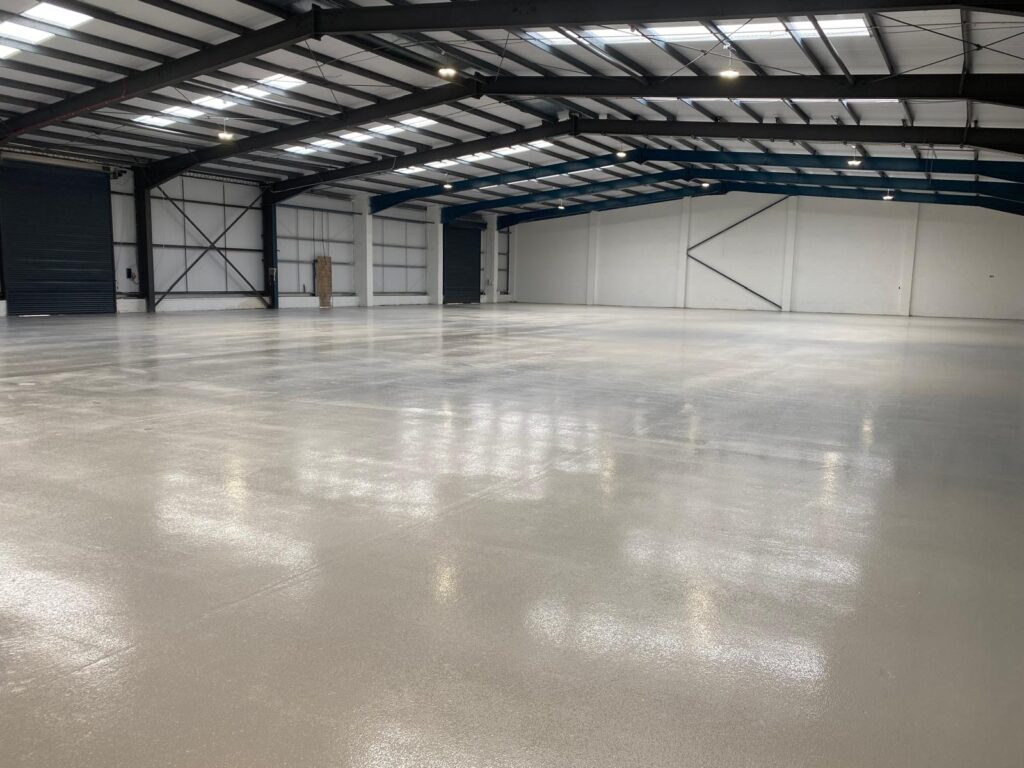
FeRFA Type 5 self-smoothing systems give a flat, uniform finish at 2 mm to 4 mm. The flowable resin levels itself across the prepared substrate. Wards, treatment rooms, clinical laboratories, and pharmacy cleanrooms all suit this build-up. The cured surface takes daily machine scrubbing without breaking down.
A level surface lowers rolling resistance for beds, medicine trolleys, and diagnostic equipment. Porters notice the difference within a single shift. The cured finish sheds no fibres or loose particulates, which protects air quality in controlled environments. Automated scrubber-dryers clean it in one pass.
FeRFA Type 7 and Type 8 heavy-duty screeds
Central sterile services departments, plant rooms, and hospital kitchens need far more build. FeRFA Type 7 heavy-duty flowable systems and Type 8 trowel-applied polyurethane screeds cover these zones. Installed from 4 mm up to 9 mm, they absorb pallet truck loads, constant trolley impact, and thermal shock.
Polyurethane screeds tolerate steam cleaning and scalding wash water from −40°C up to +120°C. The resin expands and contracts at a rate close to the concrete beneath it. That compatibility stops the bond shearing during rapid thermal cycling. Installers should always check the safety data sheet before handling any two-part resin. COSHH duties apply to the product as supplied, not to the cured floor.
Corridor Dynamics and Castor Wheel Durability
Circulation corridors and continuous rolling loads
Corridors are the logistics arteries of a hospital. They take thousands of passes each day from beds, bariatric stretchers, trolleys, and delivery tugs. Resilient sheet materials often indent, scuff, or debond under concentrated castor loads. Every ripple or lifted edge then slows portering and catches a wheel.
A rigid resin matrix bonded to a mechanically keyed substrate spreads point loads without deforming. That dimensional stability holds for years rather than months. Porters move patients without fighting wheel drag at floor transitions. Heavy traffic lanes can also take a thicker build-up where wear patterns justify the cost.
Acoustic dampening and visual contrast zoning
Resin systems can incorporate flexible polyurethane membranes that reduce footfall impact noise. Quieter corridors benefit patients recovering in adjacent bays. The membrane dampens trolley rattle, dropped equipment, and the echo of night shift footsteps. Acoustic performance rarely drives the specification, yet it changes how a ward feels.
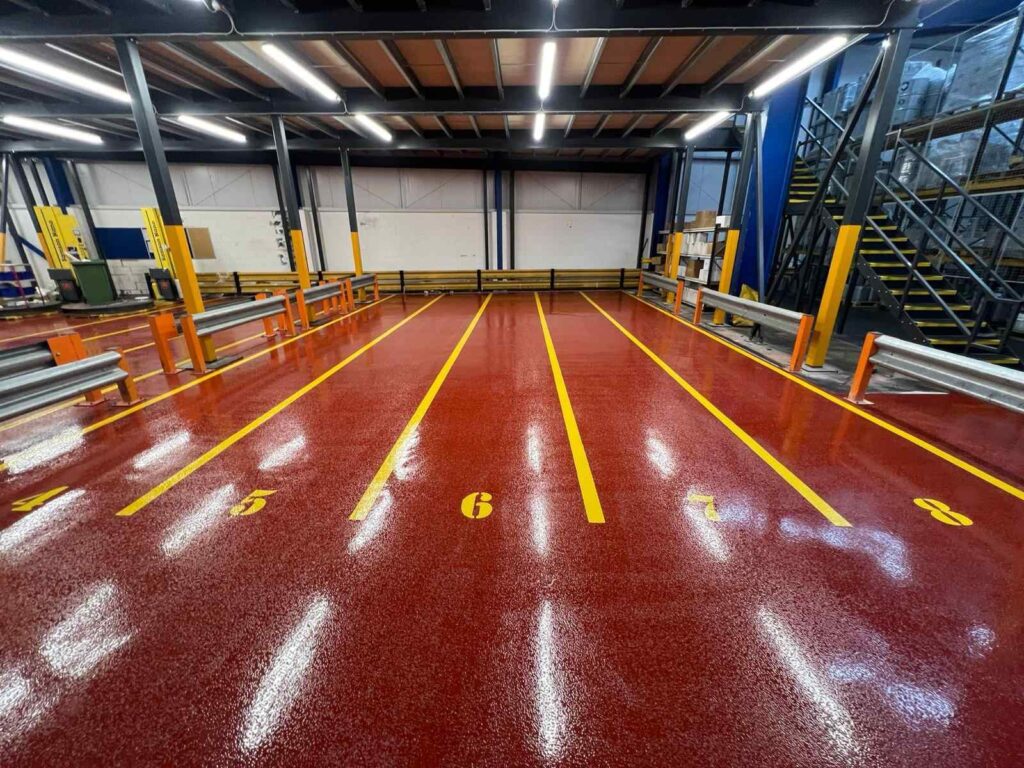
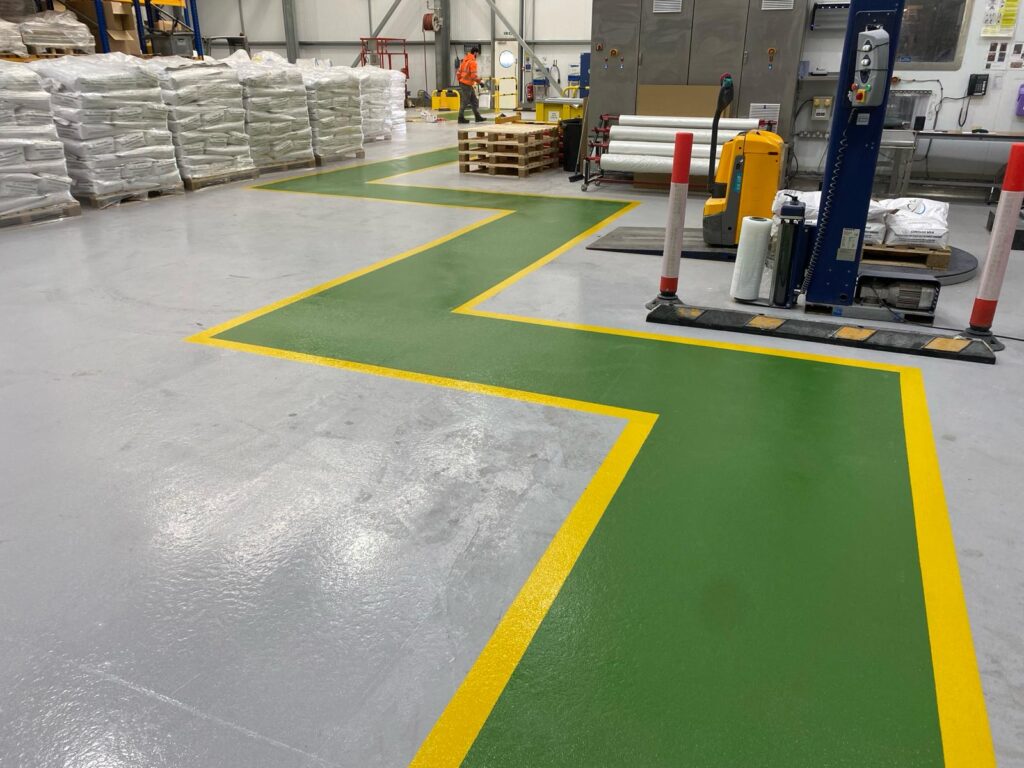
Resin also allows seamless colour demarcation without applied tape or inserts. Coloured bands mark departmental boundaries, crash trolley bays, and escape routes. BS 8300-2:2018 addresses visual contrast in the built environment. It recommends a difference of at least 30 points in light reflectance value between adjacent surfaces. That contrast supports wayfinding for people with sight loss.

Need a Resin Flooring Site Visit and Quote?
Slip Resistance in Wet Rooms and Clinical Washdowns
Pendulum test values in wet clinical environments
Sluice rooms, assisted showers, hydrotherapy suites, and catering areas carry the worst slip risk in a hospital. Water, bodily fluids, and soap residue all reduce available friction. Regulation 12 of the Workplace (Health, Safety and Welfare) Regulations 1992 requires floors not to be slippery. The duty sits with the employer.
Slip potential is measured with the pendulum tester to BS 7976. The test reproduces the heel strike of a walking person on a wet surface. A Pendulum Test Value of 36 or above indicates low slip potential. HSE data for 2024/25 puts slips, trips and falls on the same level at 30% of employer-reported non-fatal injuries.
Anti-slip texture versus surface cleanability
Anti-slip aggregate always trades grip against cleanability. Coarse aggregate delivers traction but traps mop fibres and organic soiling. A glass-smooth finish cleans easily and then fails staff during a washdown. The specification has to land between those two failures, department by department.
Installers broadcast calibrated quartz into the body coat and seal it with a chemical-resistant topcoat. The topcoat encapsulates each grain, giving an undulating but fully sealed profile. Mops and mechanical pads then release residues rather than snagging. From experience across the sector, grade selection matters more than aggregate volume.
Case Studies
Our case studies cover – Printing & Packaging, Warehousing & Logistics, Pharma & Healthcare, Automotive & Engineering, Aviation & Aerospace, Food & Drink, Printing & Packaging, Warehousing & Logistics, Pharma & Healthcare
Chemical Resistance Against Hospital Disinfectants
Disinfectant resistance in clinical cleaning
Hospital cleaning regimes use chlorine-releasing agents, hydrogen peroxide vapour, peracetic acid, and alcohol solutions. Concentrations are high and exposure is constant. Unprotected finishes fade, soften, or blister under repeated oxidising attack. The failure shows first as colour loss and then as a soft, chalky surface.
Healthcare resin flooring relies on densely cross-linked polymer matrices. Those matrices resist repeated disinfectant washdowns without degrading. A documented chemical exposure schedule should sit behind every specification. It lists the agents in use, their concentrations, and their contact times. An intact surface also stops corrosive agents reaching the concrete below.
Stain resistance against medical reagents
Pathology laboratories, theatres, and treatment bays handle iodine, staining reagents, and concentrated medical dyes. Porous floors and open grout lines absorb these fluids on contact. The discolouration is permanent and no cleaning regime reverses it. Audit teams read a stained floor as a cleanliness failure.
Dense polyurethane and epoxy topcoats stop liquid penetrating the surface. Spilt reagents sit on the finish until staff wipe them away. Prompt cleaning protocols protect both appearance and the resin itself. Long contact with strong solvents can soften even a well-specified topcoat.
“JD Flooring did an excellent job installing a resin floor in our food production facility. The floor is durable, hygienic, and meets all safety regulations. The team was knowledgeable and professional, and the project was completed within the agreed-upon timeframe. I highly recommend JD Flooring for food industry flooring needs.”
Alex Martinez
Phased Installation Around Live Clinical Wards
Zoned phasing around live clinical services
Refurbishment cannot interrupt acute care. Traditional installations carry long screed drying times and multi-day resin cures. Those programmes take beds offline for weeks at a time. Trusts then face lost capacity, cancelled lists, and patient decanting. The flooring itself is rarely the expensive part of that equation.
Live installations run in zones, isolated with temporary dust partitions and negative-pressure extraction. Off-peak and weekend shifts keep key circulation routes open. Estates teams, clinical leads, and the flooring contractor agree the sequence before anyone lifts a floor. In practice, the programme succeeds or fails on that communication.
Fast-cure polyaspartic chemistries for overnight work
Where downtime is the binding constraint, specifiers turn to fast-cure polyaspartic technology. These coatings cure quickly across a wide temperature band. Foot traffic returns in roughly two hours, with full mechanical cure inside twenty-four. That speed changes what is possible on a live clinical ward.
A contractor can grind, prime, and apply two coats overnight. Circulation routes reopen before the morning shift arrives. Bed decanting programmes disappear from the plan entirely. Polyaspartic coatings are aliphatic, so they hold colour near glazed entrances where ultraviolet light would yellow an epoxy.
Calculate The True Cost
A three day shutdown at a plant turning over £2,000 an hour is £120,000 of lost output. On most sites that is several times the cost of the new resin floor installation. We have developed our own free custom calculator top help you calculate the true cost and a new resin floor.
Substrate Preparation and Mechanical Profiling
Industrial diamond grinding and HEPA extraction
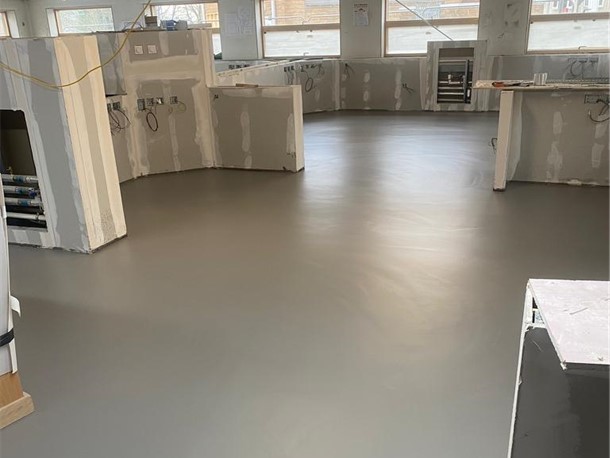
Every healthcare resin installation starts with mechanical preparation. Technicians remove laitance, failed coatings, curing compounds, and contaminants from the concrete. Diamond grinders connected to HEPA-filtered extraction open the surface pores. That open profile gives the primer something to key into. Skip it and the floor debonds within months.
Dust capture at source matters more in a hospital than anywhere else. Concrete dust contains respirable crystalline silica. The workplace exposure limit under EH40/2005 is 0.1 mg/m³ as an eight-hour time-weighted average. The International Agency for Research on Cancer classifies crystalline silica inhaled from occupational sources as a Group 1 carcinogen. On-tool extraction protects patients, clinical staff, and technicians alike.
Substrate moisture testing and liquid DPM barriers
Residual moisture in a slab drives osmotic blistering. The blisters break the resin bond and force early replacement of the floor. Technicians measure relative humidity with calibrated hygrometers before any primer goes down. Readings must fall within the product tolerance. Early detection gives estates teams time to plan a barrier.
Where humidity exceeds the resin system limit, contractors install a liquid damp proof membrane. This two-coat epoxy barrier suppresses residual construction moisture up to 98% relative humidity. The membrane adds a day to the programme and decades to the floor. On capital schemes, that trade is rarely a difficult conversation.
Final Thoughts
Hospital flooring has to clean well, grip when wet, and resist whatever the cleaning schedule brings. Polyurethane and epoxy systems deliver a continuous, impervious barrier that does all three. Seamless detailing and integral coved perimeters remove biological harbourage points for good.
Matching the FeRFA build-up to each department keeps the specification honest. Fast-cure polyaspartic options let trusts modernise ageing wards without closing them. Thorough mechanical profiling and proactive moisture suppression decide how long the floor lasts. Specified properly, a resin floor outlives several cycles of the equipment standing on it.
Arrange a Free Site Survey
If you are thinking about upgrading the flooring in your commercial or industrial space then we would love to hear from you. Our team of experts will conduct a free onsite survey and then guide you through the process of product selection and project planning, whilst remaining mindful of your budgetary restraints.
Frequently Asked Questions
A:
Corridors take constant footfall, hospital beds, and wheeled trolleys. Facilities teams usually specify FeRFA Type 5 self-smoothing resin systems or fast-cure polyaspartic coatings along these routes. Both give a seamless, level surface that lowers rolling resistance for castors. There are no grout lines or dirt traps to clean around. The finish tolerates repeated machine scrubbing. Contrasting resin colours can also be laid in as permanent wayfinding, marking departmental boundaries and escape routes without applied tape.
A:
Seamless resin systems remove the welded seams, joints, and perimeter gaps that collect organic matter and moisture. The resin is applied as a liquid and cures into one impermeable plane. There is no edge for bacteria to sit behind. Paired with integral coved skirting, the floor becomes a continuous tray rather than a surface with joints. That construction tolerates aggressive hospital disinfectants. Cleaning teams can sanitise it properly, which is what infection prevention policies actually require.
A:
Standard epoxy and polyurethane systems usually need 24 to 48 hours before foot traffic, and several days for full chemical cure. Fast-cure polyaspartic systems take foot traffic in around two hours. They reach full mechanical strength within twenty-four hours. That speed lets a contractor grind, prime, and coat a corridor overnight. The route reopens before the morning shift. Wards return to service without bed closures or patient decanting, which is why polyaspartic suits live estates.
A:
Regulation 12 of the Workplace (Health, Safety and Welfare) Regulations 1992 requires floors not to be slippery. No single rating is written into the law itself. In Great Britain, slip potential is assessed with the pendulum test to BS 7976. A Pendulum Test Value of 36 or above in wet conditions indicates low slip potential. In sluice rooms, wet rooms, and washdown bays, calibrated aggregate is broadcast into the resin to reach that threshold.
A:
Yes, provided the system matches the cleaning schedule. FeRFA Type 5 self-smoothing systems handle routine NHS disinfectants, including chlorine-releasing agents, alcohol rubs, and hydrogen peroxide vapour. Steam cleaning and boiling liquid spillage are a different matter. Those environments need thick-build FeRFA Type 8 polyurethane screeds. Their thermal expansion behaviour sits close to that of concrete, so the bond survives cycling from −40°C up to +120°C. Always confirm the specification against the chemicals actually in use.
