
Heavy Duty Polyurethane Resin Screed: Cost and Benefits
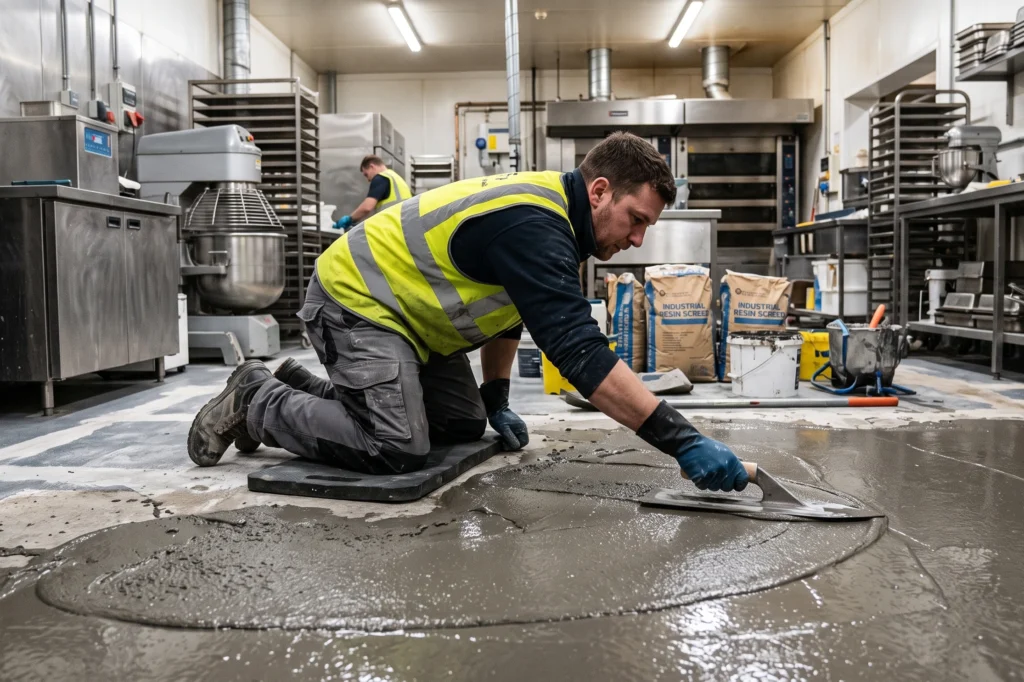
Industrial floors take punishment that ordinary finishes cannot survive. Abrasion, aggressive chemicals and violent temperature swings all attack the same surface. A heavy duty polyurethane resin screed answers all three at once. Classified under BS 8204-6 as FeRFA Type 8, it is a trowel-applied, heavily filled resin mortar. It bonds to the concrete and forms a seamless, impervious deck. Specifiers choose it to protect production, not simply to protect concrete.
Facilities managers must weigh technical performance against capital cost. Thin coatings look cheaper on day one. In practice, they rarely survive hot washdowns or concentrated organic acids. What makes a polyurethane screed the right specification, and what should you budget per square metre?
Key Takeaways
- Heavy duty polyurethane screeds hold their bond across roughly minus forty to plus one hundred and twenty degrees Celsius.
- Rigid epoxy debonds under hot washdowns, whilst flexible polyurethane moves with the concrete beneath it.
- Industrial resin flooring costs £8 to £45 per square metre, with heavy duty screeds at £30 to £40.
- Hygienic sites need coved upstands, engineered falls to drainage and a wet pendulum test value of 36 or above.
- Installers using resin containing 0.1 percent or more diisocyanates must hold current training, renewed at least every five years.
Industrial Resin Flooring Systems and Cost Comparison
Industrial resin flooring covers several distinct formulations. Each is engineered for a defined duty cycle, chemical exposure and mechanical load. FeRFA classifications set out system thickness and performance, from light dustproof seals through to heavily filled trowel-applied mortars. Matching the chemistry to the operating environment is what turns a capital budget into predictable service life.
The table below shows where a heavy duty screed sits within the wider market. Rates move with thickness, chemical performance and installation complexity. All figures are indicative professional rates. They allow for mechanical preparation, priming, materials and specialist labour. From experience across the sector, every project still needs a site survey before a firm price is issued.
| System Type | FeRFA Classification | Typical Thickness | Indicative Cost per m² |
|---|---|---|---|
| Resin Floor Seal | FeRFA Type 1 | Up to 150 µm | From £8 |
| High Build Resin Coating | FeRFA Type 3 | Up to 1000 µm | £8 – £12 |
| Self-Smoothing Resin Flooring | FeRFA Type 5 | 2 – 4 mm | £20 – £30 |
| Heavy Duty Flowable Resin | FeRFA Type 7 | 4 – 6 mm | £25 – £35 |
| Heavy Duty Polyurethane Screed | FeRFA Type 8 | 6 – 9 mm | £30 – £40 |
| Polyaspartic Fast-Cure Coating | Specialist Chemistry | 300 – 500 µm | £38 |
| Methyl Methacrylate (MMA) Screed | Specialist Chemistry | 2 – 6 mm | £45 |

Performance Characteristics of Polyurethane Screeds
Mechanical Durability and Compressive Strength
Heavy duty polyurethane screeds carry loads that thin coatings cannot. Graded silica aggregate sits within a reactive polyurethane binder. The cured mortar delivers high compressive strength and real impact tolerance. Dropped tools, laden pallet trucks and heavy stillages strike the surface without fracturing it. In practice, that toughness is the whole reason for the specification.
Thickness drives longevity more than any other factor. Thin-film coatings measure between 150 and 1000 microns. Heavy duty screeds install at 6mm to 9mm. That depth spreads point loads into the structural slab below. Steel-wheeled trolleys, counterbalance forklifts and dragged pallets strip standard floor paint within months. A fully cured FeRFA Type 8 screed keeps working for decades. The dense matrix resists gouging, spalling and aggregate pop-out under constant point loading.
Chemical Exposure Resistance
Processing floors meet reagents that destroy ordinary finishes within weeks. Polyurethane screeds resist concentrated organic acids, caustic wash solutions and many industrial solvents. Resistance is never absolute. Engineers must check concentration, contact time and cleaning temperature against the manufacturer’s data. When operating in this area, that exposure schedule decides the specification.
Chemical resistance is system-specific. No resin floor is immune to every industrial substance. Compile a full exposure schedule before finalising any specification. Polyurethane performs well against lactic, citric and acetic acids. Those acids penetrate and soften standard epoxies. Sites running clean-in-place regimes, hot sanitising alkalis or concentrated detergents rely on polyurethane to prevent matrix breakdown. FeRFA Types 1 to 3 lack the thickness for prolonged contact. Aggressive compounds leach through micro-pores, attack the bond line and corrode the concrete beneath.
Thermal Shock Performance and Mechanism
Temperature Resilience Under Extreme Cycling
A heavy duty polyurethane resin screed offers proven thermal shock resistance. It works from roughly minus forty to plus one hundred and twenty degrees Celsius. That range covers steam cleaning and boiling washdown in the same shift. The floor does not soften, blister or delaminate. In practice, few other finishes tolerate that treatment year after year.
Thickness dictates the temperature a screed will tolerate. A 6mm system handles hot process flushes and washdown cycles up to 80°C. Continuous boiling discharges or live steam lances at 100°C to 120°C demand a full 9mm application. The same screeds run continuously at minus 40°C without embrittlement. They also survive sudden swings when operators hose boiling water onto cold floors. Standard synthetic resin floors soften between 50°C and 80°C. Heavy duty polyurethane stays structurally stable through repeated shocks.
Thermal Expansion Differences Between Polyurethane and Epoxy
Standard epoxy fails under thermal cycling because the cured resin is rigid and brittle. Boiling water hitting cold epoxy generates severe shearing stress at the bond line. The resin cannot expand at the same rate as the concrete beneath. Delamination follows, usually in large sheets rather than small patches.
Concrete expands and contracts continuously under thermal swings. Standard epoxy has a coefficient of thermal expansion well above that of structural concrete. Sudden heating makes the rigid film try to expand fast. The cold slab restrains it. Shear stress then exceeds the tensile bond strength of the resin. The coating cracks, buckles and peels. Polyurethane screeds resolve this through inherent polymer flexibility. The formulation tracks concrete movement far more closely. The screed absorbs cyclic expansion and keeps its bond through years of thermal washing.
Did You Know?
The UK REACH restriction on diisocyanates took full effect on 24 August 2023. Any professional or industrial user handling a product containing 0.1 percent or more diisocyanates must hold completed training before use. Refresher training is required at least every five years.
Target Sectors and Specification Rationale
Food, Beverage and Dairy Processing Plants
Food manufacturing is an unforgiving environment for any floor. Hot effluent, aggressive cleaning chemicals and heavy machinery all converge on the same slab. Breweries, dairies and abattoirs add corrosive organic acids and relentless clean-in-place flushes. Polyurethane screeds give the seamless, impervious surface these sites need to hold food hygiene compliance.
Knowing where a polyurethane screed is specified and why comes down to mapping conditions against material limits. Dairies see constant spills of warm milk and whey. The lactic acid in both etches bare concrete and standard coatings. Breweries discharge boiling wort at 100°C across brewhouse floors, then rinse with caustic soda. Thin coatings blister and erode in those halls. Managers specify a 9mm FeRFA Type 8 screed to support HACCP compliance. The joint-free finish denies bacteria anywhere to harbour, shift after shift.
Commercial Kitchens and Cold Storage Environments
Kitchens and blast freezers push flooring to opposite thermal extremes. High-volume catering generates grease, boiling fat spills and nightly washdowns. Cold stores hold continuous sub-zero temperatures instead. Polyurethane screeds keep their elasticity down to minus forty degrees Celsius. That flexibility prevents the brittle fracture typical of rigid epoxy systems.
Commercial kitchens need flooring that survives constant foot traffic and hot fat deposits. Thinner coatings soften beneath fryers. They also peel where staff scrub with boiling water. Polyurethane screeds form a barrier that resists grease penetration and thermal degradation. In cold storage centres, standard epoxies turn brittle below 5°C and crack under reach-truck wheels. Polyurethane screeds stay durable in freezers running at minus 25°C. Transition zones at cold store doorways are harder still. Warm air meets freezing air and condensation forms. The screed handles that cycling without debonding.

Need a Resin Flooring Site Visit and Quote?
Installation Detailing for Hygienic Environments
Coved Skirting and Wall Junctions
Hygienic processing depends on perimeter detailing more than most specifiers expect. A right-angled junction between wall and floor traps soil that washing never fully removes. An integral resin cove replaces that corner with a smooth radius. Water and contaminants then drain away from the structure instead of collecting against it.
Installers form coves from a thixotropic polyurethane mortar, hand-trowelled to a 38mm or 50mm radius. The cove anchors into the concrete and rises 100mm to 150mm up the wall. It terminates into a rebated chase or sits behind hygienic wall cladding. That detail removes open seams. Water cannot track behind panels or seep beneath the floor. In food factories and pharmaceutical suites, unsealed perimeter joints harbour Listeria. Seamless coving lets pressure washers flush debris straight to the drainage channels.
Drainage Falls and Anti-Slip Textures
Liquid evacuation must be designed before any resin is mixed. Standing water creates a biological hazard and accelerates floor deterioration. Falls of roughly 1:80 to 1:100 carry effluent towards stainless gullies. Graded aggregate broadcast into the topcoat then delivers safe traction under wet, contaminated conditions.
Resin flooring follows the contours of the base beneath it. It will not correct a flat or un-pitched slab. Installers build falls with polymer-modified regulating screeds before the mortar goes down. Water then runs continuously towards stainless gullies and slot channels. Slip resistance is a primary workplace safety duty in wet processing areas. Technicians broadcast graded silica or aluminium oxide into the body coat to reach a target profile. Under BS 7976 pendulum testing, the finished floor should return a Pendulum Test Value of 36 or higher when wet.
Case Studies
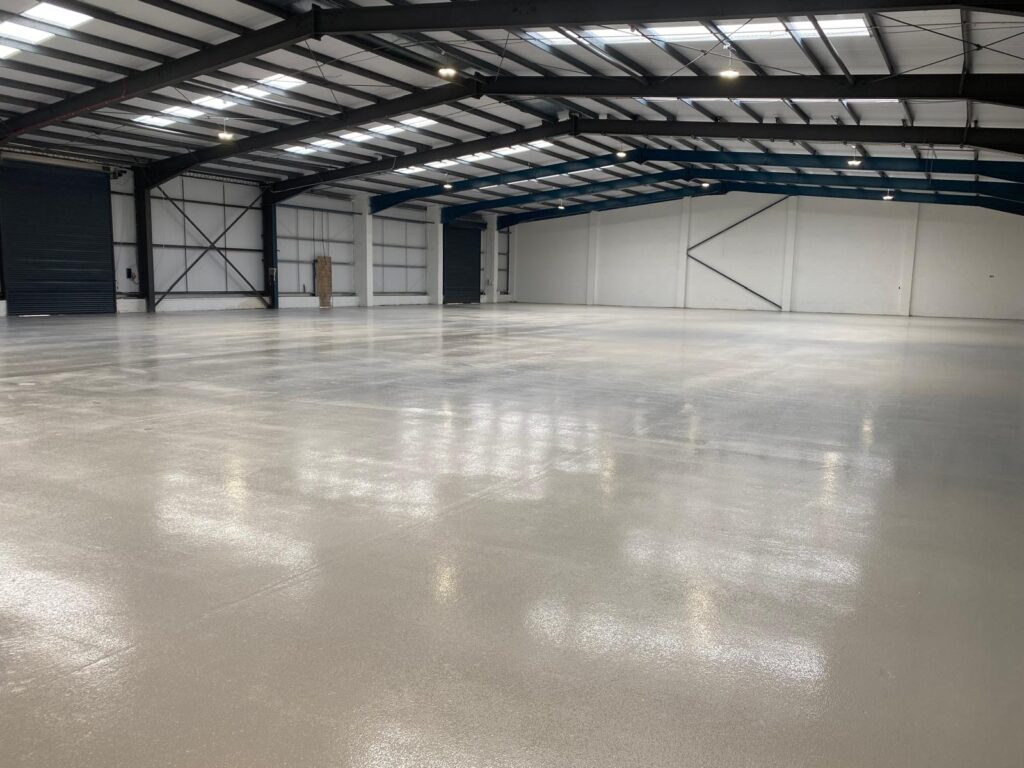
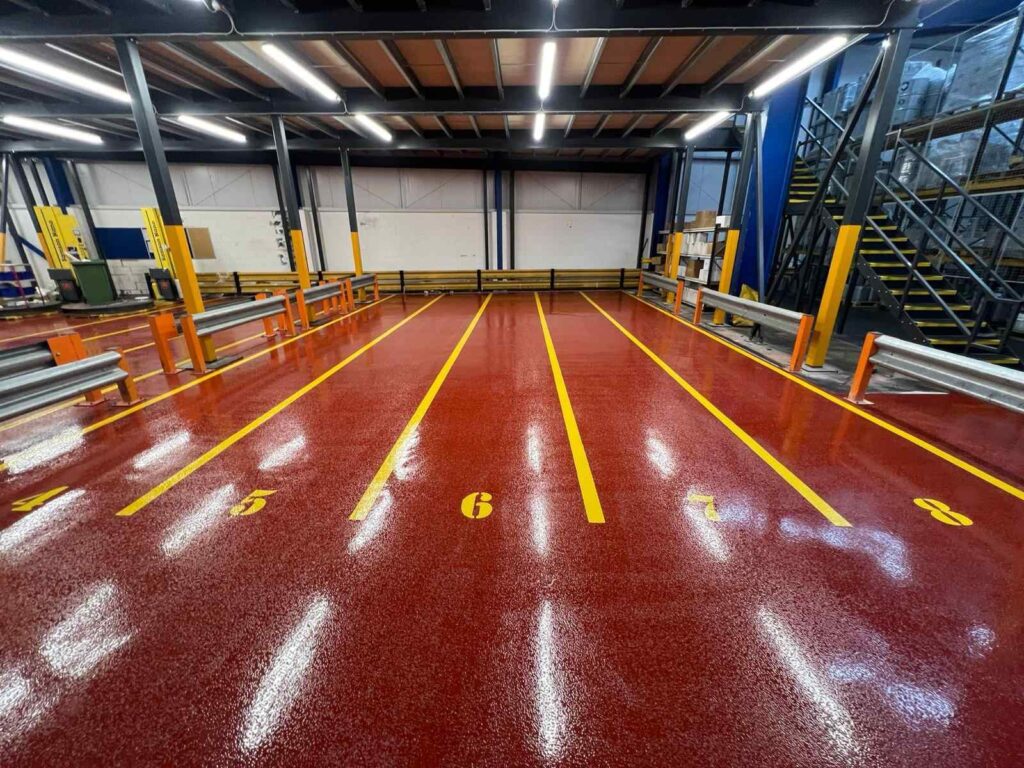
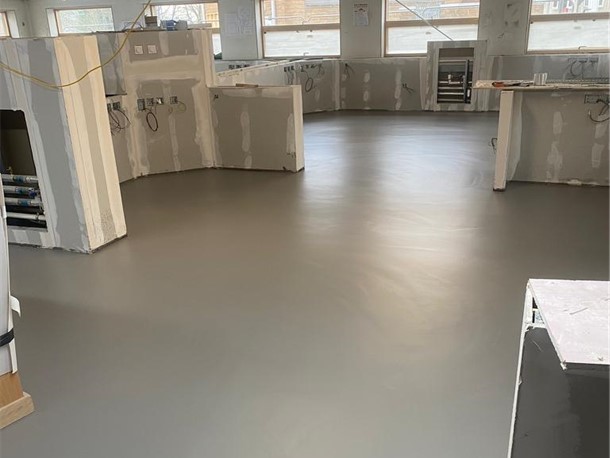
Our case studies cover – Printing & Packaging, Warehousing & Logistics, Pharma & Healthcare, Automotive & Engineering, Aviation & Aerospace, Food & Drink, Printing & Packaging, Warehousing & Logistics, Pharma & Healthcare
Substrate Preparation and Moisture Control
Mechanical Profiling Methods
Long-term performance rests almost entirely on mechanical preparation. Resin applied over weak laitance or surface contamination will delaminate early. Specialist contractors use enclosed diamond grinding or captive shot blasting with HEPA extraction. Both expose clean aggregate and open the pore structure. That profile gives the screed something real to key into.
From experience across the sector, most resin floor failures trace back to inadequate preparation. Laitance is a weak, powdery layer of cement dust and fine sand. It rises to the surface during power floating. Resin applied over it bonds only to that fragile layer and tears away under traffic. Contractors abrade the surface with multi-headed grinders or captive shot blasters. Acid etching has no place in modern contracting. It introduces uncontrolled moisture and chemical residues. On heavy duty screeds, technicians also cut anchor grooves roughly 6mm wide and 6mm deep at perimeters, drains and doorways. Those grooves lock the matrix and counteract curing shrinkage.
Moisture Testing and Liquid DPM Barriers
Excess moisture in the slab is a leading cause of osmotic blistering. Standard epoxy systems tolerate relative humidity up to roughly seventy-five percent. Above that threshold the bond is at risk. A specialist two-coat epoxy damp proof membrane then controls hydrostatic vapour pressure before the screed is laid.
Installers test moisture quantitatively, using calibrated surface hygrometers or internal relative humidity probes to BS 8204-6. Readings above 75 percent point to rising damp or residual construction moisture. Either will compromise an impermeable resin system. Osmotic pressure drives moisture upward and forms fluid-filled blisters that shatter the bond. A liquid damp proof membrane applied to the prepared concrete suppresses levels up to 98 percent relative humidity. Once it cures, technicians apply the polyurethane screed over it. The result is a fully bonded, moisture-resistant deck.
“JD Flooring did an excellent job installing a resin floor in our food production facility. The floor is durable, hygienic, and meets all safety regulations. The team was knowledgeable and professional, and the project was completed within the agreed-upon timeframe. I highly recommend JD Flooring for food industry flooring needs.”
Alex Martinez
UK Regulatory and Technical Compliance
British Standards and FeRFA Classification
UK specifications govern synthetic resin flooring through BS 8204-6 and the FeRFA system classifications. FeRFA Type 8 covers heavy duty resin screeds. These are trowel-applied, aggregate-filled mortars greater than six millimetres thick. Specifying against published British and European standards ensures the installed finish meets defined mechanical criteria.
FeRFA categories give designers and main contractors a clear benchmark. Systems run from Type 1 floor seals up to Type 8 heavy duty screeds. EN 13813 sets the physical property requirements for screed materials. It covers compressive strength, flexural strength and wear resistance. Where flammable solvents or combustible powders are handled, floors must also meet reaction-to-fire classification EN 13501-1, typically achieving Bfl-s1. Concrete protection properties fall under EN 1504-2. Working to published standards removes ambiguous product claims from the tender.
Diisocyanate Safety and Statutory Training
Reactive polyurethane systems carry strict regulatory obligations in the UK. Liquid formulations frequently contain diisocyanates, which are respiratory sensitisers. Under UK REACH restrictions, professional and industrial operatives must complete verified safety training before use. The trigger is a free diisocyanate content of 0.1 percent or greater in the product.
Check the safety data sheet and label before any product reaches site. Where diisocyanate content is 0.1 percent or above, training must be completed first. Refresher training follows at least every five years. Diisocyanates act as cross-linking agents in polyurethane chemistry. Inhaling aerosol or vapour risks occupational asthma and skin sensitisation. Professional contractors maintain ISOPA and ALIPA certified workforces trained in safe handling, ventilation control and personal protective equipment. Under COSHH, contractors also produce project-specific assessments covering their own operatives and client staff in adjacent zones.
Investment Economics and Whole-Life Value
Installation Pricing Drivers
Professional installation of a heavy duty polyurethane resin screed typically runs from £30 to £40 per square metre. That covers six to nine millimetre thicknesses. The wider industrial resin market spans £8 to £45 per square metre. Light coatings sit at the bottom and specialist chemistries at the top.
Several variables move the square-metre rate. Substrate condition dictates preparation intensity. Contaminated, pitted or uneven concrete needs extensive grinding, scarifying or epoxy patching first. Perimeter anchor detailing, hand-formed coving and intricate drainage cuts add specialist labour hours. Small, partitioned rooms increase edging work and material waste, which raises the rate. Large, clear warehouse floor plates gain the opposite benefit. Access limitations, out-of-hours working and accelerated curing schedules all adjust the commercial rate. Published figures stay indicative until a technical survey is complete.
Maintenance Planning and Extended Lifecycle
Whole-life value tells a different story from the tender price. Standard floor paint needs reapplication every twelve to eighteen months. A properly specified heavy duty polyurethane resin screed delivers fifteen to twenty years of service under rigorous industrial use. That difference dwarfs the gap in initial rates.
Installation rates are only a fraction of lifecycle expense. Thin coatings look economical at £8 to £12 per square metre. Reapplying them every two years brings repeated contractor charges, disposal costs and disruption. For manufacturers, the cost of halted production dwarfs the flooring invoice. A 9mm screed removes those repeat shutdowns. Routine maintenance is daily sweeping to lift abrasive grit, followed by automated scrubbing with pH-neutral detergent. Steam cleaning lifts stubborn fat deposits without harming the matrix. Scheduled condition inspections protect the capital investment across decades.
Final Thoughts
A heavy duty polyurethane resin screed gives industrial facilities dependable protection against physical wear, aggressive chemicals and thermal shock. The seamless FeRFA Type 8 construction removes hygienic harbourage points. It also keeps flexible adhesion across slabs exposed to steam cleaning or freezing temperatures. Adequate thickness and rigorous mechanical preparation are what secure that performance.
Correct selection comes down to matching operational parameters against proven material performance. Sites that invest in preparation, verified moisture testing and careful edge detailing secure decades of low-maintenance service. A full exposure schedule and realistic lifecycle costing remain the two most useful documents in any flooring specification.
Arrange a Free Site Survey
If you are thinking about upgrading the flooring in your commercial or industrial space then we would love to hear from you. Our team of experts will conduct a free onsite survey and then guide you through the process of product selection and project planning, whilst remaining mindful of your budgetary restraints.
Frequently Asked Questions
A:
Professional installation of a 6mm to 9mm heavy duty polyurethane resin screed generally costs between £30 and £40 per square metre. That rate includes diamond grinding preparation, specialist primer, the screed mortar and labour. Across the wider industrial resin market, prices run from £8 per square metre for basic dustproof seals up to £45 for specialised fast-curing chemistries. Final quotations depend on substrate condition, moisture levels, anchor grooving, coving meterage and site access.
A:
Epoxy resin cures into a rigid, brittle film. Concrete expands and contracts whenever temperatures shift suddenly. Polyurethane screeds have an elastic modulus and thermal expansion coefficient much closer to concrete, so the screed moves with the slab. Epoxy cannot. Sudden thermal expansion creates severe shear stress at the bond interface. The rigid coating tears away from the concrete beneath. Delamination then spreads quickly, often lifting in large sheets rather than isolated patches.
A:
Polyurethane screeds usually accept light foot traffic within 24 to 48 hours at ambient temperatures of around fifteen degrees Celsius. Full chemical resistance and mechanical cure take two to five days. Only then should the floor face heavy vehicular loading or aggressive washdowns. Cooler site conditions prolong curing. Rapid-cure alternatives such as polyaspartic systems permit foot traffic in roughly two hours, though heavy duty screeds remain the choice for extreme thermal loads.
A:
FeRFA classifications sort resin flooring by thickness, formulation and operational duty. Type 7 covers heavy duty flowable resin flooring, usually applied at 4mm to 6mm to create a smooth, self-levelling surface for heavy traffic. Type 8 is the highest duty rating. It covers heavy duty resin screeds applied above 6mm, typically 6mm to 9mm. Type 8 screeds are heavily aggregate-filled, trowel-finished mortars built for severe impact, chemical attack and intense thermal shock.
A:
Yes. UK REACH restrictions require industrial and professional operatives to complete accredited safety training before handling products containing 0.1 percent or more free diisocyanates. Polyurethane systems use diisocyanate hardeners to drive cross-linking, and inhalation risks occupational asthma. Employers must confirm that technicians hold valid certification, such as ISOPA or ALIPA credentials, before working with open liquid mixtures. Training records should be kept on site, and refresher courses are required at least every five years.
