Chemical Resistant Flooring and Floor Coatings
Specifying chemical resistant flooring demands a precise match between resin chemistry and the substance inventory on site. Many facilities assume a generic industrial finish will hold. Thin films then blister, soften and lift within weeks of an accidental release. Industrial plants handle aggressive reagents, thermal washdowns and constant traffic. The right system protects the concrete substrate, prevents environmental escape and keeps production running.
Corrosive liquids penetrate unprotected concrete quickly. They compromise structural integrity, breach containment thresholds and halt processing lines. Facility managers need to know how each polymer behaves against concentrated reagents, point loads and heat. That judgement has to be made before capital is committed. So how do plant operators build a defensible specification that survives genuine chemical attack?
Key Takeaways
- Chemical resistance depends on substance concentration, contact time and exposure temperature rather than any universal product durability rating.
- Novolac epoxy and vinyl ester systems resist concentrated inorganic acids where standard bisphenol epoxies break down rapidly under attack.
- Secondary containment bunds must provide seamless, liquid-tight containment under the Control of Pollution (Oil Storage) (England) Regulations 2001.
- Diamond grinding or captive shot blasting removes surface laitance and secures the mechanical key the resin system depends on.
- A detailed chemical exposure schedule remains the only reliable method of selecting resin systems and preventing premature flooring failure.
Industrial Chemical Resistance Performance Matrix
Selecting the correct polymer matrix means comparing chemistry limits directly against expected site contaminants. Standard bisphenol formulations cope with mild splash conditions. Dense novolac and vinyl ester chemistries handle aggressive immersion. The table below sets out common resin technologies, their resistance profiles and typical facility applications.
Every industrial facility operates under distinct mechanical and chemical demands. Specifiers must establish whether an area faces intermittent vehicle tracking, sustained reagent immersion or routine steam sanitisation. In practice, the answer rarely matches the whole building. Matching the resin matrix to each zone delivers reliable structural and environmental performance across demanding manufacturing environments.
| Resin Technology | FeRFA Classification | Primary Resistance Profile | Typical Facility Application |
|---|---|---|---|
| Standard Bisphenol Epoxy | Type 2 or Type 3 | Dilute alkalis, oils, fuels, detergents | Assembly bays, warehouses, light workshops |
| Novolac Epoxy Screed | Type 6, 7 or 8 | Concentrated sulphuric, nitric and hydrochloric acids | Battery charging, chemical dosing, plating lines |
| Polyurethane Resin Screed | Type 8 | Organic acids, caustics, extreme thermal shock | Food production, breweries, CIP washdown areas |
| Vinyl Ester Resin Lining | Specialist system | Aggressive oxidising agents, strong mineral acids | Secondary containment bunds, effluent pits |

Chemistry Fundamentals for Chemical Resistant Flooring
Standard Bisphenol Formulations and Performance Boundaries
Standard bisphenol A and F epoxies deliver high compressive strength. They resist dilute alkalis, fuels and standard lubricants dependably. These polymers perform well across machine workshops, assembly halls and dry storage areas. Their crosslink density is the limiting factor. It cannot withstand sustained contact with concentrated mineral acids or aggressive industrial solvents.
Exposed to aggressive solvents or concentrated acids, standard epoxies undergo chain scission and soften quickly. The crosslinked matrix relaxes under attack. Reagents then reach the concrete substrate beneath. In practice, we find that a standard chemical resistant floor coating specified for harsh reagents debonds early. Substrate remediation follows, and it costs far more than the correct system would have.
Novolac Resins and High Crosslink Molecular Density
Novolac epoxy resins use a densely crosslinked molecular backbone. That structure resists reagent permeation and elevated operating temperatures. Tightly linked polymer chains stop chemical molecules diffusing into the matrix. The formulation suits chemical decanting rooms, solvent handling areas and concentrated acid storage bays. Each of those zones sees contact that standard epoxies cannot survive.
More functional groups per molecule yield exceptional stability under sustained immersion and aggressive splash. Novolac formulations hold their hardness against aromatic hydrocarbons, chlorinated solvents and process reagents. General-purpose coatings do not. Specifying a novolac screed or high-build lining gives continuous protection. Severe attack would destroy a standard resin floor within hours.
Severe Acid Exposure and Polymer Selection
Aggressive Inorganic Acids and Substrate Degradation
Concentrated mineral acids attack bare concrete immediately. They dissolve calcium silicate hydrates and form soluble calcium salts. That dissolution reduces structural load capacity, generates corrosive dust and undermines equipment mountings. Without an impervious barrier, acidic liquors migrate through capillary pores. Reinforcing steel then corrodes, and concrete failure follows.
Spills of hydrochloric, nitric and phosphoric acid demand rapid neutralisation and a robust surface barrier. Plant engineers often ask which resin resists sulphuric acid spillage. The answer is novolac epoxy or vinyl ester, not standard bisphenol. High concentrations of sulphuric acid dehydrate ordinary organic resins. Only a dense polymer network endures that level of exposure.
Vinyl Ester Resins in Severe Industrial Environments
Vinyl ester resin technology resists aggressive oxidising media, bleaching chemicals and concentrated inorganic acids. The polymer is formed by esterifying an epoxy resin with methacrylic acid. That chemistry combines thermal endurance with toughness. Chemical plants, pulp mills and metal refining sites rely on vinyl esters for primary immersion protection.
These polymers withstand thermal excursions and aggressive wash cycles that crack rigid, brittle linings. Application demands rigorous substrate preparation and controlled catalyst addition to secure a full cure. Get either wrong and the system underperforms. The cured barrier then handles continuous contact with hot acid liquors, chlorinated compounds and process reagents.
Did You Know?
The Control of Pollution (Oil Storage) (England) Regulations 2001 bite at 200 litres. Above that capacity, an above-ground oil container on an industrial, commercial or institutional site must meet the prescriptive bunding requirements. Containers of 200 litres or less fall outside them.
Spill Inventories and Chemical Exposure Schedules
Chemical Concentrations and Process Temperatures
An accurate exposure schedule documents every substance present in the operating environment. It records exact concentrations and working temperatures alongside each entry. Attack rates roughly double for every 10 degree Celsius rise in liquid temperature. Warm wash solutions are therefore far more destructive than their cold equivalents. Generic chemical class labels will not do.
A dilute five percent organic acid behaves nothing like a ninety percent mineral acid. Multiple solvents present together often produce synergistic attack that accelerates failure. A precise inventory lets formulators cross-reference their test data properly. They can then supply a verified polymer system matched to real facility demands.
Contact Time and Washdown Housekeeping Regimes
Contact time between a spilled chemical and the floor finish dictates the required thickness and resin classification. Intermittent splash-and-wipe exposure allows thinner high-build coatings to perform well. That holds only where operators neutralise spills promptly. Unmonitored containment zones and standing puddles demand heavy-duty flowable screeds or multi-layer laminate systems.
Housekeeping protocols shape long-term flooring performance directly. Pooled process chemicals increase penetration risk and accelerate local mechanical wear under traffic. From experience across the sector, poor housekeeping shortens service life more than any single specification error. Scheduled washdown cycles with appropriate neutralising detergents protect the resin matrix and extend the life of chemical resistant flooring.

Need a Resin Flooring Site Visit and Quote?
Secondary Containment Bunds and Environmental Compliance
Secondary Containment Sizing and Legislative Requirements
The Control of Pollution (Oil Storage) (England) Regulations 2001 set the sizing rule for secondary containment. A bund must hold at least 110 percent of the largest container. Where several containers sit together, it must hold 25 percent of total capacity. That capacity prevents uncontrolled discharge into groundwater and public drainage networks.
Environmental protection officers enforce containment standards under the Environmental Permitting (England and Wales) Regulations 2016. Causing or permitting an unpermitted water discharge is a criminal offence. On indictment it carries an unlimited fine and imprisonment of up to five years. A certified impermeable lining makes the bund a defensible environmental barrier.
Seamless Bund Detailing and Integral Coved Skirtings
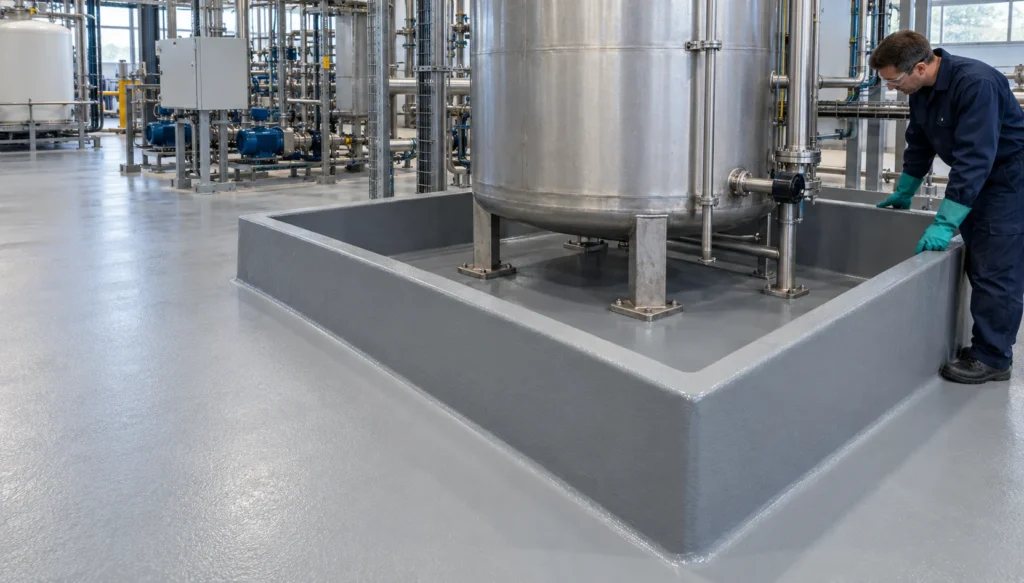
Secondary containment bunds need continuous, joint-free resin linings. The lining must run across the floor and up every vertical perimeter wall. Standard right-angled floor-to-wall junctions are stress points. They crack and allow liquid migration during a containment event. Integral resin coved skirtings remove that weakness and create a liquid-tight basin.
Pipe penetrations, support columns and plinth perimeters need elastomeric bandaging and chemical-resistant detailing before lining. Any unsealed penetration gives contained reagents an escape path. One missed detail undermines the whole structure. A fully integrated lining bridges minor substrate movement and holds environmental isolation during a vessel failure.
Case Studies
Our case studies cover – Printing & Packaging, Warehousing & Logistics, Pharma & Healthcare, Automotive & Engineering, Aviation & Aerospace, Food & Drink, Printing & Packaging, Warehousing & Logistics, Pharma & Healthcare
Mechanical Surface Preparation and Substrate Integrity
Diamond Grinding and Captive Shot Blasting Profiles
Mechanical preparation removes surface laitance, curing agents and existing contamination. It exposes the sound concrete matrix beneath. Applying high-performance resin to unprepared, power-floated concrete leads directly to interfacial delamination. Mechanical and chemical stress then does the rest. Captive shot blasting and diamond grinding create the open-pored profile that guarantees physical interlock.
Contractors select the method from the system build-up, contamination depth and site conditions. Thin-film coatings need fine-profile diamond grinding to avoid surface shadowing. Heavy screeds need a coarser shot-blasted profile. Specifiers should state the exact preparation method in tender documents. That single line makes contractor pricing genuinely comparable.
Moisture Testing and Structural Movement Isolation
Trapped moisture vapour beneath an impermeable resin film causes osmotic blistering and premature debonding. Technicians measure relative humidity within the concrete using calibrated hygrometers. Readings are judged against established industry cut-off thresholds. Where substrate humidity exceeds tolerance, a two-coat epoxy liquid damp-proof membrane suppresses rising construction moisture.
Existing expansion joints must never be bridged rigidly with screeds or standard resin mortars. Capping a movement joint transfers building stress into the floor finish. Reflective cracking across the operational surface is the usual result. Specialists detail every movement joint with chemical-resistant flexible polysulphide sealant. The joint then accommodates thermal expansion without breaking barrier continuity.
“JD Flooring did an excellent job installing a resin floor in our food production facility. The floor is durable, hygienic, and meets all safety regulations. The team was knowledgeable and professional, and the project was completed within the agreed-upon timeframe. I highly recommend JD Flooring for food industry flooring needs.”
Alex Martinez
Operational Traffic, Loading and Thickness Drivers
Film Thickness Selection Against Industrial Forklift Wear
Film thickness governs the mechanical lifespan and abrasion resistance of an industrial floor. Thin resin seals up to 150 microns stop concrete dusting effectively. They cannot withstand continuous forklift tracking or heavy point loading. Facilities running counterbalanced pallet trucks and automated guided vehicles need high-build coatings or multi-layer broadcast floors.
Concentrated point loads from solid polyurethane forklift tyres impose intense shear at the resin-substrate interface. A 6 mm to 9 mm heavy-duty screed absorbs and distributes those dynamic wheel loads. The substrate beneath is protected from pulverisation. Correct thickness lets the floor take combined abrasion and intermittent chemical contact without premature wear.
Graded Specifications for Cost-Effective Facility Zoning
Applying the heaviest chemical-resistant system across a whole site wastes capital on low-risk zones. Plant managers achieve better value by grading specifications to departmental risk and traffic intensity. High-risk dosing zones take novolac screeds. Adjacent forklift transit routes work well with hard-wearing high-build bisphenol systems instead.
Graded zoning directs budget towards severe chemical immersion, thermal shock and intense dynamic loading. Low-traffic pedestrian walkways and dry raw material stores run successfully on economical seals or thin coatings. The approach controls installation expenditure without weakening protection. Containment basins and decanting areas still receive the full specification they require.
Calculate The True Cost
A three day shutdown at a plant turning over £2,000 an hour is £120,000 of lost output. On most sites that is several times the cost of the new resin floor installation. We have developed our own free custom calculator top help you calculate the true cost and a new resin floor.
Maintenance Protocols and Long-Term Durability
Cleaning Regimes and Mechanical Scrubber Selection
Routine cleaning removes abrasive grit, tracked road salts and chemical residues. Left in place, those contaminants accelerate mechanical surface erosion. Facility managers should specify pH-neutral detergents at recommended dilutions. Correct dilution cleans glossy topcoats without etching them. Cleaning crews must also match scrubber-dryer brush grades to the floor profile.
Aggressive caustic cleaning chemicals dull decorative gloss and weaken anti-slip profiles. Topcoat integrity degrades steadily over time. Steam cleaning is safe on heavy-duty polyurethane screeds. It permanently damages thin high-build coatings through localised thermal shock. The right cleaning chemistry preserves slip resistance, optical clarity and chemical barrier performance.
Condition Surveys and Proactive Seal Coat Rejuvenation
Scheduled condition surveys catch early topcoat wear, micro-cracking and localised chemical staining. Technicians inspect high-stress arrises, joint sealants, drainage gullies and bund perimeters. A worn topcoat found early needs nothing more than overcoating. Delayed intervention is a different matter entirely. It requires disruptive substrate re-preparation and full system replacement.
Formal inspection records document pendulum slip resistance readings and confirm ongoing containment compliance. Statutory environmental audits rely on that evidence. A documented maintenance history demonstrates proactive hazard management to insurers and environmental health regulators. Planned maintenance contracts extend the serviceable life of chemical-resistant installations to fifteen or twenty years.
Final Thoughts
Dependable performance from chemical resistant flooring comes from analysing actual operational demands, not product descriptions. Plant managers should document every process chemical, concentration and temperature threshold first. The resin matrix is selected afterwards. Certified specialists then handle mechanical grinding, moisture testing and detail priming to suit the site.
A well-engineered specification balances chemical barrier integrity, mechanical wear resistance and environmental compliance. Dense novolac or vinyl ester polymers in severe exposure zones prevent premature failure and shutdowns. Robust containment detailing, appropriate film thickness and consistent maintenance keep a facility compliant for decades. Review the exposure schedule whenever a process chemical or operating temperature changes.
Arrange a Free Site Survey
If you are thinking about upgrading the flooring in your commercial or industrial space then we would love to hear from you. Our team of experts will conduct a free onsite survey and then guide you through the process of product selection and project planning, whilst remaining mindful of your budgetary restraints.
Frequently Asked Questions
A:
Selection depends on a detailed exposure schedule. Record every substance present, its maximum concentration, operating temperature and likely contact time. Then evaluate mechanical factors such as forklift axle loads, impact risks and thermal washdown frequency. Those criteria decide whether you need an economical high-build coating, a dense novolac resin or a heavy-duty polyurethane screed. A site survey with substrate moisture and strength testing confirms the final specification for your building.
A:
The difference is thickness and mechanical capability. A chemical resistant floor coating measures up to 1000 microns. It seals sound concrete against light spills and dust. Heavy-duty resin screeds measure between 4 mm and 9 mm in depth. They provide a new structural wearing surface that withstands severe impact, point loading and thermal shock. Screeds also let contractors form integral falls to drainage and seamless coved skirtings.
A:
Engineers specify novolac epoxy or vinyl ester systems rather than standard bisphenol epoxies. Standard epoxies cope with brief splashes of dilute acid. They break down rapidly once exposed to concentrated sulphuric acid. Novolac epoxies carry the dense crosslinking needed for medium to high acid concentrations. For continuous immersion or highly concentrated acid processing, vinyl ester linings deliver the highest chemical resistance and structural durability available.
A:
The Control of Pollution (Oil Storage) (England) Regulations 2001 set the sizing rules. Containment must hold at least 110 percent of the largest container or 25 percent of total stored volume. The Environmental Permitting (England and Wales) Regulations 2016 require bunds to remain impermeable. Floor and walls must form a seamless basin with no drainage outlet. Verified chemical-resistant resin linings with integral coving prevent hazardous materials reaching groundwater.
A:
Concrete substrates expand, contract and deflect under fluctuating thermal loads and vehicle traffic. Filling an expansion joint with rigid resin prevents that movement. Stress transfers into the surrounding substrate and cracks the adjacent floor finish. Movement joints must be carried through the full depth of the resin build-up. They are then filled with a chemically resistant flexible sealant such as polysulphide. The joint accommodates structural movement whilst maintaining an impervious liquid barrier.
