
BS 8204-6 Explained for Resin Flooring Specifiers
Getting BS 8204-6 explained matters to every specifier, architect and main contractor delivering an industrial or commercial finish. This code of practice governs synthetic resin floorings applied to in-situ bases. It sets benchmarks for substrate soundness, preparation, surface regularity and testing. Adherence decides whether a floor survives heavy traffic or fails early.
Commercial floor design depends on coordination between the structural base and the applied topping. When site teams skip substrate preparation or moisture testing, premature failure follows. How can a specifier make certain that every project meets this benchmark and matches the right chemistry to the operation?
Key Takeaways
- BS 8204-6 sets the benchmark for installing synthetic resin flooring over prepared concrete and cementitious screed substrates in commercial facilities.
- Substrate soundness and tensile pull-off strength are the core parameters, and mechanical preparation must remove laitance, contaminants and weak surface layers.
- Relative humidity readings decide whether the installer applies a liquid damp proof membrane to prevent osmotic blistering beneath non-porous resin.
- Material designations cross-reference EN 13813 for screed properties and EN 1504-2 for concrete surface protection, giving verifiable evidence of compliance.
- Contractors categorise systems using FeRFA Types 1 to 8, aligning specified thickness and resin matrix with real site operational demands.
Key Parameters Set by BS 8204-6
The code of practice covers synthetic resin work from first site assessment through to cure verification. This resin flooring British Standard requires specifications to account for environmental limits, substrate properties and chemical exposure. Main contractors should recognise one point early. Compliant performance rests on base preparation, not on resin chemistry alone.
The table below sets out the principal parameters the standard addresses. Against each one sits the practical specification implication on site. Specifiers must confirm that tender documents state every requirement clearly. Procurement should not begin until they do, because clear wording keeps performance benchmarks contractually enforceable.
| Standard Element | Technical Scope | Specification Requirement |
|---|---|---|
| Base Quality | Substrate soundness and tensile integrity | Mechanical profiling and pull-off adhesion verification |
| Moisture Control | Substrate relative humidity thresholds | Hygrometer assessment and liquid DPM application |
| System Classification | FeRFA Types 1 to 8 categorisation | Selection of build-up, thickness and duty band |
| Material Performance | Harmonised product property declarations | Cross-referencing EN 13813 and EN 1504-2 declarations |
| Joint Design | Stress relief and thermal expansion movement | Matching structural joints with flexible sealants |

BS 8204-6 Explained Across Project Scopes
Designation and Legal Status in Contracts
BS 8204-6 is a British Standard code of practice, not statutory legislation. Once written into a contract specification, however, its clauses become the binding technical benchmark. Courts and independent experts then measure quality disputes against its guidance. They use it to judge whether an installer applied reasonable skill and care.
Specifiers should write the standard directly into tender documentation on commercial schemes. Doing so defines acceptable site practice for main contractors and installation teams. It gives transparent criteria covering storage conditions through to surface finishing tolerances. Referencing the standard contractually stops a contractor substituting cheaper preparation methods. It also prevents diagnostic tests being quietly dropped from the programme.
Interaction with Structural Base Design
A synthetic resin finish is a protective surface, not a structural element. The code is clear that a resin floor cannot bridge unmanaged structural movement. Nor can it compensate for an inherently weak base. The concrete beneath must carry all dynamic vehicle stresses, racking point loads and building movement without excessive deflection.
Design teams should coordinate early so that base levels match the finished floor requirement. Where the substrate shows severe undulation or hollow sections, resin alone will not resolve it. In practice, we find early discussion with the engineering team is what prevents this. It confirms the base has reached adequate cure and stability before handover.
Substrate Soundness and Tensile Strength Benchmarks
Base Soundness and Compressive Capacity
Substrate soundness decides whether a bonded resin finish survives prolonged mechanical stress. The base needs sufficient compressive strength to carry operational point loading without crushing. Weak, crumbly concrete causes bond failure. Mechanical loads shear the brittle matrix directly beneath the resin interface, and the finish lifts away under trafficking.
Engineers assess soundness using rebound hammers, scratch testing or compressive cores taken across traffic paths. Areas of low structural integrity need excavation or consolidating treatment before any resin goes down. Applying a high-performance resin over a compromised base is a false economy. The finish detaches along the weak interface, and the failure spreads across the bay.
Tensile Pull-Off Testing Procedures
Direct pull-off testing confirms whether the concrete surface has adequate tensile capacity for bonding. Technicians core through the surface, bond steel dollies with epoxy adhesive, then apply calibrated tensile force until failure. A sound industrial substrate fails within the concrete aggregate itself. A clean break at the bond line signals a problem.
Where testing shows low tensile strength, the top layer cannot resist resin curing shrinkage stresses. Resins exert notable shear force across the interface as cross-linking develops. Without adequate base tensile strength, the system shears the surface concrete loose almost immediately. Specifiers should require pre-installation test records within the handover documentation.
Did You Know?
The current edition is BS 8204-6:2008+A1:2010, issued as Part 6 of the BS 8204 series on screeds, bases and in situ floorings. The +A1 marks a formal amendment published in 2010.
Mechanical Substrate Preparation Protocols
Surface Laitance and Contaminant Removal
Mechanical preparation must strip weak laitance and open the concrete pores for priming. Laitance forms when bleed water carries fine cement particles to the surface during power floating. The resulting glossy layer has no mechanical integrity. It cannot hold a high-build resin against forklift tyre twisting or point impact.
Contractors use captive shot blasting or industrial diamond grinding with HEPA dust extraction. Acid etching is no longer acceptable on modern industrial schemes. Grinding strips curing membranes, old paint residues, embedded oils and laitance in one pass. The exposed aggregate-rich profile then lets a low-viscosity primer penetrate the concrete capillary structure.
Respirable Crystalline Silica Dust Controls
Grinding operations generate respirable crystalline silica dust, which carries strict statutory control. The workplace exposure limit is 0.1 mg/m³ as an eight-hour time-weighted average under COSHH 2002. Inhaling these invisible particles causes irreversible disease. Silicosis, chronic obstructive pulmonary disease and lung cancer all follow uncontrolled exposure.
Contractors must control at source with continuous HEPA-filtered vacuum extraction fitted to the grinder. Relying on face masks alone breaches the COSHH hierarchy of control. Duty holders who fail here face HSE Fee for Intervention cost recovery. The rate stands at £188 per hour from 1 April 2026. Prosecution under the Health and Safety at Work etc. Act 1974 remains available.

Need a Resin Flooring Site Visit and Quote?
Moisture Limits and Damp Proof Membrane Rules
Substrate Relative Humidity Thresholds
Standard resin formulations need a dry substrate to avoid chemical and adhesive failure. Typical epoxy systems require substrate relative humidity below 75% to 80%. Site teams measure this with hygrometers or humidity sleeves. Laying a non-porous coating over a wet base traps vapour and builds hydrostatic and osmotic pressure.
That trapped vapour creates osmotic blistering, lifting the resin into hollow domes. The blisters hold fluid that expands over time. They eventually crack open under wheel contact, and the failure spreads from each breach. Site teams must record relative humidity across multiple floor positions. Guessing a drying rate from concrete age is not acceptable.
Epoxy Liquid Damp Proof Membrane Specification
Where substrate relative humidity exceeds the safe threshold, the specification must call for an epoxy liquid DPM. A two-coat, solvent-free liquid damp proof membrane suppresses residual construction moisture up to 98% relative humidity. The primer cures into an impermeable vapour barrier. Decorative and industrial finishes can then follow over young concrete.
A liquid DPM also removes costly programme delay while a slab dries naturally. The traditional rule of thumb puts concrete drying at roughly one month per 25 millimetres of thickness. On a tight programme, waiting months for a heavy structural base is commercially impossible. The membrane gives technical security against moisture migration and releases follow-on trades.
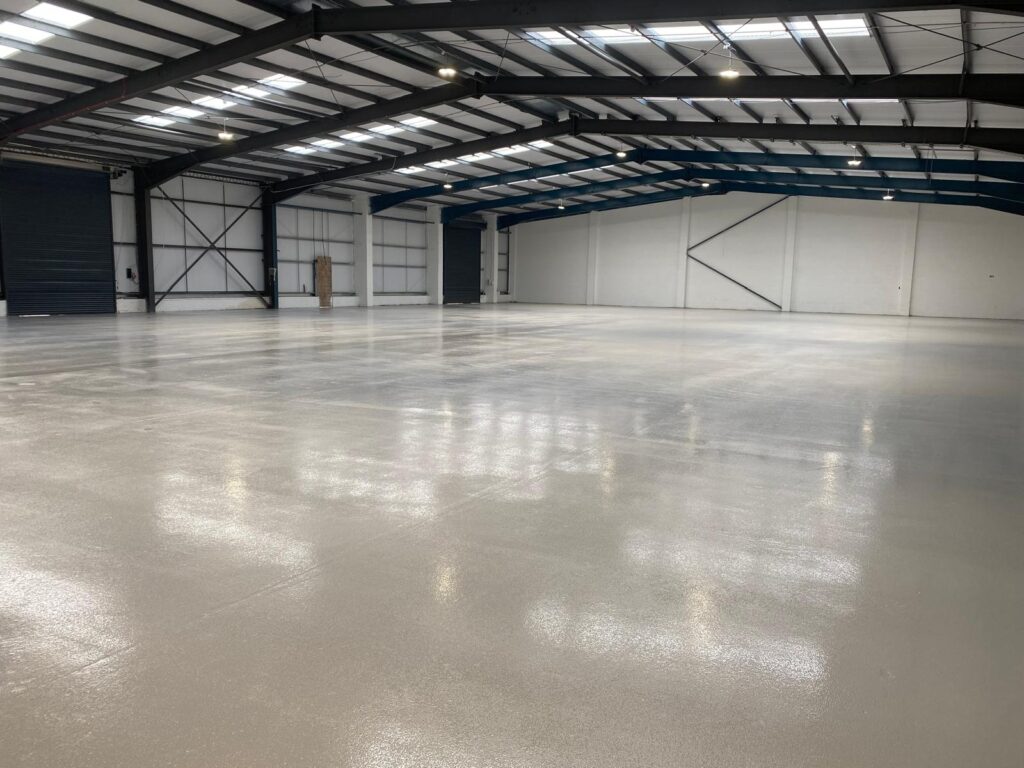
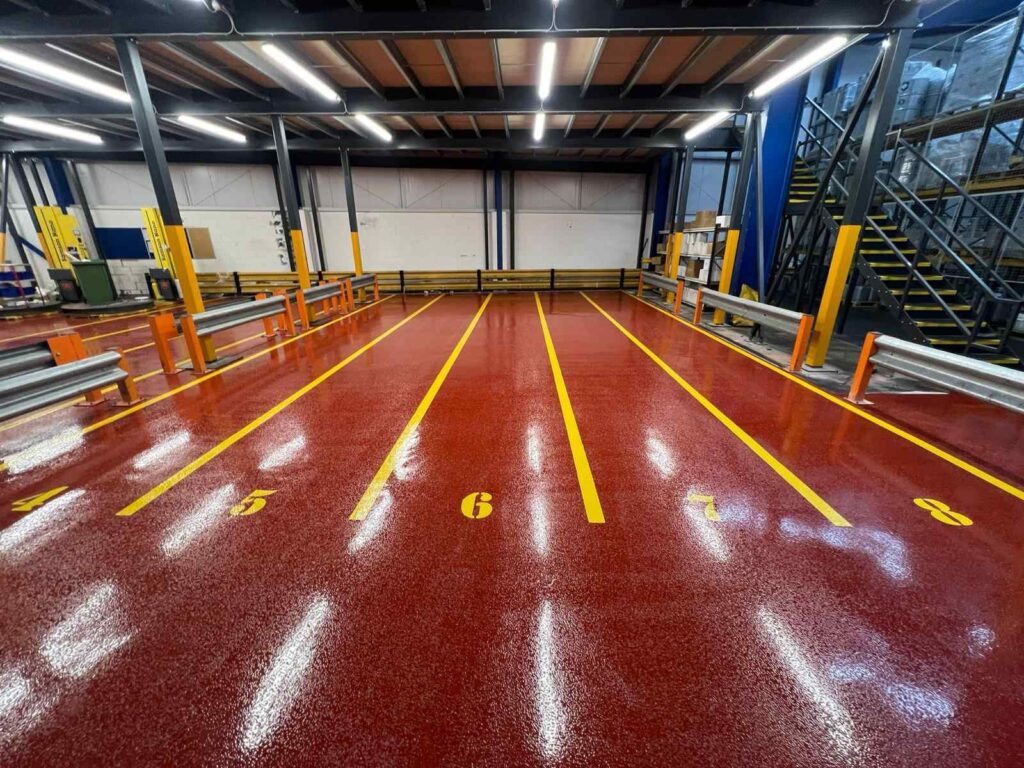
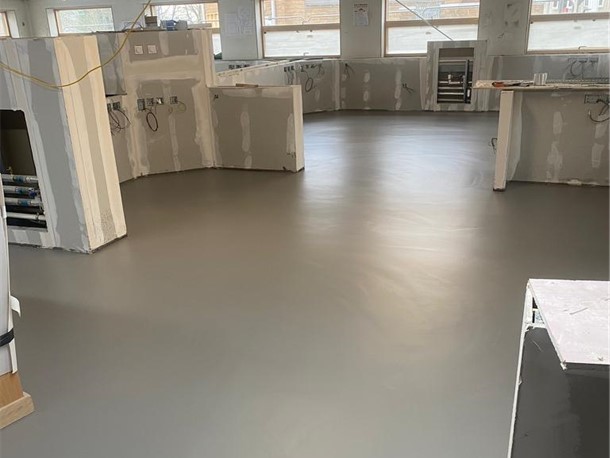
Case Studies
Our case studies cover – Printing & Packaging, Warehousing & Logistics, Pharma & Healthcare, Automotive & Engineering, Aviation & Aerospace, Food & Drink, Printing & Packaging, Warehousing & Logistics, Pharma & Healthcare
FeRFA Classifications and System Selection
FeRFA Types 1 Through 8 in Practice
The standard works alongside FeRFA classifications, which group resin systems by build-up and thickness. The scale runs from Type 1 floor seals under 150 microns to Type 8 heavy-duty trowel-applied screeds above 6 millimetres. Category depends on system profile, application method, aggregate loading and expected service life.
Choosing the right FeRFA category prevents under-specification in demanding environments. Thin coatings give dustproofing and light chemical resistance in low-traffic storage bays. Forklift aisles are different. They need multi-layer systems or heavy-duty flowable finishes to withstand continuous abrasion. Specifiers should state both the FeRFA type and the minimum dry film thickness in the contract schedule.
Specialised Chemistries Outside the FeRFA Scale
Polyaspartic and methyl methacrylate are resin chemistries, not FeRFA types. Specifiers often confuse the two. Polyaspartic systems cure rapidly down to −5°C and reach foot-traffic capability in roughly two hours. Methyl methacrylate also installs at sub-zero temperatures and hardens within hours, though its pungent odour needs managing.
Polyurethane screeds offer exceptional thermal shock tolerance. They withstand steam cleaning and service temperatures between −40°C and +120°C in food processing plants. Installers should check the SDS and the product label. Where a product contains 0.1% or more diisocyanates, professional and industrial users must complete the required diisocyanate training before use. Refresher training follows at least every five years.
“JD Flooring did an excellent job installing a resin floor in our food production facility. The floor is durable, hygienic, and meets all safety regulations. The team was knowledgeable and professional, and the project was completed within the agreed-upon timeframe. I highly recommend JD Flooring for food industry flooring needs.”
Alex Martinez
Harmonised Material Standards and Performance Testing
EN 13813 Screed Property Designations
Resin formulations specified under British Standards must declare performance in accordance with BS EN 13813. This harmonised standard governs screed materials and requires a formal Declaration of Performance from the manufacturer. It sets standardised classifications for compressive strength, designated by C, and flexural strength, designated by F. Wear resistance ratings sit alongside them.
Specifiers should demand declared performance documentation against the calculated engineering stresses. A high-performance industrial resin screed shows compressive and flexural classes far above traditional cementitious screeds. Checking these parameters stops a contractor supplying a diluted, heavily extended formulation. Such products lack the binder content to survive severe site handling.
Concrete Protection Verification Through EN 1504-2
When a resin coating protects the concrete structure beneath, it falls within EN 1504-2. The standard covers systems designed to prevent ingress, control moisture content and increase physical resistance to chemical attack. Conforming products undergo laboratory testing for carbon dioxide permeability, water absorption, abrasion wear and direct pull-off adhesion.
Pairing BS 8204-6 with EN 1504-2 makes the applied resin an active engineering barrier against chemical degradation. Facilities handling harsh chemicals, de-icing salts or aggressive oils need documented evidence of surface protection conformity. Third-party test data reassures the building owner on one point. The finish protects the structural asset across its design life and limits maintenance liability.
Calculate The True Cost
A three day shutdown at a plant turning over £2,000 an hour is £120,000 of lost output. On most sites that is several times the cost of the new resin floor installation. We have developed our own free custom calculator top help you calculate the true cost and a new resin floor.
Movement Joints, Detailing, and Curing Verification
Substrate Movement and Joint Reflection
Resin floors cannot bridge live structural movement joints within the concrete beneath. Every induced contraction joint, isolation detail and building expansion joint must reflect precisely through the resin finish. Filling a movement joint with rigid resin or structural mortar forces dynamic stress into the topping. Edge cracking and debonding follow quickly.
Contractors must reform joints cleanly and apply flexible polysulphide or polyurethane sealants that accommodate lateral movement. Saw-cut joints exposed to hard nylon forklift wheels need elastomeric infills or armoured profiles to prevent arris spalling. From experience across the sector, MHE impact against unsupported joint arrises is the primary cause of industrial floor breakdown in logistics and warehousing.
Cure Times and Return to Service Rules
Full chemical cure always takes longer than the physical hardness needed to carry foot traffic. Standard epoxy and polyurethane systems typically need 24 to 48 hours for foot traffic at 15°C. Chemical exposure can require up to five days. Cooler ambient or substrate temperatures extend both windows considerably.
Main contractors should maintain adequate ambient heating and ventilation through the colder months to protect cross-linking. Running traffic or chemical cleaning before full cure damages the molecular matrix. The result is surface dulling, staining or reduced abrasion resistance. Specifiers should confirm environmental thresholds with the installer before the programme is fixed.
Final Thoughts
Applying the technical rules of BS 8204-6 explained across this guide turns floor design from guesswork into engineering. Sound preparation, careful moisture verification and correct FeRFA alignment protect building owners from early delamination. Specifying compatible materials under EN 13813 and EN 1504-2 closes the gap between design intent and physical execution.
Successful installations depend on collaboration between structural engineers, principal designers and specialist resin contractors from the earliest design stages. Demand verifiable substrate strength data. Accommodate live structural movement joints. Respect the chemical curing windows. Teams that do all three deliver seamless, durable finishes that withstand decades of aggressive industrial use.
Arrange a Free Site Survey
If you are thinking about upgrading the flooring in your commercial or industrial space then we would love to hear from you. Our team of experts will conduct a free onsite survey and then guide you through the process of product selection and project planning, whilst remaining mindful of your budgetary restraints.
Frequently Asked Questions
A:
BS 8204-6 gives technical recommendations for designing, specifying and installing in-situ synthetic resin flooring over concrete and screed bases. It sets out requirements for substrate quality, mechanical surface profiling, moisture limits and movement joints. The code acts as the industry benchmark for commercial and industrial floors. Specifiers and courts both use it to judge whether a resin installation shows acceptable workmanship and durability.
A:
The standard sets out what BS 8204-6 requires from a resin floor on adhesion, surface regularity and curing performance. Installers must assess substrate soundness and pull-off tensile strength before application begins. After installation, it covers testing for bond integrity, slip resistance and chemical resilience. Meeting those requirements confirms the bonded finish will not delaminate early under operational traffic or warehouse loading.
A:
Resin flooring follows the exact profile of the substrate beneath and cannot level an uneven base on its own. Coatings and flowable systems simply reflect existing undulations, slopes and irregularities. Local defects need dedicated repair mortars. Establishing a genuinely flat new plane requires an underlayment screed. Design teams must specify levelling compounds before the final resin topping goes down across uneven floors.
A:
The standard aligns with FeRFA guidelines, which divide resin flooring into eight categories by build-up and thickness. These run from thin Type 1 floor seals to heavy-duty Type 8 screeds above 6 millimetres. Specifiers use the categories to match operational duty with film thickness. Specialised chemistries such as polyaspartic and methyl methacrylate describe binder formulations rather than numbered FeRFA types.
A:
Moisture testing prevents osmotic blistering and early adhesion failure beneath impermeable resin systems. Standard epoxy coatings generally need concrete relative humidity below 75% to 80%. Where hygrometer readings come back higher, the contractor must install a surface damp proof membrane. A two-coat epoxy liquid DPM suppresses moisture up to 98% relative humidity and protects the finish from trapped vapour pressure.
