A leading UK paint manufacturer approached JD Flooring Limited to undertake a challenging resin flooring installation project at their Manchester facility.
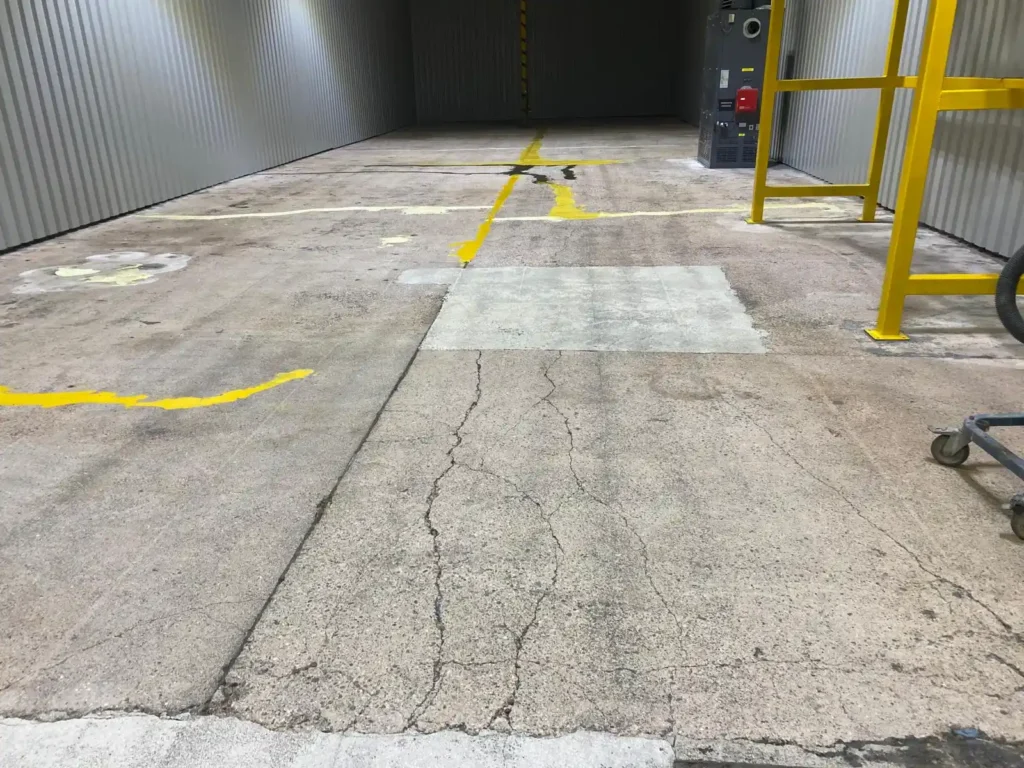
The project involved renovating a 345m² paint storage area that had endured nine decades of heavy industrial use since the company’s establishment in 1930.
The substrate presented significant challenges, having undergone multiple alterations, repairs, and concrete recasting of varying standards throughout its history, including reconstruction following bomb damage during World War II.
Working within strict budgetary constraints for preparation and coating systems, JD Flooring’s expertise was required to transform this historically complex industrial space into a functional, modernised facility that would meet current operational standards.
Assessment and Recommendation
Initial site evaluations revealed that the substrate was in particularly poor condition, necessitating an intensive focus on preparation and repairs. Our technical assessment indicated that approximately 70% of the project’s success would depend on thorough preparation work. The substrate exhibited numerous defects from decades of heavy industrial use, including extensive damage from various racking systems that had been installed and removed over the years.
Based on our findings, we recommended a comprehensive restoration approach combining grinding, shot-blasting, and extensive repair work. This would include filling countless bolt holes and addressing surface irregularities before applying a two-coat epoxy system. The recommendation prioritised creating a uniform surface that would provide the durability required for continued industrial use while ensuring compliance with current safety standards.
Preparation and Repair
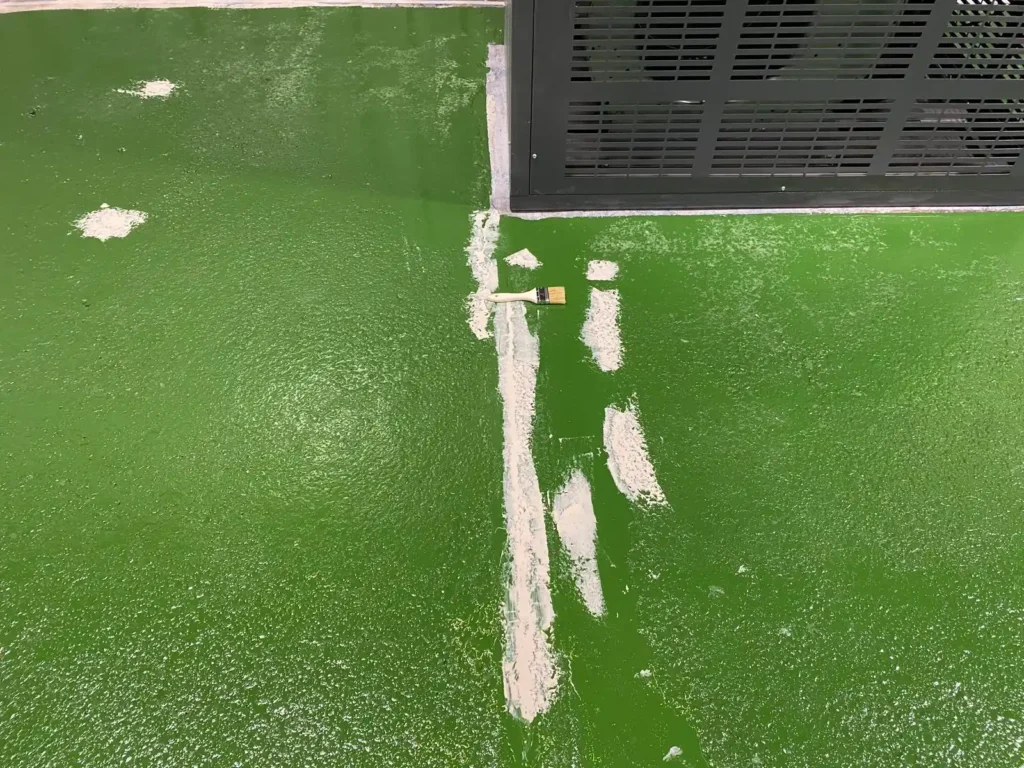
The resin flooring installation commenced with a thorough clearing of the area, revealing the full extent of the substrate’s deterioration. Our team initiated the preparation phase using planetary grinding equipment to address high areas and expose the true condition of the concrete surface.
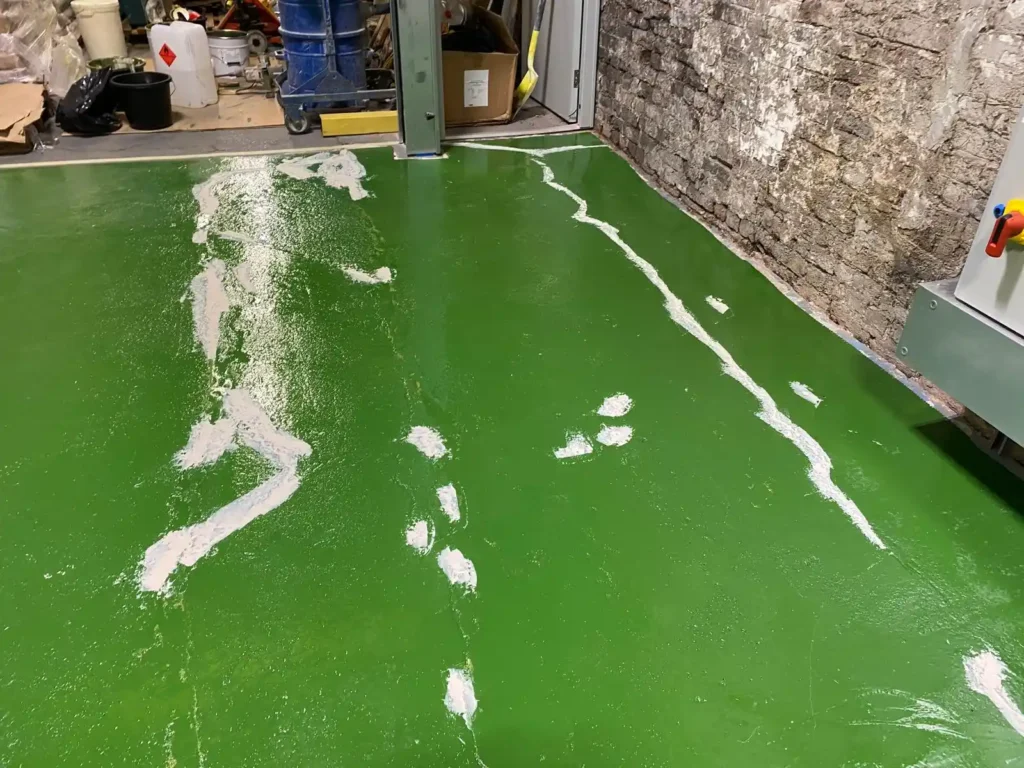
The repair phase focused on addressing joints, damage, and low points using specialised epoxy mortar. Our team utilised approximately 75kg of pure epoxy resin mixed with appropriate fillers to ensure optimal repair integrity. This substantial amount of material was necessary given the extensive surface damage and the critical importance of achieving a level surface for the planned two-coat system.
Each repair was meticulously executed, considering that any imperfections would be visible through the final coating. The decision to use epoxy-based repair materials was crucial, as it ensured chemical compatibility with the planned coating system and provided the necessary durability for continued industrial use. This attention to detail in the repair phase was essential for achieving our high standards of finish.
Installation Details
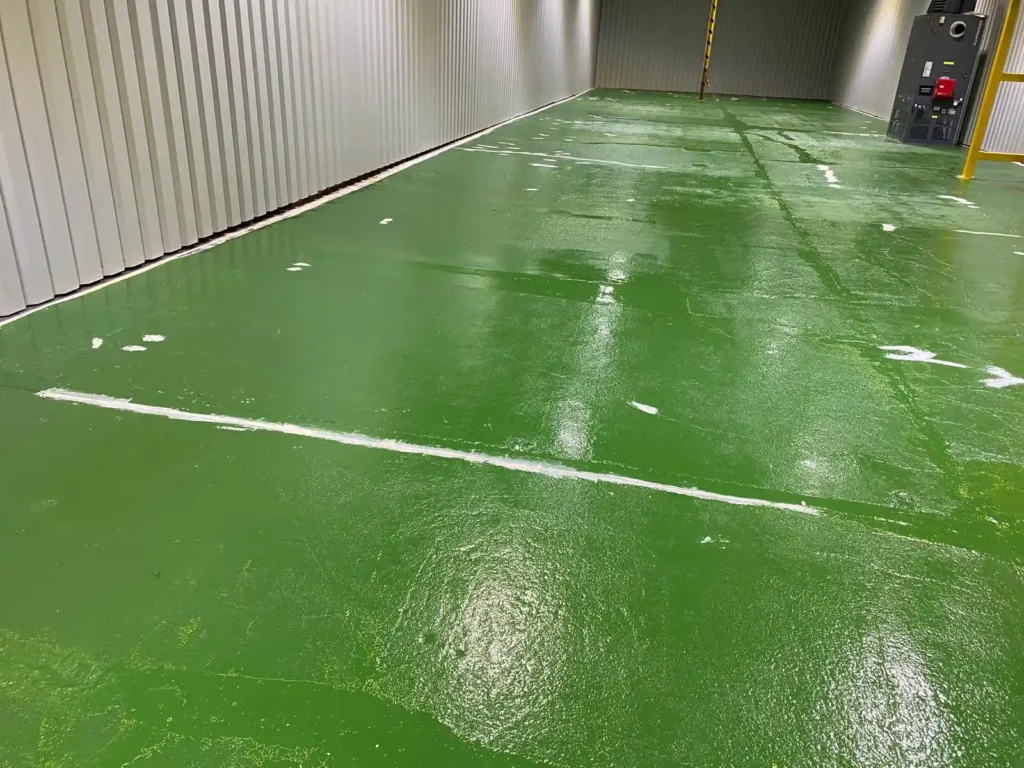
Following comprehensive repairs, our team employed hand-held flat-bed grinders connected to high-powered vacuum systems to ensure seamless integration of the repaired areas with the existing substrate. This detail-oriented approach was crucial for eliminating any visible transitions between repaired sections and the original surface. After thorough vacuum cleaning, we applied the first coat of epoxy high-build coating across the entire area.
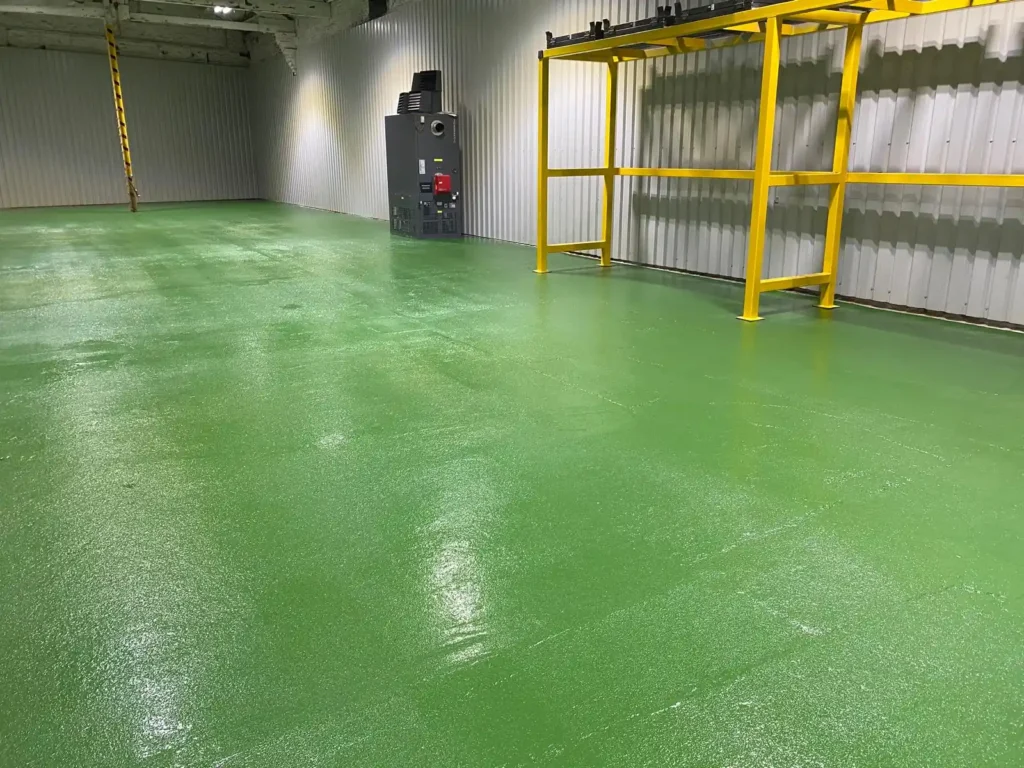
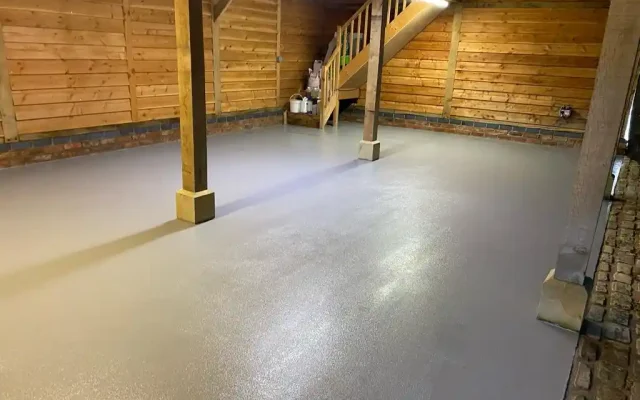
The final phase of the resin flooring installation involved addressing any remaining surface defects revealed by the initial coating. After filling these areas, we applied the final coat of epoxy high-build coating, incorporating a light aggregate scatter to enhance slip resistance in accordance with health and safety requirements. The completed installation provided a durable, safe, and aesthetically pleasing surface suitable for heavy industrial use.
The Finished Floor
Client Feedback and Satisfaction
The completion of this challenging resin flooring installation project exceeded our client’s expectations, particularly given the restricted budget and ambitious timeframe.
The Senior Management Team remarked on the remarkable transformation of their historical paint storage area, noting that they had initially been sceptical about whether such comprehensive improvements could be achieved within their budgetary constraints.
The site management and production teams were particularly impressed with our installation team’s professional approach and meticulous attention to cleanliness throughout the project. They specifically commended our team’s consideration for ongoing manufacturing operations, ensuring minimal disruption to their daily activities. The Production Manager highlighted how our team maintained an exceptionally tidy working environment, which was crucial given the sensitive nature of their paint manufacturing processes.
THE SYSTEM WE INSTALLED
Resin Flooring Type Used
Resin High Build Coating
A solvent free epoxy coating applied in two or more coats, building a film thickness of up to 1,000 microns. It is specified for medium duty use where the requirement is a clean, hard wearing surface over sound concrete.
Aggregate is scattered between coats where a slip resistant finish is needed. Anticipated life is 5 to 7 years in light use and 2 to 4 years under moderate use.
Resin High Build Coating characteristics
Application
Applied in two or more coats, solvent free
Intended Use
Medium duty use
Thickness
Up to 1000 microns
Chemicals
Some resistance to chemical spillage
Slip Resistance
Aggregate can be added to achieve a slip resistant finish
As a trusted partner and the approved contractor for a large electrical and electronics manufacturer based in Stockport, JD Flooring recently completed a resin flooring demarcation project to
As a trusted partner and the approved contractor for this international distribution company based in the West Midlands, JD Flooring was tasked with the annual re-coating of the
An engineering company based in Warrington recently relocated to new premises, requiring their 165m2 manufacturing floor space to be brought up to health and safety standards. The client
An renowned International Oil Export Company, located in the heart of the West Midlands, approached JD Flooring Ltd for a significant update on their resin screed flooring system. Five
This project involved a prominent Cheese Producing Company, based in Wales, who are widely recognised for their quality products in the Food Sector.This client, was already familiar with
Our client is a globally renowned Pharmaceutical Company, setting the benchmark in the industry. They operate in a sector where precision, cleanliness, and compliance with stringent standards are
A key player in the global market, this Leicester-based timber truss and components manufacturer faced a specific challenge within their facility.The project involved installing epoxy resin demarcation across
This project involved a prominent Cheese Producing Company, based in Wales, who are widely recognised for their quality products in the Food Sector.This client, was already familiar with
Tell us how the area is reached, what happens in it and how long it can be closed. We attend, test the substrate, and put a written specification and a fixed price in front of you at no cost.
We use strictly necessary cookies to make this site work. With your permission we would also like to use analytics cookies to see how the site is used so we can improve it. You can change your choice at any time. See our cookie policy.