

Choose the Best Aerospace Resin Flooring Installer.
Precision is the hallmark of the automotive and aerospace sectors, where every component must meet rigorous safety and performance standards. This requirement for excellence extends directly to the facility floor, which must withstand aggressive chemicals and heavy mechanical loads. Selecting a suitably experienced and certified aerospace resin flooring installer to provide guidance on these issues provides valuable expertise on a very specialised, regulated topic. Are you confident that your flooring specification meets the necessary technical and legal requirements for your facility?
The choice of a resin flooring system is a significant capital investment that dictates operational efficiency for decades. Without the correct installation partner, even the highest-grade materials can fail, leading to blistering, delamination, or safety hazards. How can project managers distinguish between general builders and specialist installers with the expertise required for high-stakes industrial environments?
Key Takeaways
- Skydrol resistance is a non-negotiable requirement for aerospace hangar and maintenance flooring systems.
- Professional installers must provide proof of ISOPA/ALIPA diisocyanate training for polyurethane applications.
- Mechanical diamond grinding is the industry-standard preparation method for ensuring long-term resin adhesion.
- Electro-static dissipative (ESD) flooring is essential in areas housing sensitive avionics or electronics.
- Certified contractors provide value engineering to match resin duty bands with specific traffic patterns.
Master Technical Requirements for High-Performance Floors
Resist Chemical Exposure and Skydrol Damage
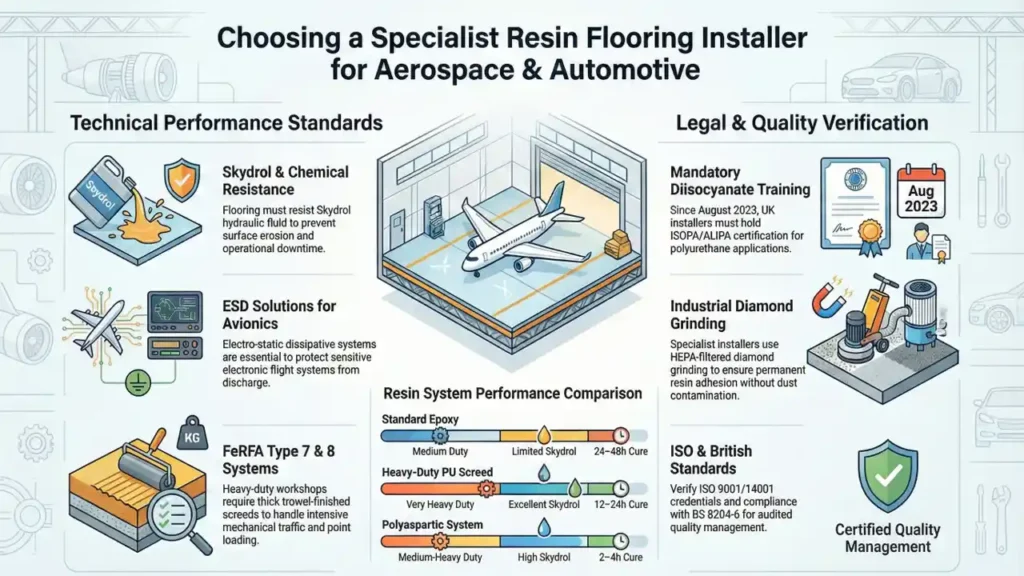
Install high-performance flooring systems that specifically resist Skydrol, a phosphate-ester hydraulic fluid that rapidly degrades standard epoxy coatings. A specialist aerospace resin flooring installer must provide verified chemical resilience against aviation fuels and aggressive solvents. Failure to specify these properties leads to surface erosion and significant operational downtime for your facility.
While standard concrete or lower-tier coatings may appear sufficient initially, they are porous and will absorb oils and fuels, creating permanent stains and structural weakening. Professional installers typically recommend FeRFA Type 7 or Type 8 heavy-duty systems for these zones. These systems create an impermeable barrier that allows for easy spill response and protects the integrity of the concrete substrate.
Select FeRFA Classifications for Heavy Duty Use
Utilise FeRFA Type 7 or Type 8 systems for heavy-duty automotive workshops and aerospace hangars to provide the necessary thickness and durability for intensive mechanical traffic. These trowel-finished or flowable screeds are engineered to handle the point loading of aircraft components and heavy vehicle machinery. Correct classification ensures the resin system matches the mechanical stresses.
Choosing a thinner Type 1 or Type 2 seal in a forklift-intensive environment is a common specification error. While lower in upfront cost, these systems lack the impact resistance needed for dropped tools or heavy equipment. A qualified contractor will assess the expected traffic—ranging from light footfall to heavy-duty vehicular movement—before recommending a system that offers the best lifecycle value.
| Feature | Standard Epoxy Coating | Heavy-Duty PU Screed | Polyaspartic System |
|---|---|---|---|
| Duty Rating | Medium (Type 3) | Very Heavy (Type 8) | Medium-Heavy (Type 4/5) |
| Skydrol Resistance | Limited | Excellent | High |
| Cure Time | 24–48 Hours | 12–24 Hours | 2–4 Hours |
| Impact Resistance | Moderate | Superior | High |
Verify Certification and Regulatory Compliance
Adhere to UK Diisocyanate Training Requirements
Ensure your aerospace resin flooring installer holds valid ISOPA/ALIPA certification to remain compliant with UK law regarding products containing 0.1% or more diisocyanates. Since August 2023, this specialist safety training is essential for legal compliance and site safety. This ensures that chemicals are handled, applied, and cured without risking personnel health on site.
Diisocyanates are common in high-performance polyurethane systems favoured by the automotive sector for their thermal shock resistance. When interviewing contractors, clients should request documentation of this training for all on-site technicians. Using uncertified labour not only breaches REACH regulations but also suggests a lack of professional oversight that could compromise the quality of the finished floor.
Check ISO and Quality Management Credentials
Confirm that your installer maintains ISO 9001 and ISO 14001 certifications, reflecting a commitment to quality management and environmental responsibility. These standards ensure that the installation follows a repeatable, audited process from initial site survey to final handover. Compliance with British Standards, specifically BS 8204-6, provides further assurance that the flooring meets UK codes of practice.
Certified contractors are often more reliable because they are subject to regular external audits. For large-scale automotive projects, these credentials simplify the procurement process and provide the necessary paperwork for health and safety audits. Furthermore, environmental management standards (ISO 14001) ensure that waste materials and chemical containers are disposed of according to current UK environmental regulations.
Execute Professional Installation and Preparation
Utilise Industrial Diamond Grinding and Dust Extraction
Prepare the concrete substrate using industrial diamond grinding to remove laitance and open the concrete pores for maximum resin adhesion. Professional installers use HEPA-filtered vacuum extraction to capture dust at the source, preventing contamination of sensitive machinery. This meticulous groundwork is what ensures the resin bonds permanently to the concrete substrate for long-term performance.
Skipping mechanical preparation or relying on acid etching is a hallmark of unqualified contractors. Without a clean, profiled surface, the resin will merely sit on top of the concrete, leading to peeling or delamination under the stress of vehicle tyres. By investing in proper grinding, the contractor ensures the floor can withstand the high-torque movements typical in automotive workshops and hangars.
Resolve Substrate Moisture with Liquid DPMs
Test the substrate for moisture using hygrometers before application to prevent osmotic blistering, which is a primary cause of floor failure. If relative humidity levels exceed 75%, a two-coat liquid damp proof membrane must be installed to suppress moisture. This technical step is vital for the long-term stability and aesthetic finish of the flooring system.
In many older automotive facilities or new-build aerospace hangars, residual construction moisture or rising damp can be problematic. A specialist contractor will not proceed until the substrate is proven to be within safe limits. The inclusion of a liquid DPM allows the main flooring system to cure in a stable environment, preventing the formation of bubbles that could compromise the seamless finish.


Review Our Work
Our 30+ case studies cover – Printing & Packaging, Warehousing & Logistics, Pharma & Healthcare, Automotive & Engineering, Aviation & Aerospace, Food & Drink, Printing & Packaging, Warehousing & Logistics, Pharma & Healthcare.
Implement Specialist Safety and Anti-Static Solutions
Install ESD Solutions for Avionics Protection
Protect sensitive avionics from static discharge damage by installing electro-static dissipative (ESD) flooring in aerospace assembly areas. An expert aerospace resin flooring installer will specify systems that include conductive additives and grounding points to safely dissipate static. This invisible insurance is essential for maintaining the integrity of electronic flight systems and preventing expensive component failures.
Static events that are imperceptible to humans can destroy expensive circuit boards and electronic components. Standard resin floors can accumulate static, particularly in low-humidity environments. Certified contractors will use EN 1081 testing standards to verify the electrical resistance of the floor post-installation, ensuring it meets the specific requirements of the aerospace electronics sector.
Optimise Slip Resistance for Workshop Safety
Enhance workplace safety by using the BS 7976 pendulum test to ensure the floor achieves a low slip potential rating in all conditions. Installers must balance ease of cleaning with sufficient slip resistance, particularly in zones prone to oil spills. This reduces the risk of workplace accidents and ensures full HSE compliance for your facility.
While high-gloss floors look impressive in showrooms, they can become dangerously slippery when contaminated with lubricants or brake fluid. A professional contractor will suggest incorporating anti-slip aggregates into the topcoat. By tailoring the texture to the specific area—such as more aggressive grip in wash bays and smoother finishes in assembly zones—safety and functionality are perfectly balanced.
Trusted By Global Brands







Analyse Lifecycle Costs and Value Engineering
Select Cost-Effective Duty Bands for Traffic
Save project costs by matching the resin flooring type to the specific operational needs of different zones through expert value engineering. For example, a warehouse area with foot traffic only might require a Type 3 high-build coating rather than a Type 8 screed. Certified contractors help clients save thousands of pounds by providing accurate, duty-based recommendations.
This consultative approach ensures that the budget is focused where it is needed most, such as heavy-duty systems for loading bays and more aesthetic coatings for walkways. Rather than offering a one-size-fits-all solution, an expert installer assesses traffic patterns, chemical exposure, and impact risks. This transparency in specification is a key indicator of a reputable, expert contractor.
Maximise Service Life through Maintenance
Extend the lifespan of your industrial floor to over 20 years by implementing a professional maintenance regime and regular inspections. Regular professional cleaning prevents the build-up of abrasive grit that can wear down the protective topcoat. Maintenance contracts ensure the floor remains in audit-ready condition while extending its total service life and improving lifecycle value.
Without maintenance, even the best heavy-duty screeds can show signs of wear within five to seven years. Proactive care, such as periodic re-coating of high-traffic lanes, is significantly more cost-effective than a full floor replacement. Expert installers often provide aftercare guidance and professional cleaning services to ensure the client’s investment continues to perform as expected.

Need a Resin Flooring Site Visit and Quote?
Review Experience and Sector-Specific Expertise
Qualify the Reputation of Specialist Installers
Verify the experience of potential contractors by reviewing their proven track record of successful projects within the industrial sector. A company with over 25 years of experience brings a level of technical intuition that cannot be matched by newer firms. This longevity is often backed by deep relationships with leading resin manufacturers and material suppliers.
Experienced installers understand the nuances of working within live automotive or aerospace environments, including the need for phased installations to minimise disruption. They are familiar with the specific challenges of these sectors, such as the need for rapid-cure systems to meet tight maintenance windows. Checking for case studies in similar facilities is a reliable way to gauge a contractor’s capability.
Inspect Technical Case Studies and References
Request verified case studies from certified contractors that demonstrate success in solving complex flooring problems within your specific industry. Whether it is a large-scale hangar refurb or a high-tech automotive assembly line, references from similar industries prove technical competence. These real-world examples should detail the challenge, the chosen specification, and the performance outcome.
Reliable installers will be happy to provide contact details for previous clients in the engineering or manufacturing sectors. Speaking directly with past customers allows you to verify the contractor’s professionalism, adherence to timelines, and the durability of their floors. A proven track record in these high-precision industries is the strongest indicator of future project success.
Did You Know?
Since 24th August 2023, the UK REACH restriction requires all professional and industrial users of polyurethane (PU) resin products containing 0.1% or more diisocyanates to have completed mandatory safety training, which must be refreshed at least every five years.
Deliver Visual Precision and Operational Demarcation
Create Safety Zones and Traffic Routes
Improve operational safety through resin demarcation lines that define pedestrian walkways, vehicle bays, and fire exits with permanent colours. Unlike paint or tape, resin lines are integral to the floor and will not peel or lift under heavy forklift traffic. This is a core requirement for 5S lean manufacturing and maintaining HSE compliance.
Effective zoning reduces the risk of collisions between personnel and machinery in busy automotive hubs. Standard colour conventions—such as yellow for walkways and red for “keep clear” zones—provide intuitive guidance for staff and visitors. A professional installer will integrate these markings seamlessly into the main flooring system, ensuring they remain vibrant and legible for years.
Maintain Seamless Finishes for Hygienic Control
Install seamless resin flooring to prevent the accumulation of dust and contaminants in aerospace clean rooms and engine assembly areas. The absence of grout lines or joints eliminates harbourage points for bacteria and particulates. This non-porous surface is easily sanitised using standard industrial cleaning equipment and chemicals to maintain strict clean-room standards.
In high-precision engineering, even a small amount of concrete dust can interfere with delicate components or paint finishes. A seamless resin system completely seals the concrete substrate, creating a dust-free environment. This level of environmental control is essential for maintaining the high quality standards required by global automotive and aerospace manufacturers.


Secure Post-Installation Support and Warranties
Establish Regular Inspection and Cleaning Regimes
Ensure the floor performs correctly by scheduling professional inspections and deep-cleaning services within the first few months of use. Professional cleaning maintains the anti-slip texture and removes aggressive chemicals before they can cause permanent damage. This proactive approach helps to identify any minor issues before they become major repairs or safety hazards.
JD Flooring, for instance, provides a free professional floor inspection and cleaning service six months after installation for their commercial clients. This service ensures the resin solution is meeting the site’s specific duty requirements. It also provides an opportunity for the installer to advise on any necessary adjustments to the site’s cleaning protocols based on actual wear patterns.
Ensure Rapid Response for Surface Repairs
Maintain facility safety by securing access to rapid repair services for surface damage caused by extreme impacts or structural movement. Specialist installers offer patch repairs and joint resealing that blend seamlessly with the original floor. This prevents moisture or chemicals from reaching the concrete through cracks, protecting the entire long-term flooring investment.
Delaying repairs can lead to delamination and larger, more expensive failures. A professional contractor with a long-term commitment to their clients will provide a quick response to any service calls. This reliability ensures that your facility remains safe, compliant, and operational, with minimal downtime for maintenance tasks.
JD Flooring Transparent Pricing
System | Duty | Thickness | Cost/m² | FeRFA Type |
Resin Floor Seal | Light | Up to 150μm | £4–£8 | Type 1 |
Resin Floor Coating | Light–Medium | 150–300μm | £8–£12 | Type 2 |
High Build Coating | Medium | 300–1000μm | £8–£12 | Type 3 |
Multi-Layer Flooring | Medium–Heavy | 1–2mm | £12–£16 | Type 4 |
Self-Smoothing | Medium–Heavy | 2–4mm | £20–£30 | Type 5 |
Heavy Duty Flowable | Heavy–V. Heavy | 4–6mm | £25–£35 | Type 7 |
Heavy Duty PU Screed | V. Heavy | 6–9mm | £30–£40 | Type 8 |
Conclusion
Choosing the right aerospace resin flooring installer is a decision that impacts the long-term safety, compliance, and efficiency of your facility. By prioritising technical expertise, chemical resistance—especially against Skydrol—and rigorous preparation standards, you ensure a flooring solution that can withstand the unique pressures of high-precision engineering. Professional installation is the foundation of a durable, safe, and high-performance workspace.
Engaging with certified contractors who possess a proven track record in the automotive and aerospace sectors provides the security of verified expertise and regulatory compliance. From ESD protection to safety demarcation, the right partner will guide you through the complexities of resin chemistry and value engineering. Secure your facility’s future by selecting an installer committed to industrial-grade excellence and long-term performance.
Frequently Asked Questions
A:
Skydrol is a highly aggressive hydraulic fluid that can quickly dissolve standard paints and low-grade epoxy resins. Specialist aerospace systems are formulated to resist this chemical, preventing surface degradation and protecting the structural integrity of the concrete floor.
A:
Electro-static dissipative (ESD) floors safely ground static electricity, protecting sensitive avionics and electronic components from discharge damage. This is essential for aerospace assembly and maintenance areas where static events could compromise safety-critical systems.
A:
Standard epoxy systems typically require 24 to 48 hours to cure at temperatures above 15°C. However, for facilities requiring rapid turnaround, polyaspartic systems can cure in as little as two hours, allowing for overnight installations with minimal operational downtime.
A:
Yes, as of August 2023, any professional in the UK handling products with a diisocyanate concentration above 0.1% must be trained. This includes most polyurethane and polyaspartic systems commonly used in heavy-duty automotive and aerospace environments.
A:
Diamond grinding provides a consistent, mechanical key by removing surface laitance and contaminants, which is essential for resin adhesion. It is a dry process that, when combined with HEPA vacuum extraction, prevents dust contamination in sensitive industrial environments.
Arrange a Free Site Survey
If you are thinking about upgrading the flooring in your commercial or industrial space then we would love to hear from you. Our team of experts will conduct a free onsite survey and then guide you through the process of product selection and project planning, whilst remaining mindful of your budgetary restraints.
