Mastering Resin Flooring Repair and Maintenance.
Maintaining a high-performance industrial or commercial surface requires a proactive approach to resin flooring repair to prevent minor abrasions from evolving into structural failures. While epoxy and polyurethane systems are renowned for their durability, the integrity of these surfaces depends heavily on consistent oversight and technical intervention. How can facility managers optimise the lifespan of their flooring while minimising operational downtime?
Industrial environments subject floors to extreme mechanical loads, chemical exposure, and thermal shock, all of which can compromise the resin bond over time. Understanding the transition from routine maintenance to essential repair is critical for preserving the safety and hygiene of a workspace. Is your current maintenance regime sufficient to prevent costly full-scale resurfacing?
Key Takeaways
- Prompt repairs prevent moisture ingress and substrate delamination.
- Professional cleaning sustains anti-slip properties and hygiene.
- Planned maintenance cycles can double the effective service life.
- Correct specification reduces long-term lifecycle expenditure.
- Preparation remains the most critical factor in successful repairs.
Address Common Resin Flooring Failures
Diagnose Surface Blistering and Osmotic Issues
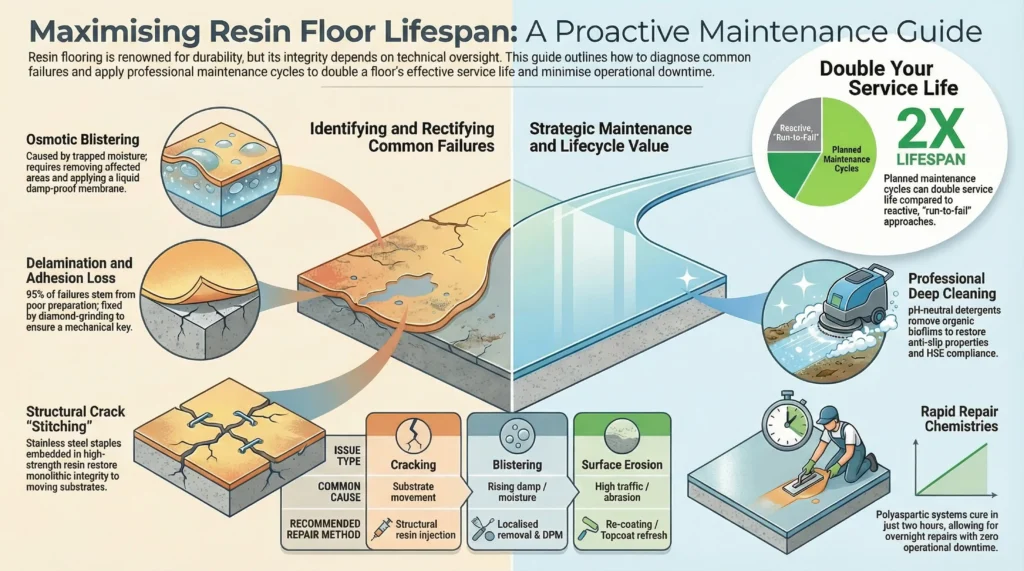
Surface blistering occurs when moisture vapour becomes trapped beneath an impermeable resin layer, typically due to inadequate moisture testing or a missing damp-proof membrane. These osmotic blisters compromise both the aesthetic and structural integrity of the floor, requiring professional resin flooring repair involving removal and liquid DPM application.
In many cases, the failure is linked to the original installation conditions where the relative humidity of the concrete exceeded 75%. To rectify this, technicians must diamond-grind the failed section back to sound concrete, ensure the substrate is dry, and reinstate the system with moisture-tolerant primers to prevent recurrence.
Rectify Delamination and Adhesion Loss
Delamination is the separation of the resin coating from the concrete substrate, usually caused by poor mechanical preparation or surface contamination such as oil and grease. Effective repair demands removing all loose material and using industrial diamond grinding to open the concrete pores, creating a mechanical key for the new resin.
JD Flooring emphasises that 95% of successful resin outcomes depend on this preparation stage. When a floor begins to peel, it is rarely a product fault but rather a sign that the initial bond was compromised by laitance or existing coatings that were not properly removed during the first installation.
| Issue Type | Common Cause | Repair Method | Prevention Strategy |
|---|---|---|---|
| Cracking | Substrate movement | Structural resin injection | Flexible joint sealants |
| Blistering | Rising damp / moisture | Localised removal & DPM | Hygrometer testing |
| Surface Erosion | High traffic / abrasion | Re-coating / Topcoat refresh | Planned maintenance |
| Chemical Staining | Aggressive spillages | Patch repair (Type 4-8) | Immediate spill response |
Implement Effective Repair Methodologies
Utilise Industrial Diamond Grinding for Patching
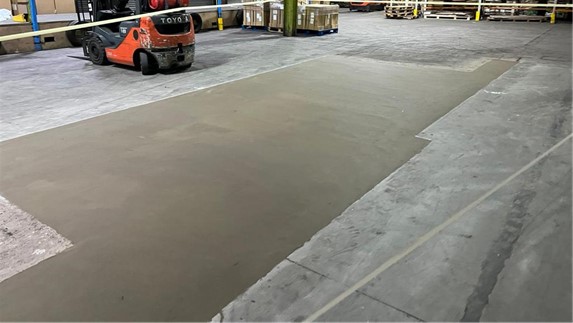
Professional patch repair requires precise mechanical preparation using HEPA-filtered diamond grinding equipment, not simply pouring new resin into a damaged area. This process removes contaminated edges and creates a level profile, allowing the repair material to bond seamlessly with the existing floor without creating trip hazards.
By using industrial-grade equipment, installers can ensure that the patch is flush with the surrounding surface. This is particularly important in environments using forklifts or pallet jacks, where uneven transitions can lead to further mechanical impact damage and accelerated wear on vehicle tyres.
Apply Structural Resin for Crack Bridging
Structural cracks caused by substrate movement require high-strength resin compounds that restore the floor’s monolithic integrity while accommodating minor shifts. Technicians often stitch these cracks using stainless steel staples embedded in resin, providing additional reinforcement to ensure the resin flooring repair withstands heavy loading.
Once the structural repair is complete, the surface is ground smooth and finished with a matching topcoat. For facilities where aesthetics are as important as function, such as automotive showrooms, this method provides a near-invisible fix that prevents the crack from spreading further across the slab.
Sustain Performance Through Professional Cleaning
Maintain Hygiene in Regulated Environments
In sectors such as food production and pharmaceuticals, professional floor cleaning is a mandatory operational requirement that inhibits bacterial growth and ensures HACCP compliance. Seamless resin surfaces are non-porous and do not harbour pathogens, but they still require pH-neutral detergents to remove organic biofilms and chemical residues.
Using the correct cleaning agents is vital; acidic or highly abrasive cleaners can etch the resin surface over time, leading to a loss of gloss and increased dirt retention. A managed cleaning regime ensures the floor remains easy to sanitise throughout its 15-to-20-year commercial lifespan.
Preserve Anti-Slip Textures and Traction
The slip resistance of a resin floor, often measured by the BS 7976 pendulum test, can be compromised by the build-up of oils, fats, or fine dust. Regular professional floor cleaning removes these contaminants, ensuring that the aggregate-rich texture continues to provide a safe working environment in wet conditions.
If the surface becomes too smooth through years of heavy traffic, it may require a technical refresh coat rather than just a deep clean. This involves a light abrasion of the existing surface followed by the application of a thin resin layer with fresh anti-slip media to restore a Low Slip Potential rating.


Review Our Work
Our 30+ case studies cover – Printing & Packaging, Warehousing & Logistics, Pharma & Healthcare, Automotive & Engineering, Aviation & Aerospace, Food & Drink, Printing & Packaging, Warehousing & Logistics, Pharma & Healthcare.
Adopt Planned Maintenance Cycles
Establish Routine Inspection Schedules
A planned maintenance strategy involves scheduled professional inspections to identify early signs of wear, such as hairline cracks or erosion in high-traffic forklift aisles. Catching these issues early allows facility managers to commission minor patch repairs that cost far less than full floor replacement.
JD Flooring provides a free professional floor inspection six months after installation as part of a comprehensive aftercare package. This ensures the system is performing as expected and allows for the adjustment of cleaning protocols based on the actual traffic patterns observed within the facility.
Execute Protective Re-coating Services
Applying a fresh seal coat or topcoat every few years is a core component of planned maintenance that restores the floor’s chemical resistance and aesthetic appeal. This sacrificial layer absorbs daily wear, protecting the core build of the resin system and extending the total service life of the installation.
For commercial showrooms or retail spaces using polyaspartic systems, these re-coats can be completed in as little as two hours due to the rapid-cure nature of the chemistry. This allows for overnight maintenance that leaves the floor ready for full foot traffic by the next business morning.
Trusted By Global Brands







Analyse Lifecycle Costs and Value
Calculate Long-Term Operational Savings
A high-build resin system may cost more upfront than bare concrete or basic floor paint, but the lifecycle cost is significantly lower due to reduced repair needs. A properly maintained resin floor can last over two decades, whereas cheap alternatives often require total replacement every three to five years.
The reduction in cleaning time, fewer slip-and-fall incidents, and the protection of expensive machinery from concrete dust contribute to a high return on investment. Value engineering focuses on matching the specific duty of the floor (FeRFA Type 1-8) to the environment to avoid over-specification while ensuring durability.
Reduce Downtime Through Rapid Repair Systems
Fast-curing chemistries such as polyaspartic or MMA resins allow essential repairs to be conducted during weekend closures or holiday periods. This approach minimises the hidden cost of flooring work — lost production time — ensuring the facility remains operational while the resin flooring repair cures to full strength.
These rapid systems can even cure at temperatures as low as -5°C, making them ideal for cold storage facilities where traditional epoxies would fail to harden. The ability to perform repairs without a full facility defrost represents a massive operational saving for logistics and food distribution firms.

Need a Resin Flooring Site Visit and Quote?
Manage Expansion Joints and Movement
Implement Flexible Polysulphide Sealants
Expansion joints accommodate the natural movement of a building’s concrete slabs, and filling them with rigid resin is a common cause of floor failure. Correct maintenance involves using flexible polysulphide sealants that allow expansion and contraction while maintaining a seamless, hygienic, and trafficable surface for forklifts.
When these joints break down, they create arrears that damage forklift wheels and increase vibration for operators. A professional repair involves raking out the old joint, repairing the shoulders of the concrete with structural resin, and installing a new flexible seal to restore the smooth transition across the floor.
Prevent Shoulder Spalling in Loading Bays
Loading bays experience the highest point loads in a warehouse, leading to spalling where concrete edges of joints crumble under the weight of pallet jacks. Effective maintenance in these zones requires heavy-duty resin screeds (FeRFA Type 7 or 8) that deliver high compressive strength and impact resistance.
By reinforcing these high-stress areas during the initial installation or through targeted planned maintenance, companies can avoid the structural degradation that leads to vehicle damage. A proactive approach to joint health is one of the most cost-effective ways to manage an industrial flooring asset.
Did You Know?
In the UK, professional and industrial users of polyurethane flooring products must complete mandatory diisocyanate training. Under the REACH restriction that came into effect on 24 August 2023, anyone handling products with a total diisocyanate concentration of 0.1% or higher must be certified, with refresher training required every five years.
Meet Sector-Specific Maintenance Requirements
Standardise Hygiene in Healthcare and Labs
Healthcare and laboratory environments require completely seamless, non-porous surfaces that can withstand aggressive clinical disinfectants and hydrogen peroxide vapour decontamination. Maintenance in these sectors focuses on ensuring that coved skirting and floor-to-wall transitions remain intact to prevent bacterial harbourage points.
If the surface integrity is breached, a rapid resin flooring repair is required to maintain GMP (Good Manufacturing Practice) compliance. Using self-smoothing Type 5 systems ensures that even after repair, the surface remains level and capable of supporting the movement of sensitive medical equipment and hospital beds.
Optimise Durability in Automotive Workshops
Automotive facilities face constant exposure to Skydrol, brake fluid, and engine oils, all of which degrade standard concrete over time. Maintenance cycles here must include the inspection of demarcation lines and safety zones, ensuring high-visibility markings for MOT bays and pedestrian walkways remain HSE-compliant.
Because these environments often involve dropped tools and heavy components, the resin flooring repair strategy must account for impact damage. Patch repairs using aggregate-filled epoxy resins provide the necessary toughness to resist further chipping while maintaining the oil-resistant properties of the surrounding floor.
JD Flooring Transparent Pricing
System | Duty | Thickness | Cost/m² | FeRFA Type |
Resin Floor Seal | Light | Up to 150μm | £4–£8 | Type 1 |
Resin Floor Coating | Light–Medium | 150–300μm | £8–£12 | Type 2 |
High Build Coating | Medium | 300–1000μm | £8–£12 | Type 3 |
Multi-Layer Flooring | Medium–Heavy | 1–2mm | £12–£16 | Type 4 |
Self-Smoothing | Medium–Heavy | 2–4mm | £20–£30 | Type 5 |
Heavy Duty Flowable | Heavy–V. Heavy | 4–6mm | £25–£35 | Type 7 |
Heavy Duty PU Screed | V. Heavy | 6–9mm | £30–£40 | Type 8 |
Conclusion
The longevity of an industrial surface is fundamentally linked to the quality of its resin flooring repair and the consistency of its maintenance regime. By addressing failures such as delamination and blistering through professional diamond grinding and structural resin application, facilities can avoid the massive expenditure associated with total floor failure. Whether in a high-traffic warehouse or a sterile pharmaceutical lab, the science of resin care remains the same: preparation, specification, and protection.
Engaging in planned maintenance and professional cleaning not only secures the physical asset but also supports wider operational goals, from HSE compliance to 5S certification. With over 25 years of experience, JD Flooring provides the technical expertise required to install, repair, and maintain resin systems that stand the test of time. Is your facility ready for its next professional inspection?
Frequently Asked Questions
A:
Cure times vary significantly based on the chemistry used. Standard epoxy systems typically require 24 to 48 hours at temperatures above 15°C to reach full mechanical strength. However, polyaspartic or MMA-based repair systems can cure in as little as two hours, even in freezing conditions, allowing for rapid return to service.
A:
Industrial resin systems require professional mechanical preparation, such as diamond grinding, to ensure a lasting bond. DIY kits often lack the necessary resin thickness and preparation tools, leading to premature delamination. Professional repairs also ensure compliance with UK health and safety regulations, including diisocyanate training requirements for PU products.
A:
A floor seal (FeRFA Type 1) is a thin coating up to 150μm used primarily for dustproofing. A high-build coating (Type 3) is much thicker, ranging from 300μm to 1000μm, providing significantly better resistance to abrasion and chemical spills. High-build systems are generally preferred for industrial environments where durability is a priority.
A:
While routine mopping should happen weekly, a deep professional clean is recommended every 6 to 12 months depending on traffic levels. Professional cleaning uses industrial-grade scrubbers and pH-neutral detergents to remove stubborn oils and restore the floor's slip resistance, which is essential for maintaining a safe workplace.
A:
While expert technicians strive for a close colour match, slight variations can occur due to UV ageing of the original floor or different material batches. To achieve a seamless look, it is often recommended to re-coat the entire section or bay after the structural repair is completed, ensuring a uniform finish and consistent texture.
Arrange a Free Site Survey
If you are thinking about upgrading the flooring in your commercial or industrial space then we would love to hear from you. Our team of experts will conduct a free onsite survey and then guide you through the process of product selection and project planning, whilst remaining mindful of your budgetary restraints.
resin floor repair
epoxy resin floor repair
resin floor repair and maintenance
epoxy resin floor repair
resin floor repair process